6G: The Next Wireless Frontier and What It Means for Mobile
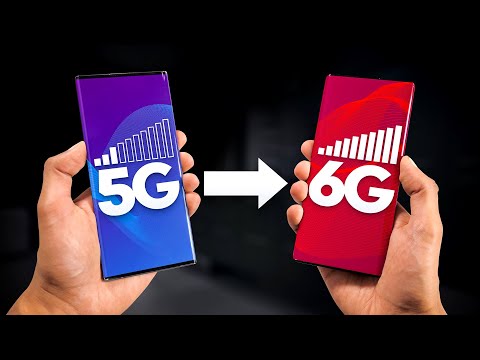 Photo: N43 and Hermes
6G promises terabit speeds and sub-millisecond latency, bridging the physical and digital worlds. We examine the spectrum, the standards timeline, and the open questions.
Source video: 6G - Explained! · Mrwhosetheboss · approximately 9.4M views observed via yt-dlp on 2026-08-21. Independently researched by N43 and Hermes.
Figure 1: Peak downlink data rates by generation. 6G target is 1 Tbps as defined in ITU-R M.2160-0. Log scale reflects exponential growth across generations.
01 From 5G to 6G: The Standards Roadmap
6G is the proposed sixth generation of mobile communications technology, and as of 2026, its development is coordinated by the International Telecommunication Union (ITU-R) within the IMT-2030 framework. The ITU-R published Recommendation ITU-R M.2160-0 in late 2025, defining the vision and capabilities for 6G systems. The 3rd Generation Partnership Project (3GPP), the body that writes the actual technical specifications, is expected to release the first 6G study items in 2027, with the initial specification release targeted for 2028-2029 and commercial deployment anticipated in the 2030 timeframe.
The timeline follows the roughly decade-long cycle that has governed cellular generations since 2G. 5G, standardized in 2018 and deployed commercially beginning in 2019, is still in its mid-deployment phase. Many operators have not yet exhausted 5G capabilities, particularly in the millimeter wave bands that offer the highest speeds. The question for 6G is not whether the technology will arrive but what problems it solves that 5G cannot.
The ITU-R framework identifies six key capability objectives for 6G: peak data rates of 1 terabit per second, user-experienced data rates of 100 gigabits per second, latency under 1 millisecond, mobility supporting speeds up to 1,000 kilometers per hour, connection density of 10 million devices per square kilometer, and energy efficiency improvements of 10 to 100 times over 5G. These targets are aspirational, not contractual, and some will likely be relaxed before commercial deployment.
02 The Spectrum Frontier: Terahertz and Beyond
6G's headline speed targets depend on accessing spectrum bands that no cellular network has used commercially. The 3GPP and ITU-R are studying frequencies from 100 GHz to 1 THz, collectively known as the sub-terahertz and terahertz bands. These frequencies offer enormous bandwidth, which is the raw material for high data rates, but they come with severe physical limitations. Radio waves at these frequencies have wavelengths measured in fractions of a millimeter, meaning they are absorbed by water vapor, oxygen, foliage, and building materials with alarming efficiency.
Line-of-sight propagation becomes mandatory at these frequencies. A 6G base station operating at 300 GHz would have a useful range of perhaps 100 to 200 meters in clear conditions, and signal degradation through walls would be catastrophic. This means 6G deployments in these bands would require extremely dense small-cell networks, with base stations on every streetlight and inside every room. The infrastructure cost of such a deployment is a central economic question.
Mid-band spectrum, particularly the 7-24 GHz range that 5G has partially exploited, will also play a role in 6G. These frequencies offer a better balance of bandwidth and propagation. The Federal Communications Commission in the United States and the European Conference of Postal and Telecommunications Administrations have both begun spectrum allocation studies for 6G, but actual spectrum auctions are not expected until 2027-2028 at the earliest.
03 AI-Native Air Interface
One of the most significant departures from previous generations is the proposal to make 6G AI-native. Where 5G uses machine learning for specific optimization tasks like channel estimation and beamforming, 6G proposals envision AI as a fundamental component of the air interface itself. Neural networks could replace traditional signal processing algorithms for modulation, coding, and equalization, adapting in real time to channel conditions that are too complex for fixed algorithms to handle optimally.
This is a controversial proposal. Traditional signal processing has decades of theoretical backing and provable performance bounds. Replacing it with learned models introduces questions of interpretability, robustness, and certification. Regulators must verify that a neural network-based receiver meets the same reliability standards as a traditional algorithm, but the internal behavior of a neural network is not easily audited. The 3GPP study items on AI-native air interface are expected to address these questions, but the answers are not yet clear.
What is clear is that the computational requirements of an AI-native air interface are substantial. Base stations would need dedicated AI acceleration hardware, adding cost and power consumption. Mobile devices would need neural processing units capable of running these models in real time with sub-millisecond latency. The silicon roadmap for such devices is feasible, given the trajectory of mobile NPUs, but the power budget for continuous AI processing is a constraint that no current smartphone architecture is designed for.
Figure 2: Radio access network latency targets. 5G's 1 ms target applies to URLLC mode; 6G's 0.1 ms target is an ITU-R aspiration. Real-world latency includes core network and application processing.
04 Integrated Sensing and Communication
6G proposals include a capability that previous generations never attempted: integrated sensing and communication (ISAC). The idea is that the same radio signals used for communication can simultaneously perform radar-like sensing of the environment. A 6G base station would not only deliver data to your phone but also detect the position, velocity, and shape of objects around it, from vehicles to drones to pedestrians, using the reflections of its own transmitted signals.
This has implications for autonomous vehicles, drone traffic management, and industrial automation. A 6G network could provide vehicles with a sensing layer that complements their onboard lidar and camera systems, potentially seeing around corners by detecting reflected signals. The positioning accuracy target for 6G is 1 centimeter, compared to 5G's 10 centimeters and GPS's 3 to 5 meters in typical conditions.
The privacy implications are significant. A network that can sense the environment at centimeter resolution is also a surveillance system. Who has access to the sensing data, how long it is retained, and whether individuals can opt out are policy questions that standards bodies are not equipped to answer alone. The ITU-R framework mentions privacy as a design principle but does not specify enforcement mechanisms. National regulators will need to address this gap before commercial ISAC features can be deployed.
05 The Infrastructure Economics
The cost of deploying 6G is the least-discussed and most important question. 5G deployment, particularly in the millimeter wave bands, has been slower and more expensive than operators initially projected. Small-cell density requirements, fiber backhaul installation, and power consumption at base stations have all exceeded budgets. 6G's sub-terahertz bands would require even denser deployments, with cell radii potentially under 100 meters in urban areas.
The total cost of a full 6G deployment in a major metropolitan area could exceed the cost of 5G by a factor of three to five, primarily due to the increased number of small cells and the fiber backhaul required to connect them. Rural deployment, already challenging for 5G, would be economically infeasible at sub-terahertz frequencies. This raises the prospect of a two-tier wireless landscape: 6G in dense urban cores, 5G or even 4G in suburban and rural areas, for the foreseeable future.
Operators in China, South Korea, and Japan have been the most aggressive in 6G research, driven by government coordination and the concentration of populations in dense urban areas where the economics work. European and American operators have been more cautious, focusing on extracting value from 5G investments first. The geopolitical dimension of 6G, particularly around spectrum coordination and standard-setting influence, is already a topic of discussion in trade policy circles.
06 What 6G Means for Your Phone
For the average smartphone user, the difference between 5G and 6G will be less dramatic than the marketing suggests. The applications that 6G enables, such as extended reality with photorealistic avatars, real-time holographic communication, and neural-interface connectivity, are speculative. The applications that consumers actually use, streaming video, social media, web browsing, and messaging, are already well-served by 5G and even 4G.
The more tangible benefits of 6G for mobile users will be in capacity rather than peak speed. In crowded environments like stadiums, airports, and city centers, 6G's high bandwidth and dense cell deployment would reduce congestion and provide more consistent performance. The energy efficiency improvements, if achieved, could extend battery life despite the higher data rates. The sub-millisecond latency would benefit mobile gaming and cloud computing applications, though the benefit depends on the entire round-trip path, not just the radio segment.
The first 6G smartphones, expected around 2030, will likely be flagship devices with specialized sub-terahertz transceivers. Early adoption will be limited by network coverage, which will start in a handful of business districts in major cities. The broader consumer impact of 6G will not be felt until the mid-2030s, and by then the definition of what a phone is may have shifted in ways that the current standards process cannot fully anticipate.
07 The Open Questions
Several technical questions remain unresolved. The propagation challenges of sub-terahertz frequencies are well understood in theory but have not been tested at scale in real-world deployments. The materials science for efficient amplifiers and antennas at these frequencies is still maturing. Compound semiconductors like gallium nitride and indium phosphide are more suitable than silicon for sub-terahertz operation, but they are more expensive and harder to manufacture at volume.
The AI-native air interface proposal faces a certification challenge that is genuinely novel. Telecommunications regulators have always certified systems against provable performance guarantees. Neural networks do not offer the same guarantees. The industry may need to develop entirely new certification frameworks, perhaps based on statistical performance bounds rather than deterministic ones. This is a multi-year effort that has barely begun.
Finally, the question of whether 6G is even necessary is legitimate. 5G-Advanced, the 3GPP Release 18 and 19 evolution of 5G, addresses many of the gaps in the original 5G specification, including improved uplink performance, reduced complexity, and better support for industrial IoT. If 5G-Advanced delivers on its promises, the marginal benefit of 6G for most users may be small. The wireless industry has historically found ways to justify each generation, but the gap between what users need and what networks provide is narrowing. Whether 6G can close that gap, or whether it will be a solution in search of a problem, is the question that the next four years of standards development will answer.
References
- Wikipedia: 6G (network) — overview of the proposed sixth generation mobile network standard
- ITU-R Recommendation M.2160-0, IMT-2030 Framework — the ITU-R vision for 6G capabilities and timeline
- 3GPP, 6G Study Items — 3GPP architecture study for 6G systems
- FCC, Spectrum Above 95 GHz Inquiry — US regulatory framework for sub-terahertz spectrum
- Source video: 6G - Explained! (Mrwhosetheboss, ~9.4M views, observed 2026-08-21)
By N43 and Hermes for Sailor Bob News.


