6G: The Next Wireless Frontier and What It Means for Mobile Computing
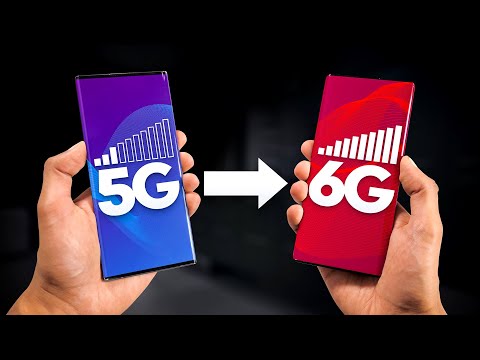 Photo: N43 and Hermes
Sixth-generation wireless promises terabit speeds, sub-millisecond latency, and AI-native networks. Here is how 6G works and why it matters.
Source video: 6G - Explained! by Mrwhosetheboss, approximately 9.4M views observed via yt-dlp on 2026-08-14. Independently researched by N43 and Hermes.
Peak data rates across mobile generations. 6G targets 1 Tbps, a 100-fold jump from 5G. Source: ITU-R IMT-2030 framework.
01 The Road From 5G to 6G
The International Telecommunication Union (ITU-R) formalized its vision for 6G in Recommendation ITU-R M.2160-0, published in 2025 under the IMT-2030 framework. This document defines the capabilities, requirements, and use cases that the sixth generation of mobile communications must deliver by the early 2030s. Unlike the jump from 4G to 5G, which was largely about more bandwidth and lower latency for consumer devices, the 6G transition is being designed around AI-native architecture, sensing capabilities, and ubiquitous connectivity that extends into space and underwater environments.
5G networks, which began commercial deployment around 2019, are still being rolled out globally. But the standards community works on a roughly ten-year cycle: 3GPP releases for 6G are expected to begin in the 2027-2028 timeframe, with initial commercial deployments projected for 2030. The ITU-R framework identifies six usage scenarios for 6G that build on the three 5G scenarios (enhanced mobile broadband, ultra-reliable low-latency communications, massive machine-type communications) and add three new ones: immersive communication, hyper-reliable and low-latency communication, and integrated AI and communication.
02 Terabit Speeds and the Physics of THz Spectrum
6G targets peak data rates of up to 1 terabit per second, a hundredfold increase over the 10 Gbps peak that 5G was designed to deliver. Achieving these speeds requires moving into new frequency bands. Where 5G primarily uses sub-6 GHz and millimeter wave (24-47 GHz) spectrum, 6G research focuses on terahertz frequencies from 100 GHz to 1 THz. These wavelengths are short enough to pack enormous data into narrow beams, but they also face severe propagation challenges: terahertz signals are absorbed by water vapor and oxygen, limiting range to tens of meters in open air.
To overcome these limitations, researchers are developing massive MIMO antenna arrays with hundreds or thousands of elements, reconfigurable intelligent surfaces (RIS) that can reflect and steer signals around obstacles, and new modulation schemes designed for the extreme bandwidth available at terahertz frequencies. The combination of these technologies could enable line-of-sight links at tens of meters that deliver tens of gigabits per second, or fixed point-to-point links at hundreds of meters that achieve terabit rates.
03 AI-Native Networks: Machine Learning at the Edge
Perhaps the most fundamental shift in 6G is the move from AI-enhanced to AI-native network architecture. In 5G, AI and machine learning are applied as overlays for optimization tasks such as traffic steering, power management, and anomaly detection. In 6G, AI is built into the air interface itself. The network is designed to use machine learning for channel estimation, beamforming, modulation selection, and resource allocation, replacing traditional model-based signal processing with data-driven approaches that can adapt to complex channel conditions in real time.
This AI-native design extends to the network management layer as well. 6G networks are expected to use digital twins that continuously model the physical network in software, predicting failures before they happen and automatically reconfiguring resources. The integration of AI at every layer of the protocol stack means that 6G devices and base stations will need significantly more on-device compute power than their 5G counterparts, blurring the line between communication and computation infrastructure.
04 Integrated Sensing: Networks That See
One of the most novel features of IMT-2030 is integrated sensing and communication. In 6G, the same radio signals used for data transmission are also used for environmental sensing. By analyzing how signals reflect off objects, a 6G base station can function as a radar system, detecting and tracking objects in its coverage area with centimeter-level precision. This capability opens applications ranging from autonomous vehicle navigation to infrastructure monitoring and human activity recognition.
The sensing resolution improves with frequency, making terahertz bands particularly attractive for high-precision imaging. Research prototypes have demonstrated 6G-style sensing at 140 GHz that can detect the position and posture of humans behind walls, track drone swarms, and measure micro-vibrations in bridges and buildings. The military and defense implications of these capabilities have not gone unnoticed, and spectrum allocation discussions are already weighing sensing requirements against communication needs.
6G target performance improvements over 5G per ITU-R IMT-2030. Targets are design goals, not measured results.
05 Spectrum Battles and Global Standardization
The World Radiocommunication Conference 2027 (WRC-27) is expected to identify the frequency bands that 6G will use. The primary candidates include bands above 100 GHz, particularly 100-300 GHz for terrestrial mobile service and segments around 275-450 GHz that are currently shared with passive services such as Earth exploration satellite and radio astronomy. The spectrum allocation process is intensely political, with competing national interests pushing different frequency ranges to favor their domestic industries.
China, the United States, the European Union, South Korea, and Japan have all launched national 6G research programs. China's IMT-2030 Promotion Group published a white paper on 6G vision in 2022, while the US Next G Alliance and the European Hexa-X project are conducting parallel research. The risk of fragmentation is real: if regional standards diverge, the global roaming and interoperability that mobile users take for granted could be compromised. The 3GPP standards body is the primary forum for resolving these tensions, and its Release 21 is expected to begin the formal 6G standardization work.
06 Security, Privacy, and the Sensing Dilemma
The integrated sensing capability that makes 6G revolutionary also introduces unprecedented privacy concerns. A network that can detect human posture through walls, track micro-movements, and image objects at centimeter resolution is also a network that can surveil populations at a scale previously impossible with dedicated radar systems. Unlike conventional surveillance cameras, 6G sensing would be built into every base station and potentially every router, operating continuously and pervasively.
Security researchers are already exploring cryptographic techniques that allow sensing functionality without revealing raw signal data, federated learning approaches that keep training data on-device, and regulatory frameworks that would govern who can access sensing data and under what conditions. The ITU-R framework acknowledges these challenges but leaves specific solutions to national regulators and standards bodies. The tension between security, privacy, and utility will be one of the defining political battles of the 6G era.
07 Timeline, Investment, and Reality Check
The 6G development timeline is aggressive but not unprecedented. 5G went from ITU-R vision document (2015) to first commercial deployment (2019) in four years. The 6G timeline follows a similar arc: ITU-R vision published in 2025, standards development in 2027-2028, and first commercial networks in 2030. However, the technical challenges are significantly harder. Terahertz transceivers, AI-native signal processing, and integrated sensing all require breakthroughs in semiconductor technology, algorithms, and system design that may not arrive on schedule.
Investment in 6G research is already substantial. Major telecommunications companies including Huawei, Ericsson, Nokia, Samsung, and Qualcomm have dedicated 6G research teams, and government funding in the tens of billions of dollars has been committed across the US, EU, China, and Japan. But the return on investment depends on whether the use cases that justify 6G deployment materialize. Holographic communication, brain-computer interfaces, and digital twins at planetary scale are the headline applications, but whether consumers or enterprises will pay for them remains an open question.
References
- Wikipedia: 6G — overview of the proposed sixth generation of mobile communications technology
- International Telecommunication Union (ITU-R): IMT-2030 Framework — Recommendation ITU-R M.2160-0 defining 6G requirements
- 3GPP: 3GPP Standards — standards body responsible for mobile communications specifications including future 6G releases
- Source video: 6G - Explained! (Mrwhosetheboss, approximately 9.4M views, observed 2026-08-14)
By N43 and Hermes for Sailor Bob News.


