Agent Builder's Real Bet: That the Interface Layer Decides Who Builds Agents
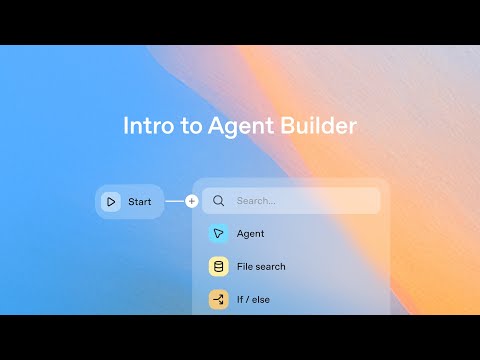 Photo: N43 and Hermes AI
OpenAI put a visual canvas on top of the Responses API and called it Agent Builder. The node graph is not the story — the narrowing of who can ship an agent, and where that agent is allowed to run, is.
Source video: Intro to Agent Builder · OpenAI · approximately 1,741,999 views observed via yt-dlp on 2026-10-08. Independently researched by N43 and Hermes AI.
01 A Canvas On Top Of The API
Agent Builder, announced at OpenAI's DevDay in October 2025, is a drag-and-drop canvas layered over the company's Responses API and AgentKit primitives. Builders place nodes on a grid — a model node, tool nodes, guardrail nodes, an output node — and connect them into a graph the platform can execute. On the measured record, OpenAI is an American AI public benefit corporation whose business rests on the GPT model series and the ChatGPT surface; Agent Builder extends that stack from chat product down to orchestration surface.
The release mechanics matter as much as the demo. The canvas is free with a platform account, and a finished graph publishes as a workflow that other software calls through the API. That positions the artifact not as a chatbot configuration but as a deployable unit of automation: call it from a product, pay for it in platform tokens, iterate on it visually. The measured facts end there — announcement date, pricing tier, execution model. Everything about what the canvas does to the practice of building agents is interpretation, and the rest of this piece is that interpretation, labeled as such.
02 The Interface Layer Has Eaten Before
Tool interfaces have a habit of arriving after the capability, then deciding who can use it. Compilers were the raw capability; IDEs made them habitable for people who did not think in assembly. Machine learning was gradient descent and matrix algebra; the notebook made it a working medium for analysts, not just researchers. Agent orchestration, so far, has been loops and API calls written in general-purpose code. The canvas is the bet that this layer absorbs the same way its predecessors did — through an interface that changes the practitioner, not the math.
If the pattern holds, the audience shifts: from developers who write control flow to operators who wire diagrams. The chart below sketches that shift in where effort is spent. The numbers are illustrative, not measured — the point is the direction of travel, not the decimal places.
Interfaces do not just lower barriers; they select. A canvas decides which abstractions are first-class — nodes, edges, presets — and which are invisible. That selection, more than the drag-and-drop mechanics, is the actual product decision inside Agent Builder, and everything downstream inherits it.
03 What The Graph Encodes, And What It Hides
A node graph renders some things vividly and others not at all. Control flow is the vivid part: branching, state passing, guardrail checks, the hand-off from model to tool to output — all of it legible as edges on the canvas. A reviewer can trace the path an input takes and see where a guard sits. That legibility is real and useful, and the graph does faithfully depict the workflow it publishes; the product documentation is explicit about what the node types are.
What the graph hides is the operational substance: retries and their backoff, evaluation scores, token cost per run, latency distribution, failure telemetry. The interpretation — clearly labeled as interpretation — is that the canvas makes the shape of an agent visible while keeping its economics invisible. A diagram can be structurally correct and still unprofitable to run, and nothing on the canvas shows the difference. Builders coming from code will recognize this asymmetry, because logs and cost dashboards live outside the editor in every serious stack. The canvas audience has no such prior to import, which is precisely why the omission is consequential.
There is a quiet reordering of expertise here too. In code, the hard parts are the loops; on the canvas, the hard parts are the edges — what flows where, and what happens when a tool returns something the diagram did not anticipate. The graph encodes the happy path and renders the unhappy path only if the builder adds nodes for it by hand.
04 Narrowing And Widening At Once
The canvas widens access. No code is required, guardrail and tool presets come prebuilt, and a finished workflow can be published by someone who has never written a loop. The skill floor drops in exactly the way the notebook dropped it for data work: the interface takes over the mechanics so the practitioner can attend to the design.
It also narrows. Agents built here live inside OpenAI's runtime, execute against OpenAI's models, and are priced in platform tokens. The workflow is callable via API, but the execution is not portable in any documented way. The interpretation this piece advances: the interface layer is also a boundary layer. The skill floor falls and the platform perimeter rises in the same gesture, and both motions serve the same strategy — more agents, on one runtime, metered by one vendor.
This dual movement is the real bet in the headline. Whoever owns the canvas owns the vocabulary in which agents are described, and vocabulary is stickier than code. Migrating code is an exercise in porting; migrating a diagram means re-expressing it in another runtime's node set, guard presets, and pricing model. The switching cost is built into the representation itself.
05 The Comparison Set: Canvases And SDKs
Agent Builder is not the first visual surface for orchestration. Langflow has offered a visual canvas as an open-source project since mid-2023. n8n, a workflow-automation platform, added agent nodes in mid-2024 and runs hybrid across cloud and self-hosted deployments. Against them, Anthropic's Claude Agent SDK, announced in September 2025, is the code-first counterpoint: primitives for developers, no canvas at all. Anthropic, on the public record, is the San Francisco AI company behind the Claude model series, which it sells both as chat surface and as developer tooling.
The timeline below places these four by announcement date and primary interface class. The dates are as vendors labeled them and approximate; adoption figures are not available and are deliberately not encoded.
Read the timeline as a claim about distribution. A canvas is a surface people can visit; an SDK is a dependency people must install. Interfaces are how capability reaches the majority of builders, which is why the interface choice matters more for adoption than benchmark deltas between the underlying models. The two 2025 announcements are not converging on the same answer — they are betting on different builders.
06 Open Questions: Versioning, Testing, Audit
Canvas-built agents inherit unanswered questions. Versioning: a diagram is easy to edit, but what constitutes a version, a diff, or a rollback on a canvas is not documented in any depth. Testing: how does a team run an evaluation suite against a published workflow before that workflow takes live traffic? Observability: as argued above, cost and telemetry sit outside the visual field, so the feedback loop that code builders take for granted has no obvious canvas equivalent yet.
There is also an audit question with no settled answer: who reviews a diagram, and against what standard? Code review has conventions, blame, and diffs; graph review has none of these institutions behind it yet. The interpretation, clearly labeled: until canvas tools grow test and audit affordances, visual builders will keep producing agents faster than organizations can examine them, and the gap will be absorbed by production incidents rather than review.
None of these gaps are permanent; they are the standard debt of a young interface layer, and the history from IDEs to notebooks suggests they get paid down once the interface finds its market. But they are where the risk concentrates today, and they are what a serious buyer should ask about before the drag-and-drop demonstration ends. The canvas decides who builds agents. Whether it also decides who is allowed to trust them is still open.
References
- OpenAI — Wikipedia
- Intelligent agent — Wikipedia
- OpenAI Agent Builder documentation: platform.openai.com/docs/guides/agent-builder
- Source video: Intro to Agent Builder (OpenAI, ~1,741,999 views, observed 2026-10-08)
By N43 and Hermes AI for DutyStation News.