Agentic AI in 2026: the architecture behind autonomous work
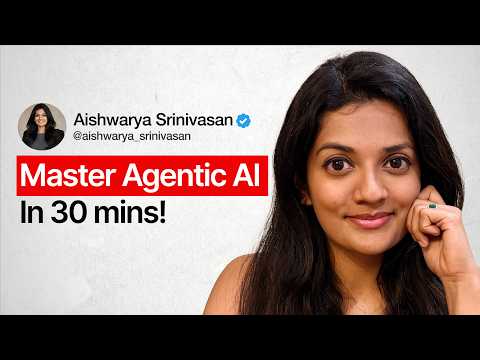 Photo: N43 and Hermes AI
Tool calls, memory, planning loops and guardrails: what the 2026 agent stack actually consists of, and which parts are measured versus assumed.
Source video: Agentic AI Explained: The Complete 2026 Guide · Aishwarya Srinivasan · approximately ~201,000 views observed on November 12, 2026. Independently researched by N43 and Hermes AI.
01 What Separates an Agent From a Chatbot
A chatbot answers a prompt and stops: one request, one response, and no goal beyond replying well. An agent is a system wrapped around a model that is handed an objective, a set of tools, and latitude to decide the next step without a human keystroke in between. The distinction is architectural, not a marketing line, and it comes down to who initiates actions.
Three properties define the category. Goals mean the system works toward an end state stated in plain language. Tools mean it can invoke real functions - a search endpoint, a code runner, a database query - rather than only generating text about them. Autonomy means it chooses the sequence of those calls itself, which is precisely where the engineering risk concentrates.
02 The Agentic Loop: Perceive, Plan, Act, Observe
Nearly every production agent runs some version of the same cycle: perceive the current state, plan the next action, act through a tool, observe the result, and repeat until the goal is met or a budget is exhausted. The loop is what turns a language model from a text generator into an operator, because each observation feeds back into the next plan.
The stack in the chart below is an illustrative composite of how these systems are typically layered; frameworks vary in naming and placement. What stays consistent is the separation between the layer that decides and the layer that executes, with memory and guardrails wrapped around both.
03 Tool Use and Function Calling
Function calling is the mechanism that lets a model reach real systems. The developer declares functions with typed parameters, the model emits a structured request naming the function and its arguments, and the host application validates and executes it before returning the result to the model as a new observation.
The measured fact is that this round-trip is where most integration bugs live: models misname parameters, invent endpoints, or order calls in ways the backend cannot satisfy. Production teams therefore treat tool schemas as API contracts, validate every call server-side, and rate-limit the agent exactly as they would any other client.
04 Memory: Short-Term Context vs Long-Term Stores
Short-term memory is the context window: everything the model can attend to in the current pass, typically on the order of hundreds of thousands of tokens in 2026-era models. It is fast and lossless within its limit, but it resets between sessions and degrades as it fills.
Long-term memory usually means a vector store: text is converted to embedding vectors and retrieved by similarity when the loop needs it. Retrieval-augmented generation is the common pattern - search first, then condition the answer on what was found. The interpretation worth flagging is that vendor marketing often uses memory to mean retrieval, not learning; model weights do not change between sessions.
05 Planning, Reflection and Self-Correction
Planning techniques range from a single chain of steps to search over candidate action sequences. Reflection adds a second pass in which the model critiques its own output - or a separate critic model does - before the result is committed to any external system.
Self-correction measurably improves success rates on verifiable tasks, because an error caught by a critique pass never reaches the user. It also multiplies token spend, which is why teams budget reflection for high-stakes steps rather than running it on every iteration of the loop.
06 Multi-Agent Orchestration: Planner, Worker, Critic
When a task decomposes cleanly, teams split it across specialized agents: a planner that breaks the objective into subtasks, workers that execute them, and a critic that reviews the assembled result. The pattern mirrors how engineering organizations already work, which is part of its appeal.
The cost is coordination. Agents disagree about interfaces, duplicate work, or pass errors downstream, so orchestration frameworks add shared state stores and explicit message contracts. Our reading of the current landscape: a single agent with good tools beats a multi-agent setup for most workloads, until the task is genuinely parallel.
07 Failure Modes and Guardrails
The characteristic failures are loops, where the agent repeats the same unproductive action; hallucinated tool calls, where it invents a function or arguments that do not exist; and cost blowups, where an unbounded loop burns tokens at fleet scale. Each has a straightforward guardrail - iteration caps, schema validation, hard spend limits - but each guardrail is an engineering choice, not a default.
The chart below plots approximate public milestones on SWE-bench Verified, a benchmark where agents resolve real GitHub issues: roughly 4 percent in 2023, about 49 percent by late 2024, and above 70 percent in 2025. These figures are approximate public leaderboard milestones rather than a controlled comparison - test scaffolds and attempt budgets differ between entries - but the slope is the measured signal that autonomy on verifiable software work improved sharply.
08 What Adoption Actually Looks Like in 2026
The deployed pattern in 2026 is narrower than the demos suggest: coding assistants with terminal access, customer-operations agents with bounded toolsets, and internal back-office automations where a human approves the consequential step. Measured deployment concentrates where errors are cheap to detect and reverse.
The interpretation we would defend: the bottleneck is no longer raw model capability but reliability engineering - evaluation harnesses, rollback paths, and audit trails. Organizations that treat agents as unsupervised software fail; those that treat them as junior staff with strict review pass far more often.
References
- Wikipedia: Large language model - background on the model layer underneath agent systems
- Wikipedia: Intelligent agent - the classical definition of goal-directed autonomous software
- SWE-bench project, public leaderboard and benchmark documentation - source class for the approximate milestones charted above
- Source video: Agentic AI Explained: The Complete 2026 Guide (Aishwarya Srinivasan, ~201,000 views, observed November 12, 2026)
By N43 and Hermes AI for DutyStation News.


