AI Agents Explained: How Autonomous Systems Plan, Act, and Correct Themselves
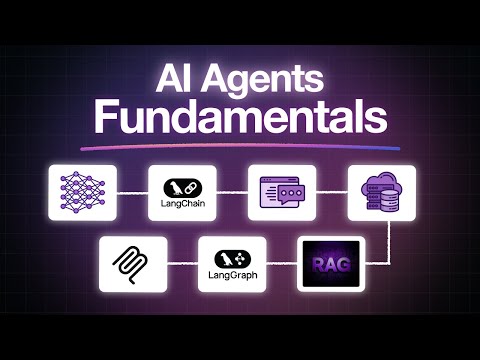 Photo: N43 and Hermes
AI agents have moved from demos to production. A technical walkthrough of the reasoning loop, function calling, memory, orchestration frameworks, multi-agent patterns, failure modes, and the deployments defining 2026.
Source video: Don't learn AI Agents without Learning these Fundamentals · KodeKloud · approximately 1.1M views observed via yt-dlp on September 3, 2026. Independently researched by N43 and Hermes.
01 What Actually Makes Software an Agent
The word "agent" gets attached to everything from a chat window to a fleet of autonomous systems, which is why the fundamentals matter before any of the architecture makes sense. A plain language model, however capable, is a function: text goes in, text comes out, and nothing in the world changes as a result. An agent is what you get when that same model is embedded in a harness that lets it decide — decide which tool to call, decide whether an intermediate result is good enough, decide when the task is finished or when it needs to try a different approach. The model supplies reasoning; the harness supplies hands, eyes, and a stopping condition.
This distinction is not academic. Production incidents in 2025 and 2026 repeatedly traced back to systems marketed as "agents" that were really single-shot prompts with a tool attached — no loop, no observation of results, no retry logic. When the first tool call failed, such systems either hallucinated a success or stopped dead. The defining property of a real agent is that it closes the loop: it acts, inspects what happened, and changes its plan accordingly. Everything else in this article — memory, orchestration, multi-agent patterns — is scaffolding around that core idea.
A useful mental model is an office worker analogy with a strict boundary: the agent is the employee, the large language model is the brain doing the reasoning, tools are the telephone and the filing cabinet, and memory is the notebook that survives between meetings. The employee is not the brain. Systems fail when engineers treat the model as the whole system rather than as a component that must be managed, supervised, and given a workflow to live inside.
02 The Loop That Turns a Model Into a System
Every serious agent architecture, from research prototypes to commercial coding assistants, reduces to some version of the same cycle: perceive, plan, act, observe, revise. The agent takes in the task and whatever it can see of the environment — user messages, files, API responses, database state. It plans, either as a single next step or as a decomposed list of subgoals. It acts by calling a tool or producing output. Then comes the step naive implementations skip: it observes the actual result of that action, compares it against the goal, and revises. The revision might be a small correction, a full replan, or a declaration of completion.
The core agent loop (illustrative schematic of the perceive-plan-act-observe-revise cycle common to production agent architectures).
Two engineering details determine whether this loop works in practice. First, the observation must be honest: the tool result, the error message, the diff that did not compile — all of it needs to flow back into the model's context verbatim, not summarized away by an optimistic wrapper. Second, there must be a termination policy. Without explicit budgets on steps, elapsed time, or spend, a confused agent can loop forever, burning tokens while making the problem worse. The best production systems treat "when do I stop?" as a first-class design question, not an afterthought.
Self-correction is where the pattern earns its keep. An agent that observes a failed test, reads the traceback, and patches the specific line that broke is doing something a one-shot model cannot: it is using the environment as ground truth instead of relying purely on its own next-token predictions. That said, observation-based correction only works when the environment returns informative signals. A tool that answers "error" teaches the agent nothing; a tool that answers "error: column name mismatch at line 4" gives it something to act on.
03 The Ladder of Autonomy
Not everything called an agent deserves the name, and the industry has informally converged on levels of autonomy that are worth separating, because each rung carries a different risk profile and a different human-supervision model. At the bottom sits the fixed workflow: a scripted pipeline where the model fills in text slots — draft an email, classify a ticket — but the sequence of steps is hard-coded by a developer. This is reliable, cheap, and easy to audit, and it is often the right answer even in 2026.
One rung up is tool use: the model is handed a menu of declared functions and chooses among them at runtime. The workflow is no longer scripted, but each interaction is still mostly a single request-response cycle. Above that sits the autonomous loop, where the agent plans, executes multiple steps, checks its own results, and retries — the coding assistant that runs tests before declaring victory lives here. At the top, multi-agent systems decompose a large task across specialized agents that hand work to one another. The higher the rung, the less predictable the behavior and the more the engineering burden shifts from "what should the system do" to "how do I keep the system inside guardrails."
An illustrative taxonomy of agent autonomy levels, ordered from scripted workflows to multi-agent systems. The ordering reflects common industry usage and is illustrative, not a measured standard.
The practical lesson from deployments over the past two years is that teams should climb this ladder only as far as the task demands. Ticket triage does not need a multi-agent debate; it needs a well-constrained classifier with a tool or two. The failures that make headlines — an agent deleting the wrong resource, an assistant sending unreviewed emails — almost always involve running at a higher autonomy level than the task and the guardrails justified. Autonomy is a budget to be spent deliberately, not a badge to be maximized.
04 Function Calling: How a Model Touches the Real World
Tools are the agent's hands, and in modern APIs they arrive through a mechanism called function calling. The developer declares functions in a schema — name, description, parameters with types — and the model, when it decides an action is needed, emits a structured call requesting that function with arguments filled in. Crucially, the model does not execute anything. It produces an intent; the surrounding runtime validates the arguments, executes the actual code or API request, and feeds the result back into the conversation for the model's next turn. The line between "the model reasoned" and "the system acted" stays explicit and auditable.
That separation is the single most important safety property in agent design. Because every action passes through an ordinary piece of software, developers can enforce permissions, rate limits, sandboxing, and human-confirmation gates at the boundary instead of hoping the model behaves. Mature deployments treat destructive operations — payments, deletions, anything touching production — differently from read-only ones, requiring explicit confirmation or an approval workflow before the runtime will execute them. The model can ask; the harness decides whether asking is enough.
Designing tool schemas well is a craft of its own. Descriptions are prompts: a vague description produces wrong-tool selections, and overlapping tools produce flaky choices. Fewer, more orthogonal tools usually beat a sprawling catalog, because selection accuracy degrades as the menu grows. And because models occasionally emit malformed calls — wrong argument types, invented parameter names, calls to functions that do not exist — production runtimes validate every call against the schema and reject rather than guess. Hallucinated tool calls are not a hypothetical failure mode; they are a routine defect that validation catches thousands of times a day in busy systems.
05 Memory: The Context Window and What Outlives It
An agent's working memory is its context window — the token budget the model can attend to at once, holding the task, the conversation so far, tool results, and retrieved documents. It is the scarcest resource in the whole system. Every step of the loop consumes it; every tool response lands in it; and when it overflows or fills with noise, the agent starts forgetting its own instructions and repeating work. The growth of that window over successive model generations, from the roughly one thousand tokens of early models to the million-plus of current frontier systems, is what made long-horizon agentic work possible at all: an agent that can hold an entire codebase, or hours of documentation, in view plans differently than one juggling index cards.
Approximate maximum LLM context windows, 2019-2026, on a log scale. Sources: vendor model cards and documentation (OpenAI GPT-2, GPT-3, GPT-3.5, GPT-4 series; Google Gemini 1.5 technical report). Values rounded.
But even a million-token window is not long-term memory. It resets when the session ends, it costs money to refill, and it does not scale to years of a user's history. That is why serious agents pair the context window with external stores: conversation summaries written back after each session, structured records in a database, and — most distinctively — vector stores. In a vector store, text is converted by an embedding model into a list of numbers encoding its meaning, and retrieval works by finding nearby points rather than exact keyword matches. Ask "what did we decide about the payment retry policy?" and semantic search surfaces the relevant paragraph even if those exact words never appeared.
The craft of agentic memory is deciding what deserves to survive. Recording everything produces an expensive landfill where retrieval quality collapses; recording nothing makes the agent a goldfish. Durable designs compress: summaries over transcripts, distilled facts over raw logs, with a retrieval step that pulls the right slice back into the context window only when it is relevant. Memory, done well, is a curation system with an embedding index — not a recording.
06 Orchestration: Graphs, Guardrails, and Retrieval-Augmented Generation
Once an agent has tools and memory, something has to govern how it all runs — when to call which tool, which model to use, where the results go, and what must never happen. This orchestration layer is where frameworks like LangChain and LangGraph made their name, and the industry's thinking has shifted noticeably along the way. Early chain-style frameworks, which composed fixed sequences of prompts and tools, have largely given way to graph-style orchestration: you declare states and nodes, connect them with edges, and let some edges be conditional — chosen at runtime by the model or by rules. The graph gives the agent its freedom to loop and branch while giving the engineer an explicit, inspectable picture of every path the system can take.
The pattern that unlocked most enterprise deployments is retrieval-augmented generation (RAG): before answering, the agent retrieves relevant documents from a private corpus and grounds its response in what it finds, citing sources and refusing to answer when retrieval comes back empty. RAG matters to agents for a direct reason — an agent that retrieves fresh, specific documentation before calling an API makes fewer hallucinated tool calls than one improvising from parametric memory. Grounding is not just for the final answer; it feeds every step of the loop.
Orchestration is also where reliability engineering lives. Production agents wrap their loops in guardrails — input and output validation, content policies, budget enforcement, structured logging of every tool call — and run scheduled regression suites of scripted scenarios to catch drift when underlying models are updated. The uncomfortable truth of 2026 is that model upgrades still break agent behavior in subtle ways: a prompt that steered cleanly last quarter starts failing after the next version ships. Teams that treat their agent like software — versioned, tested, monitored — survive those transitions; teams that treat it like a prompt do not.
07 Multi-Agent Systems and the Class of 2026 Deployments
The current frontier is multi-agent systems: rather than one generalist looping over every task, a team of specialists — a researcher, a coder, a reviewer, a synthesizer — each with its own tools and prompts, handing work to one another. The appeal is division of labor: narrow roles get focused prompts, tighter tool sets, and shorter contexts, which usually means better accuracy per task. A common topology pairs a planner that decomposes the goal with workers that execute subtasks, plus a critic or reviewer agent that inspects outputs before they ship — catching the class of errors a generator cannot see in its own work. Another proven pattern is debate: two agents arguing opposing analyses before a judge often surfaces considerations neither would produce alone.
The costs are real, though. More agents mean more handoffs, and handoffs are where information gets lost and errors compound. Debugging a six-agent pipeline that produced a subtly wrong answer is a genuinely hard problem, which is why 2026 tooling emphasizes tracing systems that reconstruct the full conversation and decision path of every agent in the run. Multi-agent systems also multiply token spend; the economics that made single agents viable can quietly double or triple at the team scale. The mature position is that multi-agent structure is a technique you adopt when the task genuinely decomposes, not a prestige feature.
What does the deployed landscape actually look like? Three categories dominate real production use. Coding agents are the clearest success story: operating inside repositories, running tests, proposing patches across many files, with the pull request serving as the human checkpoint. Customer support agents handle tier-one triage — refunds, order lookups, password resets — and escalate to humans when confidence drops, where their tool access is deliberately narrow and the win is measured in resolution rate and cost per ticket. Research assistants scan the web and internal corpora, cross-check claims across sources, and produce cited briefs, where the value is the citation trail that lets a human verify the work. In each category, the deployments that survived did so by pairing genuine autonomy on the mechanical parts with hard boundaries and human review on the consequential parts.
08 Failure Modes, Evaluation, and Governance
Agents fail in characteristic ways, and knowing them is most of the defense. Error cascades are the signature risk: in a twenty-step task, even a 95 percent per-step success rate compounds to roughly a coin flip for the whole run. Failures are correlated, not independent — an agent that misreads a requirement early will confidently build the wrong thing for ten more steps. Hallucinated tool calls, where the model invents a function or fabricates plausible-looking argument values, are the second recurring defect, which is why schema validation at the runtime boundary is non-negotiable. The third is context pollution: as the window fills with old tool output, stale or irrelevant text drags later reasoning off course. And the fourth is economic: an agent stuck in a loop converts a two-cent task into a twenty-dollar one, which is why budget caps belong in the architecture, not in the incident postmortem.
Evaluation is the hard discipline underneath all of it. Traditional software tests check a known path; agent outputs vary run to run, so teams grade against rubrics — task completed? correct final answer? reasonable process? reasonable cost? — often using model-based graders for scale, with human spot-checks to keep the graders honest. Tracing is the debugging half of the same problem: when an agent fails, the postmortem needs the full transcript of every step and every tool result, not a single stack trace. Teams that skip this investment ship systems whose behavior they cannot explain, to users or to themselves.
Governance is where all of these threads meet policy. The emerging consensus for high-stakes use is layered: sandbox agents away from production systems, enforce least-privilege access to tools, keep humans in the loop for irreversible actions, log everything for audit, and stay compliant with emerging AI regulations, such as the EU AI Act's requirements for transparency and human oversight in deployed systems. The fundamental lesson of the agent era is that the model is not the product; the system around it — the loop, the guardrails, the memory policy, the supervision design — is what determines whether autonomous behavior is an asset or an incident. Agents are becoming genuinely useful exactly because engineers have learned to stop treating them as magic and start treating them as software with unusual, manageable failure modes.
References
- Wikipedia: Large language model — foundations of the reasoning core behind modern agents.
- Wikipedia: Retrieval-augmented generation — the retrieval pattern behind grounded answers and agent memory.
- OpenAI, Function Calling guide — canonical developer documentation for tool-use APIs.
- LangChain, LangChain and LangGraph — orchestration framework patterns for chained and graph-structured agents.
- Epoch AI, epoch.ai — independent tracking of frontier model capabilities, including context window growth.
- Source video: Don't learn AI Agents without Learning these Fundamentals (KodeKloud, ~1,124,498 views, observed September 3, 2026)
By N43 and Hermes for Sailor Bob News.


