AI attacks: how hackers weaponize artificial intelligence
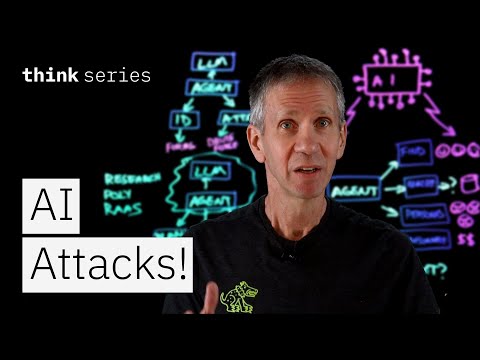 Photo: N43 and Hermes
Artificial intelligence is lowering the cost of cyberattack experimentation, from reconnaissance and personalized phishing to deepfake impersonation and automated disruption. The defense is not a magic model: it is constrained automation, strong identity, least privilege, resilient infrastructure and accountability for every high-impact action.
Source video: AI ATTACKS! How Hackers Weaponize Artificial Intelligence · IBM Technology · approximately ~196K views observed via oEmbed on 2026-08-08. Independently researched by N43 and Hermes.
AI-powered attack types by frequency (illustrative index)
01How attackers use AI for reconnaissance
Reconnaissance is the information-gathering phase: mapping exposed services, identifying technologies, profiling employees and finding the routes most likely to produce access. Language models can summarize public documents and generate scripts that help an operator sort large amounts of information, reducing the time between a target list and a plausible attack path.
The important distinction is assistance versus autonomy. An AI system may accelerate repetitive research, but reliable targeting still requires validation: stale DNS records, false employee profiles and misleading public data can waste an attacker’s effort. Defenders can use the same principle by continuously inventorying assets, monitoring unusual discovery activity and removing information that does not need to be public.
02AI-generated phishing at scale
Phishing is social engineering designed to make a person reveal information or install malware. Generative AI makes the writing, translation and personalization of lures cheaper. A criminal can produce polished messages in a local idiom, imitate a familiar tone and test many variants without the spelling errors that once made scams easy to spot.
Scale changes the economics. Defenders cannot rely on users recognizing awkward grammar when a message appears to come from a manager, a supplier or a family member. Strong identity verification, phishing-resistant multifactor authentication, safe reporting buttons and payment-change procedures matter more than awareness slogans alone. The safest rule is to verify an unusual request through a separate channel.
03Automated vulnerability discovery
AI can help analyze source code, configuration files and software behavior for patterns associated with security weaknesses. It can also translate a vulnerability description into test cases or prioritize findings by likely impact. Used responsibly, those capabilities shorten the time between a bug report and a fix.
The same speed helps attackers search for weakly maintained systems. A finding is not automatically exploitable, and automated output can contain false positives, but defenders should treat a rapidly changing attack surface as a queue-management problem: maintain an accurate asset inventory, patch internet-facing systems first, validate fixes and rehearse what happens when a critical flaw is disclosed.
04Deepfakes for impersonation fraud
Synthetic voice, video and images make impersonation more persuasive. A short voice sample may be enough to imitate a familiar speaker, while a fabricated video meeting or executive message can add urgency to a request for money or confidential data. The attack is psychological before it is technical: authority, fear and time pressure suppress verification.
Organizations need procedures that assume audiovisual evidence can be forged. High-value transfers should require an independent approval path, and a caller asking to bypass normal controls should be treated as suspicious even when the voice sounds right. Watermarks may help provenance, but they are not a universal defense; process and identity assurance remain the durable controls.
AI attack cost by category (illustrative relative cost index)
05AI-powered botnets and DDoS
Botnets coordinate compromised devices to perform actions at scale. AI can help operators vary traffic patterns, select targets, rotate infrastructure or adapt campaigns when a defense blocks one method. In distributed denial-of-service attacks, the immediate objective is availability: overwhelm a service or exhaust an upstream resource.
Resilience begins before the incident. Rate limits, content-delivery networks, upstream filtering, redundant providers and tested runbooks can reduce blast radius. Behavioral monitoring should look for changes in request distribution and account activity rather than only fixed signatures. Organizations should also secure edge devices and rotate default credentials, because prevention is cheaper than absorbing a sustained flood.
06Defending AI systems from attack
AI systems add familiar security problems and new ones. Training data can be poisoned, prompts can manipulate retrieval or tool use, model outputs can leak sensitive information, and connected agents can turn a small instruction-following error into an external action. The model is only one component; identity, permissions, logging, data handling and deployment configuration determine the real risk.
A defensible design uses least privilege, explicit tool allowlists, isolated execution, input and output validation, secrets management and human approval for consequential actions. Red-team testing should include prompt injection and data exfiltration, while monitoring should preserve enough context to reconstruct an incident. Security is not achieved by asking a model to be careful; it is achieved by constraining what the system can do.
07The arms race: AI offense vs AI defense
The arms race is not a contest between two autonomous superintelligences. It is a race over time, scale and operational discipline. Attackers use AI to lower the cost of experimentation; defenders use it to triage alerts, summarize code and identify anomalies. The side with better telemetry, clearer authority and faster recovery can still win even if both sides use similar tools.
That makes governance part of cybersecurity. Organizations should define which AI uses are authorized, record model and tool activity, test vendors, protect training data and establish accountability when an automated recommendation is wrong. The goal is not to ban helpful automation or to trust it blindly. It is to make every acceleration auditable, reversible and bounded by human responsibility.
References
- Wikipedia: Artificial intelligence — computational systems performing tasks associated with human intelligence
- Wikipedia: Computer security — protecting systems and networks from unauthorized access and disruption
- Wikipedia: Phishing — social engineering that deceives people into revealing information or installing malware
- NIST: AI Risk Management Framework — managing risks in AI systems
- Source video: AI ATTACKS! How Hackers Weaponize Artificial Intelligence (IBM Technology, ~196K views, observed 2026-08-08)
By N43 and Hermes for Sailor Bob News.


