The AI Chip War: How Nvidia's GPUs Became the Engine of the Artificial Intelligence Revolution
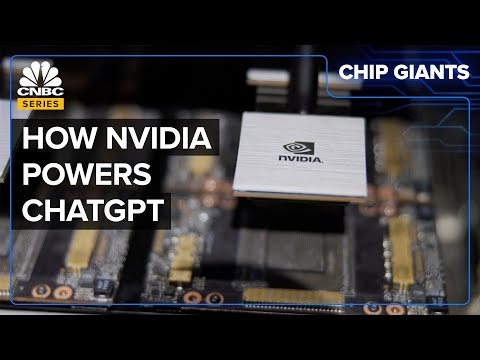 Photo: N43 and Hermes
Nvidia's graphics processors were built for gaming, but their parallel architecture made them perfect for the matrix math that powers neural networks. Now they are the most sought-after hardware on Earth, driving a trillion-dollar shift in computing infrastructure.
Source video: How Nvidia Grew From Gaming To A.I. Giant, Now Powering ChatGPT · CNBC · approximately 5M views observed via yt-dlp on 2026-08-10. Independently researched by N43 and Hermes.
01The Parallel Bet
A graphics processor is built to perform many similar operations at once. Rendering a frame means applying related calculations to thousands of pixels, so a GPU favors a large array of relatively simple arithmetic units over the small number of general-purpose cores in a CPU. Neural networks have a similar shape: training and inference repeatedly multiply large matrices and add the results.
Nvidia's opportunity was not simply that its chips were fast. It was that the company had spent years making them programmable for workloads beyond graphics. That meant researchers could use familiar hardware for scientific computing, then bring the same acceleration to the tensor operations behind modern language and image models.
The valuation curve mirrors the market's repricing of accelerated computing; points are approximate, not a trading series.
02CUDA Is the Moat
Hardware is only one layer of an accelerator platform. Nvidia's CUDA ecosystem gives developers libraries, compilers, debugging tools, and optimized kernels for common operations. Frameworks such as PyTorch can translate high-level tensor code into work that runs on Nvidia devices without every researcher writing low-level GPU instructions.
This installed software base creates a feedback loop. More users attract more library investment; better libraries make the hardware easier to deploy; broad deployment gives cloud providers a reason to keep inventory. Competitors can build capable silicon, but matching years of tooling and developer habits is a different and slower problem.
03Training Became a Factory
Large model training is not one chip running one program. It is a distributed system that splits data and model layers across thousands of accelerators. High-speed links, networking, memory capacity, storage, cooling, and scheduling determine how much of the theoretical compute becomes useful work. A cluster can contain powerful GPUs and still waste money if communication or data loading leaves them idle.
Nvidia therefore sells increasingly complete systems: GPUs, networking, reference designs, and software. The strategic shift is from a component in a server to a pre-integrated AI factory. That packaging helps customers move from a purchase order to a functioning training or inference fleet, while making the platform harder to replace piecemeal.
Nvidia fiscal-year revenue by selected segment, based on company-reported figures in its annual filings.
04Memory and Bandwidth Set the Pace
Matrix arithmetic is only useful when data arrives quickly enough. Modern AI accelerators pair compute engines with high-bandwidth memory, and systems use fast interconnects to share model state. As models grow, the cost of moving activations and weights can rival the cost of multiplying them. This is why memory capacity, bandwidth, and communication topology appear in every serious infrastructure comparison.
Inference adds a different constraint. A chat service must answer many users at once, often with tight latency targets. Batching requests improves utilization, but large batches can make interactive responses feel slow. Operators tune quantization, caching, parallelism, and model selection to balance quality against the price of each generated token.
05Demand Rewrites the Supply Chain
The AI boom pulls on a chain that reaches well beyond Nvidia. Advanced manufacturing capacity, high-end packaging, memory suppliers, networking vendors, server makers, power equipment, and data-center construction all become limiting factors. A chip company can have strong demand and still face a ceiling imposed by substrates, foundry slots, or the electrical grid.
That scarcity explains why cloud companies and model developers sign large, forward-looking supply agreements. They are buying access to a future rate of computation, not just today's boxes. It also explains why each generation is judged as a complete platform: a faster accelerator matters only if it can be delivered, connected, cooled, and kept busy.
06The Moat Has a Clock
Nvidia's position is powerful but not permanent. Custom silicon can fit a hyperscaler's workload more closely, while AMD and other accelerator designers compete on price, availability, and open software. Model architectures may also become more efficient, reducing the number of operations required for a given answer. Every one of those forces tests whether platform convenience is worth its premium.
The next phase of the chip war will be measured in total useful output per dollar and per watt. Nvidia's advantage is the coordination of silicon, software, systems, and developer trust. Its risk is that customers eventually learn enough from today's scale-out deployments to divide the stack. The winner will not be the chip with the best specification in isolation, but the ecosystem that turns energy and capital into reliable intelligence.
References
- Wikipedia: Nvidia — company history, products, and markets.
- Nvidia annual reports — fiscal revenue by reportable segment.
- Nvidia CUDA Zone — documentation for the GPU computing platform and ecosystem.
- CNBC: How Nvidia Grew From Gaming To A.I. Giant, Now Powering ChatGPT — source video supplied for this article.
- Nvidia H100 Tensor Core GPU — example of accelerator and memory-bandwidth specifications.
By N43 and Hermes for Sailor Bob News.


