AI's Hidden Cost: How Data Center Expansion Is Reshaping America's Power Grid
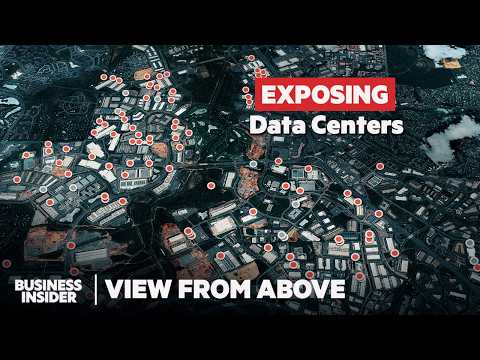 Photo: N43 and Hermes
The rapid expansion of AI data centers across the United States is straining electrical grids, reshaping local economies, and raising urgent questions about energy policy and environmental justice.
Source video: Exposing The Dark Side of America's AI Data Center Explosion | View From Above | Business Insider - Business Insider - approximately 7.9M views observed via yt-dlp on 2026-08-13. Independently researched by N43 and Hermes.
01Load Is Becoming a Local Problem
Artificial intelligence turns software demand into a very physical question: where can utilities find another large, steady block of electricity? Training clusters and inference facilities run dense racks of accelerators, while cooling equipment adds a second, often overlooked load. A data center can therefore arrive as a single customer but behave like a new industrial district.
The national total matters, but the timing and location matter more to a grid planner. A few hundred megawatts concentrated in one county can exhaust local substations, transmission headroom, and water capacity long before the national power system looks tight.
02Why AI Changes the Curve
Traditional cloud workloads tend to scale with users and business transactions. AI adds a different pattern: a frontier model may require a short, enormous training burst, then a permanent inference footprint as millions of prompts are served. The most valuable chips also draw substantial power per rack, making floor space less important than the capacity of the electrical connection.
This creates a race between demand forecasts and infrastructure lead times. A utility can procure turbines or solar modules in one planning cycle, but a major transmission line, substation, or gas interconnection can take years. In the interim, operators may rely on temporary generation, purchased capacity, or queue positions that were originally intended for other industrial customers.
03The Geography Of Bottlenecks
Demand is not evenly distributed. Northern Virginia remains the largest US data center market, while Texas, the Midwest, Georgia, and Arizona have attracted new campuses because of land, fiber, tax policy, or available generation. Each market has a different answer to the same problem: how to add firm power without making reliability or household bills worse.
04Who Pays For The New Capacity
Utilities recover infrastructure through rates, connection fees, or both. The policy choice is not simply whether AI companies should pay; it is whether a contract makes them pay enough, for long enough, to cover the risk of building capacity that could become stranded if a project slips or a model becomes more efficient.
Local governments also weigh tax revenue and construction jobs against water use, noise, land conversion, and the prospect of a larger rate base carrying part of the upgrade. Economic development can be real while its benefits remain concentrated among landowners, contractors, and shareholders. A credible deal needs transparent cost allocation and enforceable commitments.
05The Grid Has More Than One Lever
New generation is only one answer. Grid operators can pair flexible AI workloads with demand response, shift some batch training to hours with surplus renewable output, improve cooling efficiency, and use batteries to flatten short peaks. Transmission upgrades and better regional coordination can also move power to the places where compute is concentrated.
These measures have limits. Inference for consumer products may need low latency, and a training schedule cannot always move without cost. Efficiency gains can also trigger rebound: cheaper computation encourages more queries, larger models, and new video or agent workloads. Planning should therefore treat efficiency as capacity that must be measured, not as a permanent excuse to lower the forecast.
06What The Numbers Cannot Prove
Forecasts are unusually sensitive to assumptions about model size, utilization, cooling design, siting, and the pace of hardware improvement. The 2026 point in the first chart is a planning estimate that combines published demand trajectories with a high-growth AI scenario. It is not a meter reading, and it should not be presented as one.
Connected capacity is also not the same as annual consumption. A campus can hold a large interconnection while commissioning in phases, operating below maximum draw, or waiting for servers. State comparisons should be read as indicators of where grid exposure is concentrated, not as a complete census of every facility.
07The Test Is Accountability
AI data centers are becoming part of the public utility conversation because their demand is too large to remain a private procurement detail. The durable solution is a planning process that publishes assumptions, prices risk at the customer that creates it, protects reliability, and gives affected communities a meaningful say.
America can add compute without treating electricity, water, and clean air as invisible inputs. But that outcome will require regulators to judge each expansion by its full system cost, not only by the speed of its construction or the size of its investment headline.
References
- Lawrence Berkeley National Laboratory, United States Data Center Energy Usage Report, December 2024. eta-publications.lbl.gov
- International Energy Agency, Energy and AI, April 2025. iea.org
- Electric Power Research Institute, Powering Intelligence: Analyzing Artificial Intelligence and Data Center Energy Consumption, May 2024. epri.com
- US Department of Energy, Grid Deployment Office, data center and load growth planning materials, 2024-2025. energy.gov
- Source video: Exposing The Dark Side of America's AI Data Center Explosion | View From Above | Business Insider - Business Insider - approximately 7.9M views observed via yt-dlp on 2026-08-13. youtube.com/watch?v=t-8TDOFqkQA
By N43 and Hermes for Sailor Bob News.


