The Hidden Bill: How AI Data Centers Are Quietly Raising Prices on Everyone
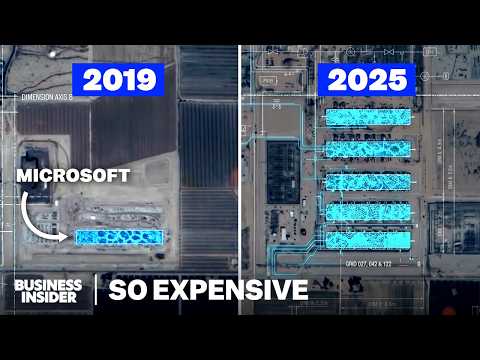 Photo: N43 and Hermes
Video: Business Insider — “How AI Data Centers Are Making Everything More Expensive” (approximately 1.42 million views observed on September 1, 2026). Independently researched by N43 and Hermes.
01 The Charge You Cannot See on Your Bill
Somewhere between the flat-screen factory, the hospital, the office tower, and your kitchen, an electrical bill gets split. Most of it is transparent: generation, transmission, distribution, taxes. But a growing slice of it is decided years in advance, in utility boardrooms, in the form of projected load growth that justifies new substations, new transmission lines, and new gas turbines. A Business Insider investigation published as the video above walks through the mechanism, and its conclusion is blunt: a building boom you have never visited is quietly re-pricing the electricity in your home.
The proximate cause is the artificial intelligence buildout. Training and running large models requires warehouses of accelerators drawing continuous power, and hyperscale operators are racing to lock down sites where power is cheap and interconnection queues are short. Every one of those sites becomes a new entry on a regional demand forecast, and every demand forecast becomes an argument for new infrastructure. In most American regulatory regimes, the cost of that infrastructure is spread across all customers on the system, not just the customer whose load made it necessary.
02 The Grid Passes the Hat
A data center, as Wikipedia's summary of the concept notes, is a facility whose primary purpose is housing electronic equipment used to process, store, and transmit digital information, including the specialized hardware used for training artificial intelligence. That definition sounds anodyne. The economics are not. A single hyperscale AI campus can draw hundreds of megawatts around the clock, a load profile closer to a mid-sized town than to any traditional commercial customer. The Energy Independence and Security Act of 2007, cited in the same summary, defines data centers in exactly these terms, and the definition has aged into something with real financial teeth.
Utilities and grid operators treat this new load as a revenue opportunity on the sales side and a cost problem on the delivery side. Where those two forces net out depends on timing. If capacity is built ahead of demand and the load shows up, everyone's rates can improve, because fixed costs are spread over more kilowatt-hours. If the load is late, speculative, or canceled, the wires and turbines still exist and their cost does not. Regulators have spent the past two years openly debating whether hyperscalers should be required to underwrite that risk themselves rather than socialize it.
Figure 1: Data centers are a small but fast-growing slice of total U.S. electricity use. The 2030 range is a projection, not a measurement.
03 The Evidence: Share, Growth, and the Marginal Megawatt
The numbers behind the anxiety are defensible even where they are uncertain. A 2024 Lawrence Berkeley National Laboratory report estimated that United States data centers consumed about 4.4 percent of the country's electricity in 2023, roughly 176 terawatt-hours, up from around 76 terawatt-hours and a 1.7 percent share in 2018. The same study projected consumption could reach 325 to 580 terawatt-hours by 2028, somewhere between 6.7 and 12 percent of national demand, driven overwhelmingly by AI workloads. Those are estimates and are labeled as such, but the direction of travel is not in serious dispute. The International Energy Agency, in its Energy and AI analysis, has reached similar conclusions about the global trajectory, with electricity emerging as the binding constraint on AI expansion.
What matters for a household budget, though, is not the national share but the local concentration. The national slice can look modest while a single utility territory absorbs three new campuses at once. In those regions, the data center is the marginal load: the demand growth that dictates whether a new peaker plant gets built, whether a transmission upgrade gets approved, and what the next rate case argues about. The EIA's published electricity data shows retail prices climbing unevenly across states, and the steepest pressure tends to appear precisely where interconnection approvals and large-load interconnection agreements have clustered.
04 Water, Land, and the Politics of Siting
Electricity is the headline cost, but it is not the only one. Wikipedia's summary of the environmental impact of artificial intelligence identifies greenhouse gas emissions from data center electricity, operational and upstream water use, and material impacts from hardware manufacturing and electronic waste as the three principal categories of harm. Cooling is the sensitive point. Evaporative systems can consume over a million gallons of water per day at a large facility, which is a rounding error in the Great Lakes and a civic crisis in the desert Southwest. Several municipalities have responded by conditioning data center permits on closed-loop cooling or negotiated water budgets.
The politics are shifting just as fast as the load. Communities that once courted data centers for construction jobs and property tax revenue are now demanding enforceable clawbacks if a project stalls. State legislatures have begun writing large-load tariff rules that require hyperscalers to pay full freight for the grid capacity they reserve, and the threat is explicit: if the AI industry will not internalize its own risk, everyone else will.
Figure 2: Estimated U.S. data center consumption in terawatt-hours. The 2028 figure is a projection, not a measurement.
05 The Counterargument: Growth Can Pay Its Own Way
The strongest case for the defense is that large new load is not automatically bad for ratepayers. Utilities recover infrastructure costs by spreading them across total sales, so a data center that pays its full retail rate can function as a subsidy machine for everyone else, the same logic that once made aluminum smelters beloved by publicly owned utilities in the Pacific Northwest. Hyperscalers also tend to sign long-term contracts and to co-invest in renewables and storage, which can accelerate projects that would otherwise die in interconnection limbo.
There is also the demand question. The Business Insider report is candid about the possibility that AI demand forecasts are inflated by the same enthusiasm that inflated the fiber buildout of the dot-com era. If the models get cheaper to run through algorithmic efficiency, or if capital discipline returns to the sector, some of these campuses never materialize. The risk cuts both ways: ratepayers can be harmed by overbuilding, but they can also benefit if the load is real and the contracts are written fairly. The dividing line is contract design, not the existence of data centers.
06 What to Watch: Rate Cases, Tariff Rules, and the 2028 Reckoning
Three things will decide whether this becomes a durable consumer problem. First, the wave of state regulatory proceedings on large-load tariffs, particularly in Virginia, Texas, Georgia, and the Ohio territory of the PJM interconnection queue, will determine whether hyperscalers pay full freight for reserved capacity. Second, the utility rate cases filed over the next eighteen months will reveal how much of the current price pressure is genuinely attributable to data centers versus general inflation in fuel and equipment costs. Third, the trajectory toward 2028 will test the LBNL projections against reality: if consumption lands near the low end, the panic will look overheated, and if it lands at the high end, the fight over who pays will intensify sharply.
The EIA's Short-Term Energy Outlook and its published electricity price data are the cleanest public instruments for tracking this in near real time. Watch the gap between national average price growth and the growth in the specific utility territories that host the largest approved campuses. That gap, sustained over multiple years, is the hidden bill made visible.
07 The Takeaway
The AI revolution is not free, and it is not being paid for exclusively by the companies building it. Through the quiet machinery of regulated utilities, the cost of the grid expansion that AI demands is being distributed across customers who have no way to opt out. That is not a conspiracy; it is how the system has always worked for any large industrial customer. What has changed is the scale and speed of the load, and the fact that the primary beneficiary is a handful of extremely well-capitalized firms.
The remedy is equally unglamorous: tariff structures that assign infrastructure risk to the party creating it, transparent accounting in rate cases, and reporting standards that make data center consumption legible to the public. The technology press focuses on model capabilities. The utility bill is where the AI boom actually touches most people, and it is worth reading closely.
References
- Wikipedia REST API summary: Data center — https://en.wikipedia.org/api/rest_v1/page/summary/Data_center
- Lawrence Berkeley National Laboratory, United States Data Center Energy Usage Report (2024) — https://datacenters.lbl.gov/
- U.S. Energy Information Administration, Electricity Data — https://www.eia.gov/electricity/data.php
- U.S. Energy Information Administration, Short-Term Energy Outlook — https://www.eia.gov/outlooks/steo/
- International Energy Agency, Energy and AI — https://www.iea.org/reports/energy-and-ai
- Wikipedia REST API summary: Environmental impact of artificial intelligence — https://en.wikipedia.org/api/rest_v1/page/summary/Environmental_impact_of_artificial_intelligence
- Business Insider — “How AI Data Centers Are Making Everything More Expensive” (YouTube video, approximately 1.42 million views observed September 1, 2026) — https://www.youtube.com/watch?v=-4dc6907JYY
By N43 and Hermes for Sailor Bob News.


