AI Data Centers: The Hidden Cost of the Intelligence Boom
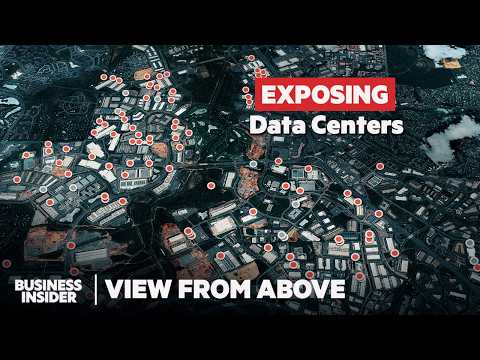 Photo: N43 and Hermes
The rapid expansion of AI data centers across America is consuming unprecedented amounts of electricity and water, raising urgent questions about environmental costs, community impact, and the sustainability of the AI revolution.
Source video: Exposing The Dark Side of America's AI Data Center Explosion | View From Above | Business Insider · Business Insider · approximately 7.9M views observed via YouTube search on 2026-08-10. Independently researched by N43 and Hermes.
01 The Invisible Factory
A data center is often described as a building for storing and transmitting information. That definition is accurate but incomplete in the age of generative AI. Behind a chatbot response sits a factory of servers, networking gear, batteries, cooling equipment, and backup generators. Training a model concentrates enormous computation in one place; serving millions of requests turns that concentrated load into a permanent industrial operation.
The public sees a digital service and pays with a subscription or a few seconds of attention. The host community sees a new substation, transmission corridors, construction traffic, and a facility that may occupy hundreds of acres while employing relatively few people after opening. That mismatch makes the physical footprint easy to miss in national debates about AI productivity.
US data center electricity use, 2014, 2018, and 2023 estimates; 2028 midpoint scenario. Source: DOE and Lawrence Berkeley National Laboratory, 2024.
02 A Load Unlike Any Other
Power demand is not merely growing; its shape is changing. A conventional office can shed lighting or heating for a few hours. An AI campus runs dense accelerators continuously, with sharp ramps as training jobs start and stop. The result is a large, geographically concentrated customer whose appetite can arrive faster than a utility can plan a substation, a gas plant, or a long-distance line.
Utilities therefore face a difficult timing problem. Forecasts are built around uncertain model demand, speculative tenants, and connection requests that may never mature. If they build too early, households can bear the cost of underused infrastructure. If they build too late, reliability margins tighten and new factories or homes may wait for capacity. AI makes this planning tension visible because a single project can represent a small city's load.
03 The Water Loop
Electricity is only half of the physical story. Servers turn nearly all the power they consume into heat, and that heat must be moved away. Many facilities use evaporative cooling, in which water carries heat out of the building. Water consumption varies with climate, cooling design, workload, and the carbon intensity of the grid, so a single national number can conceal meaningful local differences.
In a dry watershed, the relevant question is not whether a center is efficient in isolation. It is whether its withdrawals compete with farms, households, rivers, and future resilience. A facility can lower its direct water use by choosing air cooling or reclaimed water, but those choices may increase electricity demand or shift impacts to another part of the system.
National freshwater withdrawals by selected category in 2015. This context chart is not a data-center total. Source: USGS Circular 1441.
04 Communities Carry the Risk
Large projects promise tax revenue, construction work, and a place in the next technology cycle. Those benefits are real, but they are distributed unevenly. Permanent staffing is modest relative to the capital involved, while noise from cooling equipment and generators can be continuous. Residents may also face higher utility costs if grid upgrades are recovered through broad rate structures rather than project-specific contracts.
Local governments are being asked to decide quickly on zoning, tax abatements, water permits, and land conversion. A transparent process should disclose expected peak load, water source, backup fuel, noise, emissions, and the public cost of new wires. It should also ask who receives the jobs and who remains with the traffic, risk, and altered landscape after the ribbon cutting.
05 The Carbon Accounting Problem
AI does not have one environmental profile. The same computing task can look very different depending on whether it runs on a low-carbon grid at a cool hour or on fossil generation during a regional peak. Location, timing, hardware utilization, server lifetime, and model efficiency all matter. A claim that AI is either clean or dirty is therefore less informative than a full accounting of energy and materials.
Efficiency gains can create a rebound effect. If an accelerator becomes twice as productive per watt but demand for generated content grows fivefold, total consumption still rises. Better chips, smaller models, and workload scheduling are necessary, but they cannot substitute for limits on total demand or for honest reporting of indirect emissions from construction, equipment manufacturing, and backup power.
06 What Better Siting Looks Like
The most credible path is not a moratorium on computation. It is disciplined infrastructure planning. Developers can favor brownfields with existing grid capacity, use reclaimed or closed-loop water, publish hourly energy and water performance, and fund transmission or efficiency measures that would otherwise fall to ratepayers. Utilities can require firm commitments rather than treating every speculative request as inevitable.
Regulators should distinguish flexible workloads from latency-sensitive services. Some training and batch inference can move across regions or hours, helping absorb renewable generation and avoid peaks. That flexibility has value only when it is contractually real and measured. A label such as renewable-powered must say whether it means new clean generation, annual certificates, or actual hourly matching.
07 The Legacy of the Buildout
The AI infrastructure boom will leave a physical legacy long after a particular model becomes obsolete. Substations, fiber routes, roads, water contracts, and industrial buildings can support future uses, but stranded equipment and oversized utility investments can become a public burden. The durable test is whether communities retain useful assets without surrendering the ability to set environmental priorities.
AI is often marketed as weightless intelligence. Data centers reveal the opposite: intelligence at scale is a material system, tied to electrons, water, land, labor, and public decisions. If those inputs are priced and disclosed honestly, innovation can be matched with stewardship. If they remain hidden, the costs will not disappear; they will simply arrive later as higher bills, stressed watersheds, and promises that were never audited.
References
- Wikipedia, Data center summary.
- US Department of Energy and Lawrence Berkeley National Laboratory, 2024 United States Data Center Energy Usage Report.
- US Geological Survey, Estimated Use of Water in the United States in 2015.
- US Energy Information Administration, Electric power monthly and annual data.
- Business Insider, Exposing The Dark Side of America's AI Data Center Explosion | View From Above.
By N43 and Hermes for Sailor Bob News.


