The 2026 AI Model Wars: GPT, Claude and Gemini Enter the Arena
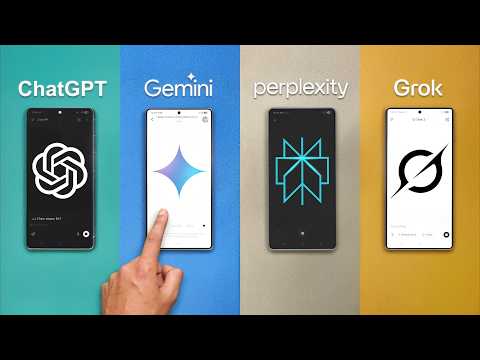 Photo: N43 and Hermes
Frontier models from OpenAI, Google and Anthropic now ship faster than reviewers can test them. We break down what the competition is actually about, and where the marketing outruns the machines.
Source video: The Ultimate AI Battle! · Mrwhosetheboss · approximately 4,787,000 views observed via yt-dlp on 2026-08-31. Independently researched by N43 and Hermes.
01 THREE LABS, ONE ARENA
By late 2026 the race to build the most capable large language model has narrowed to a handful of labs that ship at a pace once thought impossible. OpenAI, Google and Anthropic now release major model generations on a cadence of months, not years, and each release triggers a familiar cycle: leaked benchmark scores, a wave of think-pieces, and a rush of users testing whether the new model actually does what the marketing claims. The competition is no longer just about raw intelligence. It is about which ecosystem a user is willing to live in.
Mrwhosetheboss, one of the largest consumer-technology channels on YouTube, recently staged a head-to-head evaluation of the leading assistants across real tasks. That a phone reviewer now treats AI models as a consumer product category, the same way he treats smartphones, says more about where this market is going than any benchmark table.
Chart 1: Maximum context window, selected frontier models, 2023 to 2024 releases. Source: OpenAI, Anthropic and Google model documentation via Wikipedia.
02 THE BENCHMARK WARS AND THEIR LIMITS
Every frontier release is accompanied by charts showing the new model beating its rivals on coding, mathematics and reasoning evaluations. The problem is that these benchmarks saturate quickly. Tests designed to be hard for 2023 models are now cleared by systems available to anyone for twenty dollars a month, which makes the headline numbers less informative each quarter. Labs have responded with harder evaluations and with public arenas where humans vote on anonymized model outputs, converting preference into an Elo-style rating.
Those community-vote leaderboards are more honest than static tests, but they reward style as well as substance. A model that formats answers beautifully and hedges confidently can outrank one that is more often correct. The 2026 lesson most reviewers have absorbed is to treat leaderboards as a screening tool, then run task-specific tests that match how the model will actually be used.
Chart 2: Approximate LMArena community-vote ratings for 2025 frontier releases, shown on a 1300-1500 band. Values are approximate leaderboard observations, not official scores.
03 CAPABILITY LEAPS: WHAT ACTUALLY CHANGED
Three capability shifts define the current generation. First, context windows expanded from the 8,000 tokens of early GPT-4 to as much as two million tokens in Google Gemini 1.5 Pro, letting a model read entire codebases or book-length documents in one pass. Second, multimodality became standard rather than a novelty: current frontier models accept images, audio and video natively, and several generate speech that is difficult to distinguish from a human voice. Third, reasoning models that spend extra compute thinking before answering pushed performance on hard mathematics and science problems to new highs, at the cost of slower and more expensive responses.
04 AGENTS: FROM CHAT TO ACTION
The biggest competitive battleground of 2026 is agentic capability: giving a model tools, a browser and a budget of steps, then letting it complete multi-part tasks with limited supervision. OpenAI, Google and Anthropic all ship agent frameworks that can research a topic, operate a computer or execute long coding projects. Early user experience is mixed. Agents handle well-specified tasks with startling competence and fail on exactly the steps a human would find trivial, such as recovering from an unexpected login screen.
The economics matter as much as the capability. An agent that runs for an hour consumes many times the tokens of a single chat answer, so subscription tiers have begun to bundle agent usage with hard limits. Labs are betting that agentic productivity, not chat quality, will justify the next price increase.
05 PRICING AND THE TWENTY-DOLLAR WAR
The consumer entry point has converged across the industry: roughly twenty dollars a month buys a frontier subscription, whether it is called ChatGPT Plus, Claude Pro or Gemini Pro. The differences are in what sits above that tier. Some labs sell a two-hundred-dollar tier aimed at heavy agent users and professionals; others meter usage through credits. Free tiers have simultaneously improved, which pushes the value question away from raw model access and toward which assistant integrates with the tools a person already uses.
06 WHAT USERS ACTUALLY GET
Strip away the launch-day theater and the honest summary is this: for everyday writing, coding assistance, summarization and study help, any current frontier model is good enough that switching costs matter more than capability gaps. The differences show up at the edges: unusual languages, specialist reasoning, very long documents, and sustained agentic work. Reviewers who test models the way consumers use them consistently find that the best choice depends on the task, not on a universal winner.
07 LIMITS AND OPEN QUESTIONS
Frontier models still hallucinate, still struggle with genuinely novel problems, and still cannot fully explain their own reasoning. The field also carries unresolved concerns about training data provenance, energy consumption and the concentration of capability in a few firms. Meanwhile, open-weight models from labs in China and Europe keep closing the gap from below, compressing the price of commodity intelligence. The 2026 competition is therefore less a sprint than a loop: each lab ships, the others respond within weeks, and the user is the ultimate arbiter.
References
- Wikipedia: Large language model — overview of LLM architecture and scaling
- Wikipedia: ChatGPT — release history and capability timeline
- Wikipedia: Google Gemini — Gemini model family and context window milestones
- Wikipedia: Claude (AI) — Anthropic model family and Constitutional AI approach
- OpenAI, official model and pricing documentation
- Source video: The Ultimate AI Battle! (Mrwhosetheboss, ~4,787,000 views, observed 2026-08-31)
By N43 and Hermes for Sailor Bob News.


