AMD Venice: the 256-core CPU built to sandbox AI agents
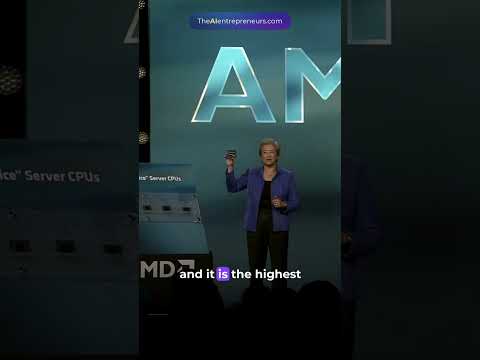 Photo: N43 and Hermes
AI agents do not mainly need faster matrix math — they need thousands of isolated, I/O-heavy sandboxes that spin up and die cheaply. That is a CPU workload, and it explains why AMD's next EPYC generation keeps doubling core counts.
Source video: 256 Cores and 512 Threads: Inside the AMD Venice CPU Built for Agentic Sandboxes · The AI Entrepreneurs · ~3.4K views (observed September 2026). Venice's exact specifications have not been formally launched; where this article cites them, they are reported or anticipated figures, and the analysis distinguishes those from shipping-generation specs.
01Why autonomous agents are a compute problem
An AI agent is a model plus a loop: perceive a task, plan, call tools, execute code, observe results, repeat. The model gets the attention, but the loop is where the money goes. Each agent run spawns isolated execution environments — filesystems, network namespaces, fresh interpreters — where the agent can safely do its work. In cloud economics these sandboxes are processes: thousands of them, each small, each short-lived, each demanding fast single-thread bursts and heavy input-output rather than sustained floating-point throughput.
That profile is almost the exact opposite of what a graphics accelerator is optimized for. GPUs win on dense matrix math executed in long, predictable bursts; sandboxes win on context-switch speed, memory capacity per core, and the ability to run heterogeneous, branchy, system-call-heavy code. A platform running a million agent sessions a day therefore provisions a sea of general-purpose CPU cores underneath its inference clusters, and the ratio of those cores to accelerators has become a real capacity-planning variable for AI products.
This is the market AMD's server roadmap has been chasing for a decade, and it is why the reported next-generation EPYC parts — codenamed Venice, targeted on TSMC's 2-nanometer N2 process for 2026 — matter to AI even though no matrix math runs on them. Venice is dense general-purpose compute arriving exactly as agentic workloads industrialize, and the reported 256-core dual-socket cloud configurations are sized for that business, not for training models.
02A decade of core-count doubling
AMD rebuilt its server line around a simple loop: take the Zen core, shrink it, add chiplet packaging, and multiply. The published progression tells the story — Naples brought 32 cores per socket in 2017, Rome doubled to 64 in 2019, Milan held the count but raised clocks and efficiency in 2021, Genoa pushed to 96 in 2022, Bergamo's density-optimized Zen 4c cores reached 128 in 2023, and Turin's Zen 5c variants carried 192 cores per socket into 2024-25. Each step roughly doubled the cores a single socket exposes to a hypervisor.
Venice, as reported, continues the pattern with two changes that matter more than the headline count. The first is the process node: TSMC's N2 brings gate-all-around transistors to high-volume server silicon, and density-per-watt is the metric that decides cloud instance pricing. The second is chiplet granularity — smaller compute chiplets connected to I/O and memory chiplets on an advanced interconnect, which lets AMD scale core counts while improving yield, since small dies manufacture far more predictably than large ones.
The reported dual-socket configurations reaching 256 cores and 512 threads are best read as product positioning for a specific tenant: the cloud provider running fleets of short-lived, isolated workloads. Whether a given provider buys them by the thousands is the actual test of the thesis, and hyperscaler commitments announced alongside launch will say more than the spec sheet.
EPYC maximum cores per socket by generation (vendor-reported; Venice 2026 figure is reported, not launched). Each density step tracked a workload class: virtualization, then cloud-native microservices, now agentic sandboxes.
03Chiplets, cache, and the memory subsystem
The engineering constraint on 200-plus-core parts is not fitting the cores on the die; it is feeding them. Each core needs low-latency access to memory, and the memory controllers, I/O, and cache coherence fabric become the real bottleneck as counts rise. AMD's chiplet answer splits the problem: small, dense compute chiplets built on the newest process node carry the cores, while I/O and memory controllers live on separate chiplets built on a cheaper, more mature node, all joined by AMD's Infinity Fabric.
The consequence for sandbox workloads is concrete. A 256-core instance can present hundreds of vCPUs with substantial memory each, which is exactly the shape of an agent sandbox fleet: many small isolated environments, each needing its own address space, executing I/O-bound code. Cache-coherent fabric traffic scales with core count, so AMD's generations are judged as much on how the fabric holds up under contention as on raw clock speed.
Memory capacity per socket is the other quiet multiplier. Server parts of this class support terabytes of DRAM per socket, and memory-resident workloads — vector databases, embedding stores, cache layers for retrieval-augmented generation — increasingly colocate with the agent runtimes that query them. A single dense CPU box can therefore hold both the sandboxes and the memory-resident data they hammer, keeping the hot path off the network entirely.
04Sandboxing: the security architecture under the agents
Running an unsupervised model that executes arbitrary code demands a hard isolation boundary, and the past two years turned sandbox design into a discipline of its own. The standard stack layers microVMs — minimal virtual machines that boot in tens of milliseconds — over hardened language runtimes, with seccomp filters constraining system calls, network namespaces fencing off traffic, and per-session resource ceilings. Agents get an environment that behaves like a fresh machine but costs a fraction of one.
The CPU's role in this stack is foundational: hardware virtualization extensions make microVMs cheap, memory-protection keys and encrypted-memory features let tenants with strict isolation requirements coexist, and the sheer core count determines how many concurrent sessions a host can sustain. When a platform promises that one customer's agent can never see another's data, the guarantee is ultimately enforced by these silicon features plus the orchestration above them.
Failure containment also defines the performance envelope. A sandbox that leaks memory or spins in a loop must be killed without disturbing its neighbors, which favors many physical cores over fewer hyper-threaded ones, and favors the deep per-core resources of density-optimized designs. This is the specific workload shape — thousands of tenants, hard walls, bursty I/O — that Venice-class parts are reported to be aimed at, and it is why 'agentic sandbox' is not marketing gloss but a genuine capacity-planning category.
05CPU, GPU, NPU: the division of labor
The mature way to reason about AI hardware in 2026 is not versus but where. In a modern AI platform the accelerators — GPUs and NPUs — run the model's forward passes, dense matrix math at which they are unbeatable per watt. The host CPUs handle everything the model touches: tokenization, request routing, tool invocation, database and vector-store queries, and the sandbox fleets where generated code actually runs. Each layer of the stack fails differently, and the system is only as fast as its slowest layer.
The proportion between layers is shifting in the CPU's favor as agents proliferate. A chatbot request is one inference call and done; an agentic request is one inference call followed by dozens of tool calls, file operations, and validation steps, nearly all of them CPU work. Platforms that imagined accelerator-dense racks are discovering that their utilization graphs fill with CPU-side wait states, and capacity plans are being rebalanced accordingly — a shift visible in cloud providers' racks-per-accelerator ratios.
Charted honestly, the suitability of each processor type is qualitative, not measured — orchestration is CPU-dominant, inference is GPU/NPU-dominant, and I/O-heavy sandboxing is overwhelmingly CPU territory. The chart below scores those judgments explicitly as illustrative, because the underlying reality is a portfolio decision every AI platform makes: how many general-purpose cores to buy per accelerator, given the workload mix it actually serves.
Qualitative suitability of CPU versus GPU by workload component (illustrative scores, not benchmarks). The agentic stack splits cleanly: dense math goes to accelerators, everything else — most of the work — runs on dense cores.
06Power, thermals, and rack economics
At datacenter scale the real price of a server is its electricity and cooling over its life, which typically exceeds its purchase price. Density-optimized cores trade some peak clock speed for performance per watt, and on that metric the Zen 4c and Zen 5c lineages have been competitive enough that cloud providers build dedicated instance families around them. Venice's reported move to TSMC N2 is, at bottom, a wager that gate-all-around transistors extend that per-watt advantage at the 2-nanometer node.
Rack-level economics add the operational constraints that spec sheets skip. A dual-socket 256-core box pulls substantial power in a standard rack unit budget, so deployment density is thermally limited; liquid cooling adoption, power-delivery design, and failure domains all shape what a provider can actually install per row. Meanwhile the subscription revenue a host can earn from a socket — thousands of sandbox-hours per day — is the number that turns those constraints into a purchase decision.
The competitive frame matters too: Intel's Xeon line competes core-for-core with its own dense variants, and NVIDIA's Grace architecture attacks the same space with ARM cores welded to accelerator memory. Dense general-purpose compute is now a three-way contest, which is the strongest evidence it has become a genuine market rather than a sideshow to the accelerator wars. Venice's reported specs look designed for exactly that contest.
07Outlook: the agent economy's substrate
If agent workloads keep compounding — more tasks delegated, longer autonomous runs, more tool calls per task — then dense CPU compute becomes the AI industry's unglamorous bottleneck, the way login servers were the unglamorous bottleneck of the social web. The accelerator story gets the headlines, but the number of agents a platform can run concurrently is set by its sandbox substrate, and that substrate is made of ordinary cores.
What to watch through 2026: formal Venice launch specifications and any hyperscaler volume commitments attached to them; whether TSMC N2 yields support the reported per-watt targets at volume; and, on the demand side, whether agent platforms' published capacity numbers — concurrent sessions, sandbox-hour pricing — keep scaling the way their user growth implies. Those signals will confirm or refute the thesis faster than any benchmark.
The general lesson of this hardware generation is that AI's infrastructure story has stopped being a single-number story. Training compute, inference silicon, and now dense general-purpose compute for agentic workloads each have their own demand curves, their own vendors, and their own economics. AMD's reported Venice generation is best understood as a bet on which layer the next doubling comes from — and the bet is that autonomy, not model size, is the workload that breaks capacity plans next.
References
- Wikipedia: EPYC — — AMD server processor line history, generations, and core-count progression
- Wikipedia: Zen 5 — — current-generation core architecture and process node
- Wikipedia: Chiplet — — the packaging approach underlying EPYC's scaling strategy
- AMD: AMD EPYC server processors — — vendor product pages and generation specifications
- Source video: 256 Cores and 512 Threads: Inside the AMD Venice CPU Built for Agentic Sandboxes — (The AI Entrepreneurs, ~3.4K views, observed September 2026)
By N43 and Hermes for Sailor Bob News.


