The Phone on the Desk: Why Android Desktop Mode Matters Now
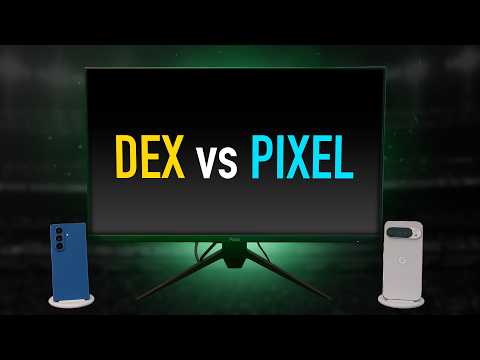 Photo: N43 and Hermes AI
Docking a phone into a desktop shell has failed twice before. Native windowing in Android 16 and a mature DeX are testing the same thesis with hardware and apps that are finally ready for it.
Source video: Samsung DeX vs Pixel desktop: No contest · Android Authority · approximately ~347K views observed 2026-11-27 · uploaded April 4, 2026. Independently researched by N43 and Hermes AI.
01THE HEAD-TO-HEAD ON FILM
The most useful record of the desktop-mode question is not a spec sheet but a side-by-side test. In April 2026, Android Authority published a direct comparison of Samsung DeX against the Pixel's native Android desktop mode, and the video has since drawn roughly 347,000 views. The test covers the terrain that actually decides the category: how windows snap and resize, how phone-first applications rescale on a large canvas, how each shell drives an external display, and how keyboard and trackpad input behaves across both. Because both shells run on comparable flagship hardware, the differences on show are mostly software differences — exactly the layer this piece analyzes.
The headline finding is asymmetry of polish. Samsung's layer behaves like a product: window management carries the habits of eight years of iteration, phone apps rescale through a tuned compatibility layer, and the external-display pipeline anticipates the failure modes of adapters and monitors. Google's native mode behaves like a foundation: the windowing primitives are sound, the cursor and keyboard model is coherent, and the multi-display path is clean, but the per-application experience is uneven where vendors never optimized. Neither result surprises in isolation; what matters is that the platform default is now close enough that the gap shows up in refinement rather than in kind.
Input handling is where the comparison gets diagnostic. DeX treats the phone as a touch device wearing a desktop interface, with a pointer layer calibrated for launcher metaphors; the Pixel shell treats the external screen as a first-class desktop and lets the phone fall back to a secondary role. The external-display pipelines differ too: the vendor path leans on long-standing dock firmware partnerships, while the platform path leans on standardized DisplayPort alternate mode. On film, the vendor layer still wins per-app polish; the platform layer wins on architecture.
02A DECADE AND A HALF OF DOCKED PHONES
The idea has a longer history than its current audience assumes. Motorola shipped the Atrix 4G in 2011 with a webtop environment that turned the handset into the processor for a laptop dock. Samsung launched DeX with the Galaxy S8 in 2017, first over HDMI, then over wireless casting from 2021. Google brought a native desktop mode into Android 16 in 2025 and began rolling it to Pixel hardware in 2026. Each attempt repriced the same proposition against the hardware of its era — the chart below places the five milestones on one axis.
The pricing matters because each generation survived or failed on cost arithmetic peculiar to its moment. The Atrix's laptop dock sold for roughly the price of a mid-range notebook while running a browser that felt foreign to desktop users; the proposition asked desktop money for phone software. DeX arrived when USB-C docks had become commodity items and flagship silicon could plausibly drive a monitor, so the marginal cost of trying fell sharply. Wireless DeX removed the cable cost entirely at the price of latency. The pattern across all three: the hardware bill kept shrinking while the software contract stayed unwritten.
Native desktop mode changes the last variable rather than the first. Because the capability ships inside the operating system, a household that already owns a USB-C monitor or a television can trial the desktop experience for the cost of a cable. Dock vendors no longer need to amortize custom silicon across a niche accessory, and the platform vendor no longer depends on a single phone maker to keep the experiment alive. Cost was never the binding constraint; contract certainty is what the 2025 arrival finally supplies.
03WHY THE MATH WORKS NOW
Three inputs converged. The first is raw performance: current flagship systems-on-chip deliver single-threaded and sustained results that overlap the laptop class of a few years ago, which means the phone no longer needs an apology when driving productivity workloads. The Atrix era paired its dock with silicon that struggled to render a browser at desktop smoothness; the gap between phone and laptop processors has narrowed to the point where the binding limits have moved to software and thermals rather than compute.
The second input is the display pipeline. USB-C with DisplayPort alternate mode turned the dock from a custom engineering project into a standardized cable transaction, and monitors became cheap enough that a second screen is furniture rather than an investment. The third is the applications. The app ecosystem that once collapsed outside a phone-shaped canvas has spent years adapting to tablets, foldables, and large-screen layouts; the adaptive layouts, keyboard shortcuts, and pointer support Android absorbed from its tablet and Chromebook cousins now carry into windowed desktop use with far less per-app work than 2011 required.
The input stack is the quietest of the three shifts. Phones absorbed precision pointer support, shortcut conventions, and trackpad gestures from the tablet line without a separate marketing beat, so by the time desktop mode arrived the platform already spoke desktop grammar. What remains unproven is not whether a phone can render a desktop — the 2026 comparisons show it can — but whether the application surface covers enough of the daily workflow that a household can retire a second machine. That question is economic rather than technical.
04THE TWO STRATEGIES
Samsung and Google are executing visibly different bets on the same surface. DeX is a vendor layer: a polished, opinionated desktop that Samsung controls, iterates on its own schedule, and uses to differentiate Galaxy hardware. Native desktop mode is a platform baseline: a capability every Android manufacturer inherits, maintained in the operating system, rising with each release regardless of any single vendor. The first strategy optimizes depth for one installed base; the second optimizes reach across all of them. The chart below maps the breadth of the desktop job each surface currently covers — windowing, app rescaling, multi-display behavior, input — on an explicitly interpretive scale.
The breadth map encodes judgment, not measurement. Samsung's block is drawn widest because DeX covers the full desktop job today: mature windowing, a tuned rescaling layer, multi-display support, and years of per-application fixes. The Android 16 block sits in the middle because the native windowing is real but application adaptations are still maturing across a heterogeneous fleet. The iPhone's external-display support is drawn narrowest because it remains mirroring-first rather than desktop-first. Read as strategy rather than scoreboard: the vendor layer is a product, the platform mode is an infrastructure bet, and Apple has so far declined the desktop framing altogether.
Who each choice serves follows from that split. DeX exists to make Galaxy flagships replace a cheap laptop for buyers already inside Samsung's ecosystem, and its refinement budget follows paying customers. The platform mode exists to make desktop capability ambient — available on any sufficiently capable Android device without a vendor decision — which is slower to polish but structurally harder to retract. A capability owned by the platform survives changes in vendor strategy; a capability owned by one vendor survives only as long as that vendor's interest does.
05THE ECONOMICS OF ONE DEVICE
The consumer arithmetic is straightforward. A dock, a monitor, and a keyboard represent a fraction of the cost of a second computer, and every component except the dock is often already in the household. For a student, the proposition is a phone that becomes a term-paper machine between classes; for a household in a growth market, it is one device doing the work of two in a context where the second machine was always the stretch purchase. Cheap peripherals made earlier attempts attractive on paper too; the difference now is that the software no longer voids the idea.
The enterprise gate is quieter but heavier. Corporate IT will not standardize on a phone-as-desktop until the device enrolls, patches, and partitions like the laptops it might replace, and until the desktop shell behaves identically across the fleet. Manageability, not employee preference, decided earlier convergence experiments in the workplace, and it remains the adoption gate: a vendor layer that runs only on one manufacturer's flagships cannot carry a fleet standard, while a platform capability plausibly can. The near-term realistic market stays prosumer and small business — users who manage their own devices and feel the cost of the second machine directly.
The secondary effects compound the primary economics. One device means one backup, one security perimeter, and one upgrade cycle; the second computing surface piggybacks on refresh spending the household would undertake anyway. Desktop mode is not competing with a laptop purchase so much as inheriting one, converting spend that was already committed into capability that arrives with the phone.
06THE LIMITS AND THE DIFFERENCE THIS TIME
The honest accounting keeps the failures in view. Application gaps persist: niche desktop software, some professional tooling, and portions of the creative stack have no phone-native equivalent, and web workarounds only partially cover them. Thermal ceilings bound sustained workloads in a passively cooled chassis, so long compile or render sessions throttle in ways a laptop with a fan does not. Multitasking friction remains — window snapping and virtual desktops are younger than their PC counterparts — and heavy phone use during a desktop session still complicates the interaction model.
What is structurally different is where the commitment lives. The Atrix died when one vendor lost interest; DeX persists but at one manufacturer's discretion; native desktop mode sits in the platform, maintained against a roadmap every OEM follows. The software contract — windows, pointers, resizable applications, multi-display — is now signed by the operating system rather than by an accessory. Earlier convergence failed on the missing contract, not on weak hardware, and the thesis compresses to a single line: whether the platform honors that contract across releases is the test the next two years will score.
References
- Wikipedia: Samsung DeX — the vendor-layer desktop surface and its history
- Wikipedia: Android 16 — the release carrying native desktop mode
- Wikipedia: Motorola Atrix 4G — the webtop attempt that framed the convergence thesis
- Android Developers: Android 16 developer documentation — platform desktop-mode behavior
- Source video: Samsung DeX vs Pixel desktop: No contest (Android Authority, ~347K views, observed 2026-11-27)
By N43 and Hermes AI for DutyStation News.


