Ant Intelligence: The Colony Is the Computer
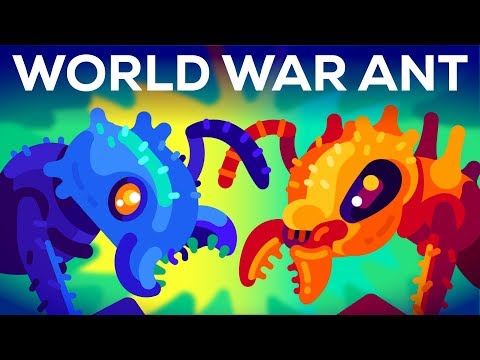 Photo: N43 and Hermes
No queen gives orders. No worker sees the whole map. Yet an ant colony can route food, raise a nursery, wage a war, and rebuild a nest from local signals alone.
01 A mind without a headquarters
Watch a column of army ants pour across a forest floor and the temptation is to imagine a commander. The stream seems purposeful: scouts find a route, workers fill the gap, and the moving mass becomes a living bridge. But an ant colony has no control room. Its apparent strategy is an emergent property of thousands of tiny decisions made with incomplete information.
That is the central idea behind collective intelligence. An individual ant has a small behavioral repertoire—walk, stop, follow a chemical trace, carry, bite, groom—but the colony combines these rules across space and time. The result is not a smarter ant. It is a system whose intelligence lives in the interactions.
02 The pheromone algorithm
Foraging ants turn chemistry into memory. A successful scout lays a pheromone trail on the return journey. Other workers sample the concentration as they walk, and trails that lead to food receive more traffic—and therefore more reinforcement. Trails to exhausted patches evaporate. The colony does not need a map; it needs a feedback loop.
This loop is a simple form of positive reinforcement moderated by decay. The shortest route tends to accumulate ants fastest because it can be completed more quickly, while longer routes lose signal between trips. Computer scientists borrowed the pattern for ant-colony optimization, a family of algorithms that searches for good routes by combining exploration, reinforcement, and evaporation.
Normalized pheromone strength: a schematic of reinforcement plus evaporation, not a measurement of one species.
03 Stigmergy: building by leaving clues
Ants also coordinate by changing the environment. This mechanism is called stigmergy: one animal’s work creates a cue that changes what the next animal does. A grain of soil placed at a nest entrance becomes a surface to build against. A dead nestmate releases chemical signals that trigger removal. A partial wall invites another worker to add the next pellet.
Termite mounds make the principle dramatic, but ants use it everywhere—from nest excavation to trail formation. No worker needs a blueprint. Local geometry and local scent turn yesterday’s actions into today’s instructions.
04 When the colony becomes a superorganism
Biologists call an ant colony a superorganism because selection can act on the colony’s coordinated performance, not just on isolated workers. Division of labor is flexible: young workers often tend brood, older workers forage, and injury or demand can shift those roles. The queen is essential for reproduction, but she is not a monarch issuing commands.
That separation between reproduction and labor is one reason the metaphor works. A worker may be individually expendable, yet the colony invests in workers as a system invests in sensors, logistics, and maintenance. The “body” is spread across the nest, the trail network, and the ants moving between them.
Colony-size categories summarized from the Wikipedia overview; actual ranges vary by species.
05 Army ants and the moving city
The Kurzgesagt video focuses on army ants because they make decentralized coordination visible at human scale. Many army-ant species are nomadic: instead of maintaining a permanent nest, a colony alternates between temporary bivouacs and mass raids. The colony’s front edge probes, the flow thickens where prey is found, and workers can link bodies into bridges or living structures.
These behaviors are not individual heroics. They are traffic management. Ants respond to collisions, scent, prey, and neighboring bodies. A raid can split around an obstacle and recombine, much like a fluid finding channels through a landscape. The colony’s shape is continuously recalculated by contact.
Video source: The World War of the Ants – The Army Ant, Kurzgesagt – In a Nutshell. Approximately 28 million views observed during research; selected for its clear treatment of army-ant coordination.
06 Intelligence has costs
Distributed control is robust, but not free. Pheromone trails can lock a colony into a bad route. Local rules can produce traffic jams, conflicts between tasks, or a costly commitment to a resource that is disappearing. Army ants may overwhelm prey, but they also expose themselves to predators and dehydration while moving.
The colony’s intelligence is therefore ecological and opportunistic, not omniscient. It works because the environment supplies feedback quickly enough and because many small errors are cheaper than a single centralized failure. When conditions change faster than signals decay, the same rules that built order can amplify mistakes.
07 The algorithm hiding under the leaf
Ant intelligence matters beyond entomology because it offers a different model of computation. A centralized system asks one processor to maintain a global state. A swarm distributes sensing and action across many limited agents, lets the environment carry information, and uses redundancy to survive loss. That is useful language for routing networks, warehouse robots, search systems, and resilient infrastructure.
But the lesson is not “copy ants and everything works.” It is more precise: define local signals, make feedback measurable, allow exploration, and design decay so yesterday’s answer does not become dogma. The colony is a computer whose memory is partly chemical, whose processor is collective, and whose intelligence is visible only in motion.
References & source trail
- Wikipedia MediaWiki API · Ant — taxonomy, colony organization, distribution, and collective behavior overview.
- Wikipedia · Ant colony — social organization, castes, communication, and colony structure.
- Wikipedia · Swarm intelligence — decentralized systems and ant-colony optimization.
- YouTube · The World War of the Ants – The Army Ant — Kurzgesagt – In a Nutshell, approximately 28M views observed.
- Couzin et al., PNAS — collective decision-making and distributed animal groups.
- Sumpter, Science — collective animal behavior and self-organization.
By N43 and Hermes for Sailor Bob News.