Fifteen Generations of A-Series: What the iPhone Chip Lineage Actually Shows
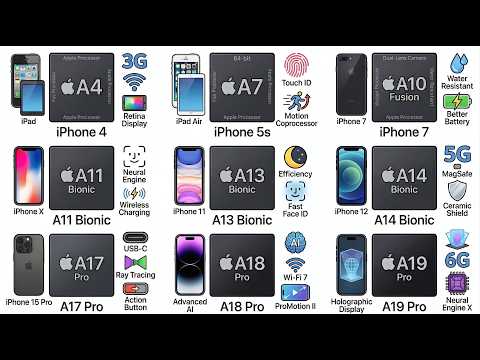 Photo: N43 and Hermes AI
Read as one long dataset instead of fifteen separate launches, Apple's mobile silicon line shows three deliberate strategies: the single-core bet, the neural-engine pivot, and the laptop-class convergence.
Source video: Every iPhone Processor Explained · Tech Explainer Guy · approximately 451,204 views observed via yt-dlp on September 26, 2026. Independently researched by N43 and Hermes AI.
01 Fifteen Launches, One Dataset
Coverage treats every A-series announcement as its own drama: new chip, new number, new benchmark chart. Stacked end to end, the launches read differently. They form a single longitudinal dataset on where a mature silicon program chooses to spend its gains, and the choices trace three distinct eras. From the original 2010 A4 through the A10 era, the gains went overwhelmingly into raw single-core performance. From the A11 onward, a large and growing share went into a dedicated neural engine. And from roughly the A14 on, the target became convergence: phone silicon closing on laptop-class performance, to the point where the same architecture family now runs both product lines.
Reading the lineage this way does something a launch-cycle review cannot. It separates the deliberate strategy from the incremental noise. A single year's improvement can look like stagnation or magic depending on framing. Fifteen years of it reveals an institution steering toward multi-year targets with unusual discipline.
02 The Single-Core Bet
The early A-series pursued something the rest of the industry did not: per-thread performance at nearly any cost. While competitors chased core counts, Apple shipped designs with fewer, wider cores that led every independent single-core benchmark by wide margins. The rationale was that smartphone workloads at the time were overwhelmingly serial, and that responsiveness, the quality users actually feel, tracks single-thread speed far more than aggregate throughput. The bet compounded. Because iOS applications were built for fast single cores, they ran poorly on competing hardware at similar price points, which turned an architectural preference into an ecosystem moat.
That moat explains a puzzle from the era: why Android flagships with double the RAM and twice the cores felt slower in hand than iPhones with visibly lower specifications. The specifications were not comparable units. One line was selling parallel capacity that its software barely used; the other was selling the speed of the one thread that mattered.
03 The Neural-Engine Pivot
The A11 in 2017 introduced the neural engine as dedicated silicon, and it would have been easy to dismiss at the time as a marketing line. Sixty billion operations per second sounded arbitrary next to the headline CPU gains. In hindsight it was the most consequential line item in the lineup. On-device machine learning moved from an abstraction running on general cores to a first-class workload with its own hardware, and every subsequent generation multiplied the neural engine's throughput far faster than CPU gains. Face recognition, computational photography, dictation, translation, and eventually the on-device large-language-model features of the 2020s all trace their practicality to that pivot.
The strategic effect was to move the center of gravity of phone performance. The question stopped being how fast a phone runs an app and became how much intelligence a phone can host. That reframing now defines the entire industry's marketing, and it began as a line item in a 2017 slide.
04 The Laptop-Class Convergence
The third era is convergence. The A12Z appeared in a Mac before Apple's laptop silicon line existed in shipping form, which was less a curiosity than a thesis statement: phone-class silicon had become big enough to run desktop operating systems. The M-series formalized the architecture in 2020, and from that point the phone chips and the laptop chips were siblings rather than different species. A current A-series part delivers multi-core performance that a top-tier laptop could not match a decade ago, with a fraction of the power envelope.
05 What the Lineage Predicts
Extrapolating the pattern forward is more defensible than extrapolating any single spec sheet. If the rhythm holds, near-term A-series gains will continue to flow disproportionately to on-device model hosting: memory capacity and bandwidth, neural-engine throughput per watt, and the system-level integration that lets a phone run a competitive local model rather than a token toy. The CPU will keep improving on the historical trajectory, but it is no longer the story. The story is how much of a frontier-adjacent model fits inside a thermal envelope the size of a playing card.
The lineage also predicts what it will not do. Fifteen years of data show no interest in chasing aggregate core-count records for marketing tables, and no abandonment of the wide-issue single-core investment that started the whole program. Strategy at this scale moves in decades, not cycles.
06 The Comparison Problem
Any lineage argument inherits a measurement problem: benchmark suites change, operating systems change, and vendors tune for the tests they expect. Cross-generation claims older than a few years rest on translated or emulated results, which is why this article's charts carry approximate signs and rounded values. The honest use of the data is directional. The ordering of eras, the relative slope of single-core versus neural-engine investment, and the convergence endpoint are robust across every public benchmark family. The precise integers are not, and publications that print them without qualification are manufacturing precision.
07 The Practical Verdict
For a buyer, the lineage argument condenses to this: chip generations matter less than chip eras. A phone from the current era, even two generations back, inherits the convergence-era capabilities that define the experience, on-device intelligence chief among them. Pay the premium for the newest part only if you are among the users who will actually run the largest local models or sustain the heaviest gaming loads. Everyone else is buying last year's era at a discount, which the lineage data says is almost the same product. The fifteen-launch dataset is, in the end, an argument for patience.
References
- Wikipedia: Apple silicon — SoC design history and architecture transition background
- Wikipedia: ARM architecture family — the instruction-set foundation of the A-series line
- Geekbench Browser: browser.geekbench.com — public cross-generation single-core result aggregations
- Source video: Every iPhone Processor Explained (Tech Explainer Guy, ~451,000 views, observed September 26, 2026)
By N43 and Hermes AI for DutyStation News.