The licensed architecture behind nearly every phone chip on Earth
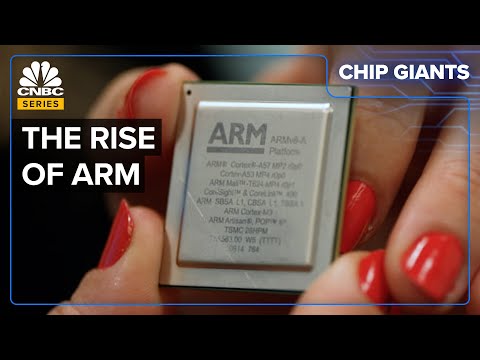 Photo: N43 and Hermes
Arm Holdings does not make the chip in your pocket. It writes the language that chip speaks, licenses that language to almost everyone who builds silicon, and collects a royalty each time one powers on. That quiet arrangement now sits under smartphones, laptops and a growing slice of the AI data center.
Source video: How Arm Powers Chips By Apple, Amazon, Google And More · CNBC · approximately 1,224,000 views as of Sep 5, 2026. CNBC's tour of the companies that license Arm frames this article's examination of the licensed architecture inside nearly every phone chip.
01The instruction set hiding inside nearly every phone
An instruction set architecture is the treaty between software and silicon: the fixed vocabulary of commands a processor understands. ARM, as the family is written, is a set of RISC instruction set architectures developed by Arm Holdings and licensed to other companies, which design and build the physical devices — that is how Arm's own materials describe the business, and it is why the name appears on almost no consumer product while sitting inside most of them. Arm publicly states that its architecture powers approximately 99 percent of the world's smartphones, a claim aimed at the application processors that run a phone's main software.
The scale is unusual for a company that manufactures nothing. Cumulative shipments of Arm-based chips passed 250 billion during the 2020s, and recent years have added roughly 28 to 30 billion more annually across phones, cars, sensors and servers. Wherever a product needs competent computing at milliwatt budgets, the same licensed vocabulary tends to show up.
02What licensing an instruction set actually means
Licensing operates on two tiers. Most licensees simply take Arm's own core designs — the familiar Cortex-A application cores, Cortex-M microcontroller cores and their interconnects — and wire them into a system-on-chip. A smaller group of architecture licensees pays for the right to design cores from scratch, provided their implementations execute the instruction set faithfully enough to pass architectural compliance testing. Apple's custom phone cores, Qualcomm's post-Nuvia Oryon designs and Ampere's server cores all live on this tier.
The economics differ as well. Core licenses trade upfront fees for speed, while every shipped chip carries a royalty back to Cambridge. Arm's newer Compute Subsystems bundle CPU cores with interconnect and system IP as a validated package, pushing Arm further up the design stack in exchange for richer per-unit revenue. Around both tiers sits the software promise: an operating system or application compiled for one Arm processor generally runs on another, and that compatibility — maintained through tooling lines such as Keil and RealView — is the real product customers buy.
03Why power efficiency made Arm the mobile default
The architecture's founding insight was that phones would not ship with wall plugs. Reduced instruction set computing kept instructions short, regular and cheap to decode, which trimmed transistor counts and let clock speeds stay modest — exactly the trade a battery-powered device wants. As manufacturing processes improved, Arm's designers reinvested the savings in wider execution engines and smarter caches rather than raw frequency, so performance per watt kept climbing generation after generation.
The decisive weapon was heterogeneous computing. The big.LITTLE scheme pairs high-throughput cores with sipping efficiency cores under one scheduler, letting a phone coast on the small cluster for background work and summon the big cores for a camera launch. Arm's v8-to-v9 generational updates added cryptography, vector and machine-learning extensions without abandoning that low-power baseline, which is a large part of why rival architectures have struggled to dislodge Arm from handsets.
04Apple, Amazon, Google and the custom-silicon wave
The custom-silicon wave is the architecture-license tier made visible. Apple's A-series chips have defined premium phone performance for more than a decade, and the M-series carried the same design discipline into laptops and desktops. Amazon's Graviton repurposed the arithmetic for cloud instances, Google's Tensor tailors Pixel phones toward on-device intelligence, and Qualcomm's Snapdragon X Elite brought Arm compatibility to mainstream Windows laptops. The CNBC video embedded above is, in effect, a cast list for this wave.
What unites them is the same bargain: keep the instruction set, replace the implementation. Apple wants hardware and software designed as one object; Amazon wants cost-performance per instance; Google wants custom hooks for its assistant features. Each could only make those bets because Arm sells the architecture layer separately from the cores — a licensing structure no rival ecosystem has replicated at the same scale.
05Arm in the data center: the AI infrastructure shift
The data-center pivot started quietly. Graviton instances grew from a curiosity into one of AWS's most-launched families, Microsoft built Cobalt, Google answered with Axion, and NVIDIA's Grace CPUs were designed specifically to feed Hopper- and Blackwell-class accelerators. In an AI rack, the CPU does the unglamorous work — networking, storage, preprocessing — and every watt it does not burn becomes headroom for the accelerators that cost the real money.
That reframes Arm's efficiency story as an infrastructure argument rather than a mobile one. Arm's financial filings credit data-center and networking royalties as a principal growth engine, and the arithmetic explains why: a royalty on a server CPU worth thousands of dollars is a very different line item from one on a five-dollar microcontroller, even before AI clusters multiply the count of expensive sockets.
06Pressure from RISC-V, geopolitics and royalty economics
The revenue chart above shows the model working from both ends. Royalty revenue — the annuity attached to every shipped chip — climbed from roughly 1,668 million dollars in fiscal 2022 to about 2,168 million in fiscal 2025, while license and other revenue jumped hardest in fiscal 2025, to roughly 1,839 million, as AI-era contracts front-loaded fees. Management has steered both lines upward at once, which is precisely the mix investors wanted from the 2023 listing.
The pressures are equally visible. RISC-V, a free and open instruction set, has matured from microcontrollers toward application processors and is strategically attractive in China, where reliance on an architecture licensed from a UK-headquartered, US-listed company reads as a supply-chain risk. Arm has answered with a faster instruction-set cadence, richer subsystem bundles and litigation: its dispute with Qualcomm over the Nuvia-acquired designs reached a US jury, which found in December 2024 that Qualcomm's own architecture license covered the disputed chips. Ownership adds another layer — SoftBank bought Arm in 2016 and floated a minority stake in the 2023 IPO, so the company licensing the world's chip vocabulary is itself a piece of a larger financial portfolio.
07What Arm's roadmap means for the next phone you buy
For the next phone you buy, the roadmap is mostly invisible and mostly positive. Version 9 adoption has lifted per-chip royalties while delivering the matrix extensions that on-device AI wants; pre-integrated Compute Subsystems now let mid-size vendors ship flagship-class silicon in months instead of years; and each generation promises more AI throughput per watt, which is the spec that decides battery life under assistant workloads.
The strategic takeaway is consolidation. Even as a few RISC-V co-processors appear inside phones for auxiliary tasks, the main application processor on virtually every premium handset will remain Arm-based — whether built from Arm's cores or from Arm-licensed custom designs. The license you never signed still sets the price, the efficiency and, increasingly, the intelligence of the phone in your pocket.
References
- Wikipedia: ARM architecture family — overview of the RISC instruction set family and its licensing model.
- Wikipedia: Arm Holdings — company profile covering core design, tooling brands and licensing business.
- Arm Holdings Investor Relations, investor.arm.com — annual report and Form 10-K/20-F disclosures used for the fiscal-year revenue chart.
- Source video: How Arm Powers Chips By Apple, Amazon, Google And More (CNBC, approximately 1,224,000 views as of Sep 5, 2026).
By N43 and Hermes for Sailor Bob News.


