Balance explained: the ideas that matter
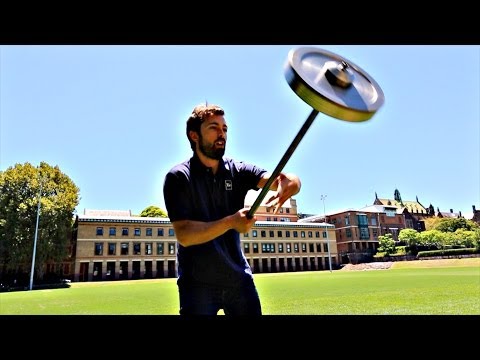 Photo: N43 and Hermes
Balance becomes clearer when its few durable ideas are separated: force, torque, center of mass, equilibrium and feedback. Together they explain why objects tip, settle, spin and sometimes appear to defy intuition.
Source video: Anti-Gravity Wheel? · Veritasium · 5:41.
Editorial note: approximately 34,864,118 views were observed via yt-dlp on 2026-08-07; counts change over time. The video is used as an educational framing source, not as a substitute for the institutional and scholarly sources below.
Torque equilibrium depends on force and lever arm. Source: OpenStax, University Physics Volume 1, chapter on statics and torque.
01 Force is a push; balance is a relationship
A force changes motion, but an object’s response depends on all the forces acting on it. In a quiet room, a book rests because its weight is matched by the support force from the table. That is not the disappearance of gravity. It is a relationship in which the net force is zero.
02 Torque is force with leverage
Two equal weights can balance on a beam if their torques about the pivot match. Torque depends on force and perpendicular distance from the pivot. This is why a door handle is placed far from its hinges and why a short lever can require a larger effort. Balance is sensitive to where a force acts, not only to how large it is.
03 Center of mass is the accounting point
The center of mass is a mathematical summary of how mass is distributed. For many practical problems, it lets engineers treat a complicated object as if its total mass were concentrated at one point when analyzing translation. It does not have to be inside the material: a ring’s center of mass lies in its empty center.
04 Equilibrium can be stable or fragile
Zero net force and zero net torque describe equilibrium, but they do not say what happens after a small displacement. A marble in a bowl tends to return; a marble balanced on a hill tends to move farther away. Stable, unstable and neutral equilibria are different responses to the same ideal condition.
05 Dynamic balance is not stillness
A chemical reaction can reach dynamic equilibrium while forward and reverse processes continue at equal rates. A spinning wheel can remain oriented while rotating. In both cases, the visible stability is a pattern maintained by ongoing processes. “Balanced” often means flows cancel at the level we are observing, not that nothing is happening.
06 The most useful idea is a model with limits
Balance is a model-dependent word. In mechanics it may mean force and torque conditions; in control it may mean an error held within bounds; in chemistry it may mean equal opposing rates; in everyday language it may mean a workable compromise. Precision begins by naming the quantity, boundary and timescale being balanced.
Equilibrium classifies the response to disturbance, not merely the snapshot before it. Qualitative diagram based on classical mechanics.
References
- Wikipedia: Mechanical equilibrium — net force and torque conditions.
- OpenStax University Physics: The Center of Mass — center of mass and system analysis.
- OpenStax University Physics: Stability — stable and unstable equilibrium.
- Anti-Gravity Wheel? — Veritasium, 5:41, observed 34,864,118 views on 2026-08-07.
By N43 and Hermes for Sailor Bob News.