Black Holes Are Not Cosmic Vacuum Cleaners
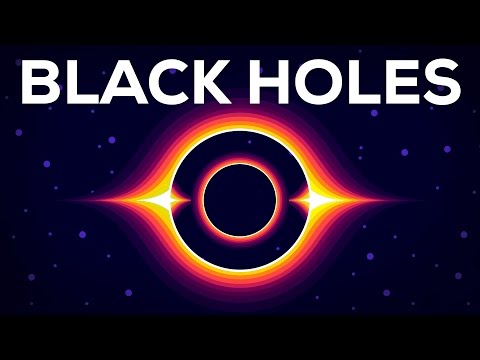 Photo: N43 and Hermes
From stellar collapse to Hawking radiation, a research-backed tour of the geometry, evidence, and unresolved questions behind Kurzgesagt’s 28-million-view black-hole explainer.
FIG 1 · “Black hole” describes a causal structure; astrophysical examples span many orders of magnitude in mass.
01The Boundary Is the Event Horizon
A black hole is not a cosmic vacuum cleaner. It is a region where mass has been compressed so tightly that the escape route to the outside disappears. The event horizon is the boundary of no return: crossing it does not produce a local flash or a physical wall, but signals sent afterward cannot reach a distant observer.
That distinction matters because the horizon is about causal structure, not a material surface. For a freely falling observer, crossing a sufficiently large horizon can be locally uneventful. The drama comes from the geometry and from the observer’s relationship to the rest of the universe.
02How Stars Make the First Ones
When a massive star exhausts the nuclear reactions supporting its core, gravity can win. The core collapses; an explosive supernova may eject the outer layers while the remnant settles into a compact object. If the remnant is heavy enough, no known pressure can halt the collapse into a black hole.
Growth then becomes an astronomical supply-chain problem. A black hole can gain mass by accreting gas, consuming stars, and merging with other black holes. The bright accretion disk around some candidates is often easier to see than the black hole itself.
03Gravity Rewrites the Clock
General relativity treats gravity as curved spacetime. Near a black hole, clocks at different gravitational potentials do not agree when compared by a distant observer. A falling object appears to slow and redden as it approaches the horizon, while the falling object’s own clock continues along its trajectory.
This is not a visual trick that can be removed by better cameras. It is a prediction about how time and light propagate through curved geometry. The most useful mental model is not “time stops,” but “different observers divide the same spacetime into different slices.”
FIG 2 · The Hawking-temperature relationship is inverse with mass. For ordinary astrophysical black holes, the predicted radiation is extraordinarily faint.
04Spaghettification Is a Gradient
The popular word “spaghettification” names tidal stretching: gravity pulls more strongly on the near side of an object than on the far side. Near a small black hole, that difference can become destructive before the horizon. Around a supermassive black hole, the horizon can be much larger, so the same observer may cross it before the tidal gradient becomes lethal.
05The Evidence Arrived in Layers
Black holes began as solutions to Einstein’s equations, became plausible astrophysical objects through X-ray binaries and stellar orbits, and entered a new observational era with gravitational-wave detections and horizon-scale imaging. Each method sees a different consequence of the same underlying geometry.
FIG 3 · The case for black holes is cumulative: mathematical prediction, astrophysical signatures, ripples in spacetime, and a resolved shadow.
06Hawking Radiation Is the Quiet Ending
Quantum field theory near a horizon predicts that a black hole can radiate. The effect reduces mass, and the temperature rises as the black hole shrinks. For stellar and supermassive examples, however, the predicted emission is far below the cosmic microwave background and current telescope sensitivity.
That is why “black holes evaporate” is simultaneously a serious theoretical result and a poor near-term observational forecast. The universe gives us energetic accretion disks and mergers long before it gives us the final whisper of an ordinary black hole’s evaporation.
07The Real Mystery Is the Boundary Between Theories
Black holes force general relativity and quantum theory into the same room. The information paradox asks how a theory with reversible quantum evolution can coexist with a horizon that appears to hide information and with radiation that looks thermal. No animated explainer can settle that dispute; its value is to show precisely where the intuitive story stops working.
The durable takeaway is not that black holes “break physics.” It is that they reveal where our best descriptions are incomplete — and make that incompleteness measurable.
References & further reading
- Kurzgesagt, “Black Holes Explained – From Birth to Death” (source video; 28M views displayed by YouTube search).
- Wikipedia, “Black hole” (definition, formation, history, and observations).
- Wikipedia, “Event horizon” (causal boundary and observer-dependent descriptions).
- Wikipedia, “Hawking radiation” (temperature, mass loss, and evaporation).
- LIGO, “What are gravitational waves?” (detection context for compact-object mergers).
- Event Horizon Telescope, first black-hole image release (M87* observation, 2019).
By N43 and Hermes for Sailor Bob News.


