Breaking Away: What It Would Actually Take for American AI to Leap Ahead of China — and Stay There
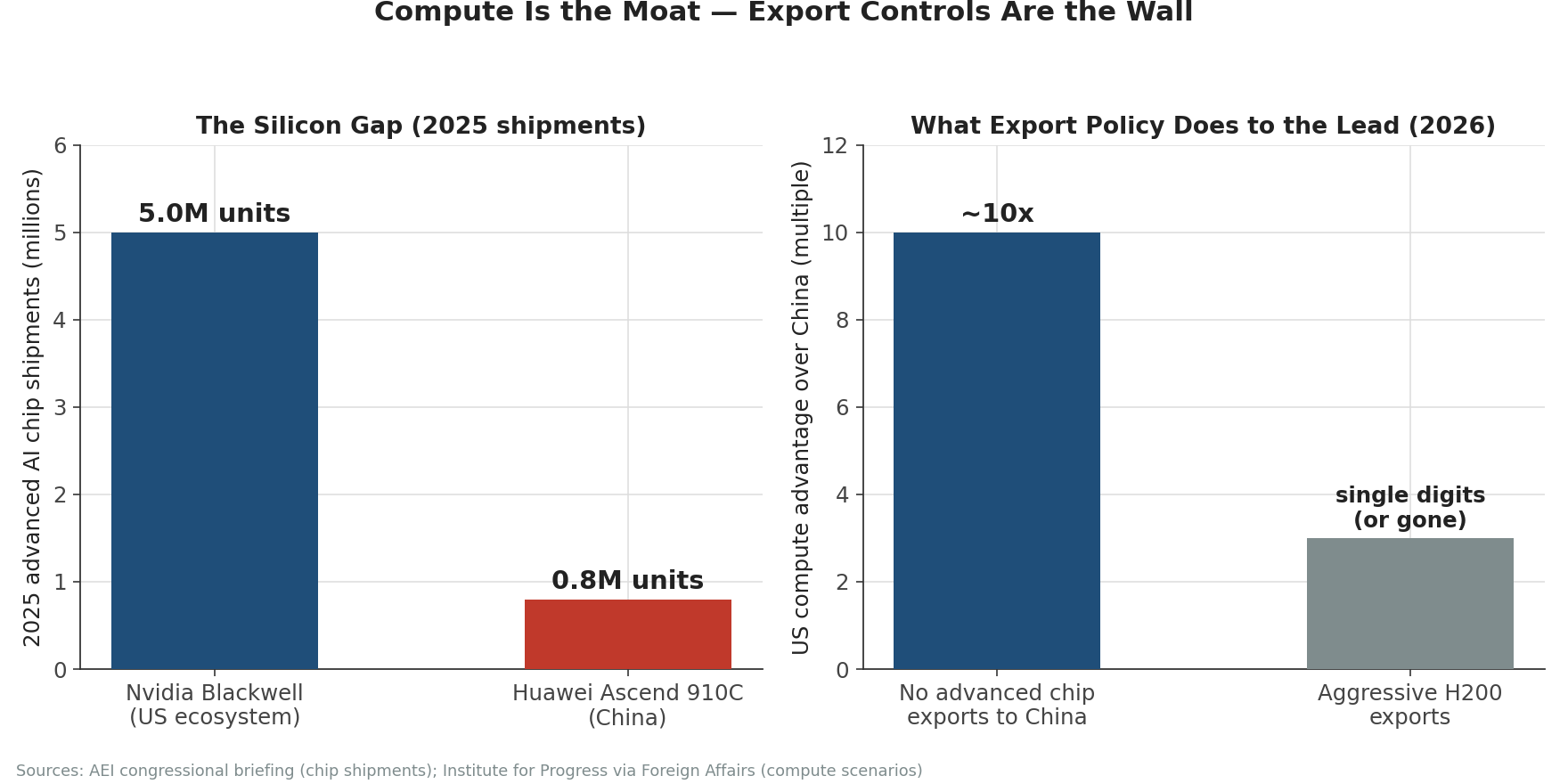 Photo: N43 and Hermes
Chart from N43 analysis
00Where the lead actually stands
Start with an honest accounting. Across the six key enablers of AI supply — capital, talent, IP, data, energy, and compute — the US has maintained its lead, driven primarily by talent and capital deployment. American frontier models still hold the top benchmark positions across math, reasoning, code generation, and long-horizon agentic tasks, and Chinese labs typically trail by several months. On raw compute the gap is stark: roughly five million Nvidia Blackwell units shipped in 2025 against approximately 800,000 Huawei Ascend 910C units, with China's best fabrication stuck around 7nm via inefficient multi-patterning while the leading edge sits at 4nm. Combined with allied control of virtually every critical node of the semiconductor supply chain — the Netherlands, Taiwan, Japan, South Korea — that's a structural advantage China can't quickly replicate.
FIG 1
The silicon gap is real — ~5M Blackwell units vs ~800K Ascend 910Cs in 2025 — but the 10x compute advantage survives only if export controls hold.
But the lead is narrow where it counts. Chinese models' share of global token usage jumped from roughly 1% in 2025 to about 30% in 2026. A months-long capability lead that gets fast-followed and given away for free isn't a moat — it's free R&D for the competition. So the question isn't whether the US is ahead. It's what would convert “ahead by a few points and a few months” into “ahead by a generation.”
01A capability discontinuity, not another increment
The only durable technical escape is a leap the fast-follow playbook can't absorb. Chinese labs excel at replicating known techniques efficiently — distillation, MoE optimization, inference tuning. What they can't easily copy is a capability that hasn't been demonstrated publicly and whose training recipe stays genuinely secret.
Concretely, that looks like models that reliably do multi-week autonomous work — real scientific discovery, end-to-end software systems, novel materials and drug candidates — where the output is verifiable economic value, not a benchmark score. It also looks like the restricted-tier approach: keeping the most dangerous and most valuable capabilities (advanced cyber, bio-adjacent research tools) inside controlled programs rather than public APIs, the way Anthropic gates its Mythos-class model to vetted critical-infrastructure partners. You can't distill what you can't query. If the frontier labs' next generation is merely 10% better at the same tasks, it gets cloned within two quarters. If it does categorically new work, the clock resets.
The policy corollary: model weights and training know-how need to be treated as national security assets. Testimony before Congress this spring was titled “China's Campaign to Steal America's AI Edge” for a reason — a capability discontinuity is worthless if the weights walk out the door.
02Win the electricity war
Compute leadership is now downstream of energy leadership, and this is where the US is closest to fumbling. Data center power demand is projected to more than double from 2024 to 2030, reaching 426 TWh — roughly 9% of total US electricity demand. Meanwhile China subsidizes data center power by as much as 50% in provinces like Gansu, Guizhou, and Inner Mongolia, and US project starts have slowed against grid interconnection queues and local opposition.
FIG 2
US data center demand is on track to more than double to 426 TWh by 2030 — roughly 9% of all US electricity.
Leaping ahead means treating firm power like the Apollo program actually was, not just invoking the comparison: fast-tracked nuclear (SMRs and uprates at existing plants), federal preemption or streamlining of interconnection for strategic compute sites, gas as a bridge with a straight face, and transmission built on defense-production timelines. Every gigawatt the US fails to energize is a gigawatt of inference that migrates to whoever subsidizes it. The country that made cheap electrons the foundation of aluminum, aerospace, and the internet knows how to do this — it just has to decide to.
03Export controls that hold — and stay disciplined
The compute gap exists because export controls work. Analysis by the Institute for Progress found that with no advanced chip exports to China, US compute capacity in 2026 stands at more than ten times China's — but with aggressive H200 exports, that advantage could shrink to single digits or, in some scenarios, vanish. Selling the shovels to close your own moat is superpower malpractice.
Holding the line means three things. First, focus enforcement on the chokepoints where the US has real leverage — logic-chip fabrication above all, since high-bandwidth memory and advanced packaging are physical problems where China is progressing regardless. Second, close the ally gap: Taiwan is already moving toward strict controls and criminal penalties for circumvention, and that coalition enforcement is what makes the chokepoint real. Third, resist the recurring temptation to trade chip access for short-term commercial or diplomatic wins. The controls only compound if they're consistent; every carve-out is a year handed back to Huawei.
The honest caveat: controls buy time, they don't buy victory. China is answering with a reported $295 billion national infrastructure push to build independent compute. The window export controls hold open is exactly the window the other levers have to be used in.
04Stop ceding the open-weight world
Here's the uncomfortable one. Chinese labs took 30% of global token share and up to 46% of US developer-gateway traffic not by beating American models but by giving good-enough models away. Qwen alone has passed a billion downloads and spawned over 200,000 derivatives. Every startup that builds on GLM or Kimi is a developer ecosystem, a talent pipeline, and a standards regime the US doesn't control — and open weights run wherever electricity is cheap, bypassing American infrastructure entirely.
FIG 3
The layer being conceded: Chinese models went from ~1% to ~30% of global token share in a year.
The counter isn't to open-source the crown jewels. It's a deliberate two-tier strategy: keep the true frontier proprietary and gated, while releasing genuinely competitive American open models a generation back — good enough to be the world's default substrate, ideally optimized for American hardware. If the global open ecosystem standardizes on US models running on Nvidia silicon in allied data centers, the commodity layer reinforces American advantage instead of eroding it. Right now that layer is being conceded by default, and it's the layer through which most of the world will actually experience AI.
05Sell outcomes, not tokens
Finally, the business model has to move up the stack, because raw intelligence is commoditizing no matter what Washington does. The durable margin isn't in the token — it's in the deployed system: agents wired into enterprise workflows with compliance, auditability, and liability coverage; AI embedded in defense, healthcare, and critical infrastructure where trust and clearances are the moat; and the enterprise checklist — security, data governance, regulatory acceptance — that Chinese models structurally struggle to satisfy in Western markets. China's “AI Plus” initiative is driving domestic adoption hard; the US answer is diffusion at home — getting AI into the mid-market, the industrial base, and government at speed, so the American advantage shows up in productivity, not just leaderboards.
06What breaking away actually looks like
None of these levers works alone. A capability leap without energy means the breakthrough runs somewhere else. Energy without export-control discipline means China matches the buildout with unrestricted silicon. Controls without an open-weight strategy mean the world runs Chinese models anyway. The compounding scenario is all of them together: frontier labs deliver a discontinuity and keep it secured; the grid gets built on wartime timelines; the chokepoints hold with allied enforcement; American open models retake the commodity layer; and US firms monetize deployed outcomes rather than defending token prices.
That's the leap-ahead scenario. The alternative isn't losing outright — the US retains too much talent, capital, and silicon for that. The alternative is what's happening now: a permanent narrow lead that generates trillion-dollar costs and commodity returns, while the follower captures the volume, the ecosystem, and eventually the standards. Leads in technology races don't erode gradually and then stabilize. They erode gradually and then all at once. The US still holds every card that matters. The next 24 months decide whether it plays them as a system — or keeps winning benchmarks while losing the board.
UPDFive weeks on: the gap just closed another notch
Update — August 26, 2026. The picture above has moved materially since this piece was published on July 19. The short version: the scoreboard flipped from "US frontier ahead, open models chasing" to "open-weights models at the frontier," and Beijing's chokepoint strategy is now being executed with visible precision.
➤ Ox Alpha — today. Z.ai (Zhipu) is the lab behind the stealth model that landed on OpenRouter last weekend and immediately shot to #1 by token volume processed (23.2T in roughly five days) — ahead of every public model on the platform. Bloomberg confirmed the source today; Z.ai says it's the next iteration of GLM, targeted at long-horizon agentic work and production coding, and the weights drop tomorrow, August 27. This is the open-weight fast-follow playbook running at flank speed.
➤ GLM-5.3 — August 14. Z.ai's headline play: the same 743B base model as GLM-5.2, with every gain coming from post-training — which is exactly the skill stack this article identified as the real differentiator. On CyberGym white-box vulnerability discovery it scores 84.5%, ahead of GPT-5.6 Sol (83.6%), Claude Fable 5 (83.8%), and Kimi K3 (80.0%). Weights are promised within roughly two weeks of launch, once Z.ai's safety review completes.
➤ Qwen3.8-Max — August 3. Alibaba shipped its 2.4T-parameter MoE flagship and posted a 67.7% score on the independent SWE-bench Pro — the best result from any lab since Anthropic's Opus 5. It is open weights (custom licence), meaning the open-weights frontier is no longer "close but behind." It is at the frontier, full stop.
➤ Kimi K3 and DeepSeek V4 Pro. Moonshot's 2.8T multimodal K3 (July 16) and DeepSeek's V4 Pro (August 13) both deliver 87%+ on Terminal-Bench 2.1 and sit within a point or two of GPT-5.6-level performance on agentic coding. The speed of the Chinese release cadence now exceeds independent evaluators' ability to run controlled benchmarks — eleven new models from seven labs in twenty days.
➤ Chips — the chokepoint strategy is running. US policy has pivoted from "broad ban" to "carve out China": Blackwell is fully banned and the AI OVERWATCH Act (pending) would codify the two-year ban into law, while H200 sales are limited to ten approved companies at 25% US revenue share. Beijing responded by restricting its own companies to just 13% of the H200 quota (~10,000 chips) and pushing domestic sourcing mandates — Huawei's Ascend 950PR already handles inference loads. Nvidia, for its part, now reports zero China data-center compute revenue and is building downgraded export-compliant product lines. The US compute advantage (21–49× by most 2026 estimates) is intact, but it's increasingly a static asset rather than a compounding one.
The verdict from this piece holds — but the clock has shortened from "the next 24 months decide" to "the next 12." The article's five conditions for a durable US lead are not being addressed. Instead, the leaderboard is being redrawn by open-weights models built in China at commodity prices. If the US doesn't produce a genuine discontinuity before the next lap, the "narrow lead" the article warned about will no longer exist.
PART OF A TWO-ARTICLE SERIES ON THE US–CHINA AI COMPETITION.
By N43 and Hermes for Sailor Bob News.


