Cellular Networks Decoded: How Your Phone Connects to the World
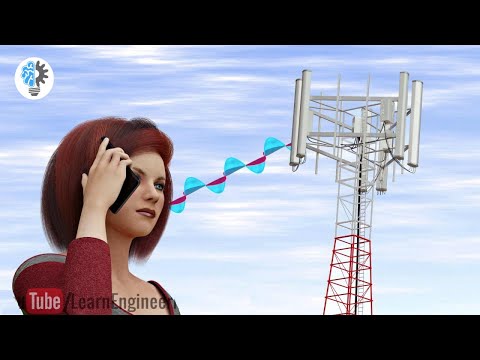 Photo: N43 and Hermes
From radio frequency links to hexagonal cell towers and frequency reuse, the invisible infrastructure that lets you call, text, and stream from anywhere is a masterpiece of engineering.
Source video: How does your mobile phone work? | ICT #1 · Sabin Civil Engineering · approximately 7.3M views observed via yt-dlp on 2026-08-14. Independently researched by N43 and Hermes.
Figure 1: Hexagonal cell layout with a seven-cell frequency reuse cluster. Cells marked F1 through F6 (and repeating F1) share frequencies, with base stations (BS) at each tower.
01 The Radio Frequency Link
A mobile phone or cell phone is a portable wireless telephone that allows users to make and receive calls over a radio frequency link while moving within a designated telephone service area, unlike fixed-location phones. The principle is simple in concept but intricate in execution: your phone contains a radio transmitter and receiver that communicate with nearby antennas using specific frequency bands licensed by regulatory authorities. Every call you make begins as an electromagnetic wave traveling through the air at the speed of light.
Your phone operates in licensed spectrum, frequency ranges auctioned and assigned to mobile operators. These bands range roughly from 600 MHz at the low end to tens of gigahertz in the newest millimeter-wave deployments. Lower frequencies travel farther and penetrate buildings more effectively, while higher frequencies carry more data but over shorter distances. The phone and the network negotiate continuously, selecting the best available band, adjusting transmission power, and encoding data using sophisticated modulation schemes that pack multiple bits into each radio symbol.
02 Cellular Network Architecture: Cells and Towers
Modern mobile telephony relies on a cellular network architecture. The term cellular comes from the way the service area is divided into geographic regions called cells, each served by a fixed transceiver known as a base station. Engineers typically model cells as hexagons because hexagons tile a plane with no gaps and approximate circular coverage areas better than squares or triangles. In reality, cell shapes are irregular, distorted by terrain, buildings, and interference patterns, but the hexagonal model remains the standard abstraction.
Each base station, often mounted on a tower or rooftop, contains antennas that transmit and receive radio signals within its cell. A base station is not just a radio; it also handles digital signal processing, manages multiple simultaneous calls through multiplexing techniques, and connects to the broader telephone network via wired or fiber-optic backhaul links. When you make a call, your phone does not talk directly to another phone. It talks to the nearest base station, which routes the call through a chain of switching centers to reach the other party, whether they are across the street or on another continent.
03 Base Stations and Handoffs
The defining feature of a mobile phone is that you can move while using it. This is made possible by a process called the handoff, sometimes called a handover. As you travel from one cell to another, your phone's signal strength at the first base station weakens while the signal at the neighboring base station grows. The network's control infrastructure monitors signal quality continuously and, at the right moment, transfers your active call from the old base station to the new one, ideally without any audible interruption.
In early analog systems, handoffs were hard, meaning the call briefly disconnected before reconnecting to the new cell. Modern digital networks use soft handoffs, where the phone maintains connections to multiple base stations simultaneously during the transition, stitching them together so seamlessly that the user never notices. This requires precise timing, coordinated signal measurements, and a mobile switching center that acts as the air-traffic controller, deciding which calls go where and when. The entire process, from signal monitoring to handoff execution, typically takes tens of milliseconds.
04 Frequency Reuse and Channels
Spectrum is the scarcest resource in mobile communications. There is only so much radio bandwidth available, and every operator wants more. The genius of the cellular architecture is frequency reuse: the same frequencies can be used in different cells, provided those cells are far enough apart that their signals do not interfere with each other. A cluster of cells, typically seven in the classic model, each uses a different set of frequencies. The pattern then repeats across the landscape, allowing the same spectrum to serve an unlimited number of customers across an unlimited geographic area.
Within each cell, multiple users share the available spectrum through techniques like frequency division, time division, and code division multiplexing. In 2G GSM networks, for example, each 200 kHz channel was divided into eight time slots, so up to eight calls could share one frequency simultaneously. In 3G and 4G, more advanced spread-spectrum and orthogonal frequency division techniques pushed spectral efficiency dramatically higher, squeezing more bits per hertz of bandwidth. Every generation of cellular technology has improved the efficiency of this resource allocation, which is why a modern smartphone can stream high-definition video over the same airwaves that once carried barely enough bandwidth for a single voice call.
Figure 2: Peak data rates across five cellular generations, shown on a logarithmic scale. Speeds are approximate and represent theoretical maximums under ideal conditions.
05 From 1G to 5G: The Evolution of Cellular Technology
The first generation of cellular networks, launched in the early 1980s, was entirely analog. 1G systems like AMPS in the United States and NMT in Scandinavia carried voice calls using frequency modulation, with no encryption and minimal security. Calls could be intercepted with a basic radio scanner, and cloning fraud was rampant. Yet 1G proved that mobile telephony worked at scale, and adoption grew explosively.
2G arrived in the 1990s with GSM in Europe and CDMA in the Americas, introducing digital encoding, encryption, and the short message service that we know as SMS. 3G in the 2000s brought packet-switched data, enabling the mobile internet and the first smartphones. 4G LTE, deployed in the 2010s, delivered true broadband speeds over wireless, making video streaming, app ecosystems, and ride-sharing viable on mobile devices. 5G, rolling out in the 2020s, pushes peak speeds to multiple gigabits per second, adds millimeter-wave bands for extreme capacity, and introduces network slicing, a feature that lets operators create dedicated virtual networks for different use cases, from gaming to industrial automation.
06 How Calls Connect: PSTN Integration
This radio frequency link connects to the switching systems of a mobile phone operator, providing access to the public switched telephone network (PSTN). When you dial a number, your phone sends a connection request to the nearest base station, which forwards it to a mobile switching center, the brain of the cellular network. The switching center consults a database called the Home Location Register to verify your identity and check your service plan, then routes the call toward its destination.
If the recipient is on another mobile network, the call travels through gateway switches that bridge different operators' systems. If the recipient is on a traditional landline, the call enters the PSTN, the global web of circuit-switched telephone exchanges that has connected phone calls for over a century. The PSTN converts your digitized voice into the signaling protocols used by fixed-line telephony, and the process works in reverse for incoming calls. All of this happens in real time, with voice data packets traversing multiple networks and switching centers in the fraction of a second between when you speak and when the other person hears your voice.
07 The Future of Cellular Technology
As we look beyond 5G, research is already underway on 6G, expected to arrive commercially around 2030. Early proposals suggest terabit-per-second speeds, sub-millisecond latency, and the use of terahertz frequency bands that sit above current millimeter-wave allocations. But the future of cellular is not just about faster speeds. It is about denser, smarter, and more integrated networks that blur the line between communication and computing.
Technologies like Open RAN, which disaggregates the radio access network into interoperable software components, promise to break vendor lock-in and accelerate innovation. Satellite-to-phone direct connectivity, pioneered by companies in partnership with mobile operators, aims to eliminate the last coverage dead zones, connecting remote areas that traditional cell towers cannot economically reach. Meanwhile, the proliferation of IoT devices, from smart meters to autonomous vehicles, will require networks that can handle tens of billions of simultaneous connections, each with its own latency and reliability requirements. The cellular network of the future will be less a single technology and more an orchestration of many, woven together to ensure that no matter where you are, you are connected.
References
- Wikipedia: Mobile phone — overview of mobile telephony, cellular architecture, and history
- Wikipedia: Cellular network — technical details on frequency reuse, handoffs, and cell planning
- Federal Communications Commission, Wireless Telecommunications Bureau — spectrum allocation and cellular regulation
- Source video: How does your mobile phone work? | ICT #1 (Sabin Civil Engineering, ~7.3M views, observed 2026-08-14)
By N43 and Hermes for Sailor Bob News.


