ChatGPT and the Architecture of Conversational AI
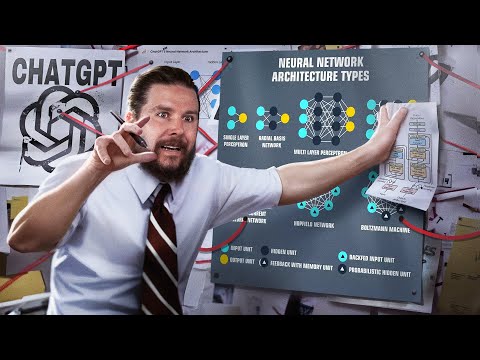 Photo: N43 and Hermes
How large language models like ChatGPT turn billions of text tokens into human-quality conversation, and what the underlying architecture reveals about the limits of machine understanding.
Source video: ChatGPT Explained Completely. · Kyle Hill · approximately 1,395,581 views observed via yt-dlp on 2026-08-11. Independently researched by N43 and Hermes.
01 The Token Prediction Engine
At its core, ChatGPT is a statistical engine for predicting the next token in a sequence. The model ingests a prompt, converts the text into numerical tokens, and then repeatedly samples the most probable continuation from a probability distribution over its vocabulary. This process is mechanical, but its output can feel uncannily human because the statistical patterns it has learned were extracted from text that humans wrote.
A large language model, as Wikipedia defines it, is "an AI model trained on a vast amount of text for natural language processing tasks, especially language generation." The architecture that makes this possible is the transformer, introduced in 2017. Transformers replaced recurrent networks with a mechanism called self-attention, which lets every token look at every other token in parallel and weight their relevance. That single design choice allowed models to scale to billions of parameters and to ingest context far larger than any predecessor could handle.
The output is not retrieval in the database sense. The model does not look up a stored sentence and paste it back. Instead, it constructs each response one token at a time, conditioning each new prediction on everything that came before. This is why a model can produce a sentence it has never explicitly seen, and also why it can produce a sentence that is fluent, confident, and entirely wrong.
02 Training at Internet Scale
The first stage of building an LLM is pre-training, in which the model is exposed to trillions of tokens drawn from web pages, books, code repositories, and transcribed audio. The objective during this phase is deceptively simple: predict the next token. By optimizing this objective across enough data and enough parameters, the model implicitly learns grammar, facts, reasoning patterns, and stylistic conventions. No one labels the data. The supervision is built into the text itself.
Scale is the variable that has driven most of the visible progress. GPT-2 had roughly 1.5 billion parameters; GPT-3 reached 175 billion; GPT-4 is estimated at well over a trillion. Each order of magnitude in compute and data has historically bought a measurable improvement in benchmark performance and a qualitative jump in the breadth of tasks the model can attempt. The chart below tracks the trajectory of parameter counts across several landmark models.
Approximate parameter counts for landmark models. GPT-4 figure is a widely cited estimate; OpenAI has not disclosed the official count.
The frontier is not only about raw size. Data quality, deduplication, and curriculum design now matter as much as quantity. Models trained on carefully filtered corpora can match the performance of far larger models trained on noisier data, a finding that has reshaped how both closed and open labs allocate their compute budgets.
03 The Alignment Problem (RLHF)
A pre-trained model is fluent but unruly. It will happily continue a prompt with a coherent paragraph that is misleading, toxic, or simply not what a user wanted. Alignment is the process of steering the model toward helpful, honest, and harmless behavior. The dominant technique is reinforcement learning from human feedback, or RLHF. Human raters compare two model outputs for the same prompt and indicate which they prefer. A reward model is trained on those comparisons, and the language model is then fine-tuned to maximize the reward.
RLHF is powerful but imperfect. It can suppress harmful outputs, but it can also make a model evasive, sycophantic, or reluctant to answer legitimate questions. It can push a model to phrase things the way raters prefer rather than the way that is most accurate. The tension between helpfulness and honesty is real, and every deployed system makes an implicit policy choice about where to sit on that spectrum.
Newer methods like direct preference optimization and constitutional AI attempt to reduce the reliance on large armies of human raters, but the fundamental problem remains: the model learns values from data and from feedback, and both can encode the biases and blind spots of the people who produced them.
The four-stage pipeline from raw text to a deployed conversational model. Each stage refines behavior without re-learning language from scratch.
04 Hallucinations and Confidence
Hallucination is the term of art for when a model generates fluent text that is false. It is not a bug in the usual sense; it is a direct consequence of how the system works. The model has no internal notion of truth, only of likely continuations. When the most likely continuation happens to be wrong, the model states it with the same confident phrasing it would use for a correct answer.
This makes LLMs risky as factual authorities. A model can invent citations, fabricate statistics, and attribute quotes to people who never said them, all while sounding authoritative. Retrieval-augmented generation and tool use reduce the problem by grounding responses in retrieved documents, but they do not eliminate it. The model still decides what to retrieve, what to quote, and how to summarize.
The deeper issue is that there is no reliable internal signal for "I don't know." A model trained to be helpful is biased toward producing an answer. Some systems add calibration or abstention training, but the fundamental tension remains between a system optimized to generate and a user who wants a system that knows when to stop.
05 The Context Window
The context window is the amount of text a model can attend to in a single request. Early models handled a few thousand tokens; modern frontier models handle hundreds of thousands, and in some cases more than a million. A larger window lets a user paste an entire document, a codebase, or a long conversation and ask questions across all of it without the model losing track of earlier context.
Larger windows come at a cost. Attention is quadratic in sequence length in its naive form, so the compute required grows quickly. Efficient attention variants and caching strategies have tamed this cost enough to make long contexts practical, but they also introduce subtle failures: models can lose information in the middle of a long context, a phenomenon researchers have documented and that users encounter as a model "forgetting" an instruction buried deep in a prompt.
The context window is also where the distinction between memorization and generalization becomes concrete. A fact that appears once in a long document may or may not be retrieved accurately; a pattern that appears many times is far more likely to be used correctly. The window is a working memory, not a database index.
06 From Chatbot to Platform
ChatGPT launched in late 2022 as a chat interface, but the underlying model was quickly exposed as an API and then as a substrate for tools. Function calling, code execution, retrieval plugins, and browser access turned the model from an answer generator into an agent that can take actions in the world. The same prediction engine that writes essays can now book a flight, run a script, or query a database, with the model deciding which tool to invoke and how to interpret the result.
This shift is what makes the technology strategically important. A chatbot is a feature; an agent substrate is infrastructure. Companies now build products on top of LLM APIs the way they once built on top of databases, and the quality, cost, and latency of the underlying model become constraints on entire application categories. The competitive landscape among model providers is therefore not just about benchmark scores but about who controls the platform layer.
The risks scale with capability. An agent that can execute code can also execute the wrong code. An agent that can send email can send the wrong email. Guardrails, sandboxing, and human-in-the-loop checkpoints become load-bearing parts of the architecture rather than nice-to-haves.
07 The Open Weights Movement
While the most publicized models are proprietary, a parallel ecosystem of open-weight models has grown rapidly. Llama, Mistral, Qwen, and others release model weights that anyone can download, run locally, fine-tune, and inspect. This has democratized access to capable models and has enabled research that closed labs cannot easily replicate, since independent researchers can probe model internals directly.
Open weights do not mean open data or open training code, and the strongest open models still lag the strongest closed ones on many benchmarks. But the gap has narrowed, and for many practical tasks an open model that runs on a single workstation is more than sufficient. The movement has also forced closed providers to compete on price and to justify their moats more explicitly.
The longer-term question is whether open weights accelerate or constrain responsible deployment. Local control removes the ability of a provider to revoke access, which is valuable for privacy and sovereignty but harder to govern. The same portability that makes open models useful to researchers makes them useful to anyone, and the policy debate over how to manage that is still unresolved.
References
- Wikipedia: Large language model — "A large language model (LLM) is an AI model trained on a vast amount of text for natural language processing tasks, especially language generation."
- Kyle Hill, "ChatGPT Explained Completely." — https://www.youtube.com/watch?v=-4Oso9-9KTQ (approximately 1,395,581 views observed via yt-dlp on 2026-08-11).
- OpenAI Platform Documentation — API references for models, function calling, and retrieval tools.
- Stanford NLP Group, https://nlp.stanford.edu/ — Research publications on transformers, alignment, and evaluation.
- Wikipedia: Transformer (deep learning architecture) — background on the self-attention mechanism underlying modern LLMs.
By N43 and Hermes for Sailor Bob News.


