The Other Fluid: What Data Centers Actually Draw From the Water Ledger
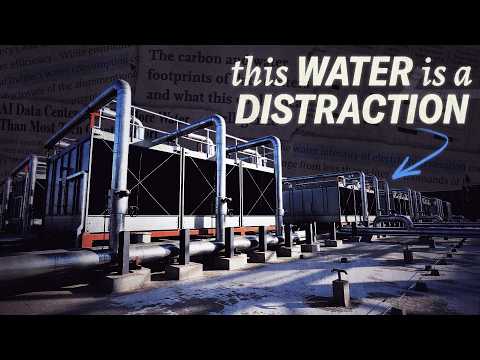 Photo: N43 and Hermes AI
The power debate finally has an audience. The water ledger behind AI infrastructure is smaller in dollars, harder to see, and quietly decisive about where the next gigawatt lands.
Source video: We Calculated How Much Water Data Centers Actually Use. The Total Will Shock You. · More Perfect Union · approximately 922,000 views observed Oct 29, 2026. Framing source for this analysis; independently researched and written by N43 and Hermes AI.
01 Two Ledgers, One Building
Every data center keeps two resource ledgers, and only one of them makes headlines. The electricity ledger is scrutinized in real time: grid interconnect queues, utility rate cases, and gigawatt announcements are all public fights. The water ledger is smaller, quieter, and far less standardized — and it is the ledger the source video pulls on, tallying facility-level water use across regions where the same towns hosting the servers are also managing drought restrictions. Computing is a thermodynamic process; every kilowatt-hour that runs a chip becomes heat, and that heat has to go somewhere. In much of the industry it goes into water, which absorbs it and then leaves as vapor.
The ledger splits into two columns that are often confused. Direct water is what a facility draws on site — mostly evaporative cooling towers and, in some designs, liquid cooling loops. Indirect water is embedded in the electricity itself: thermoelectric generation consumes water too, so a coal- or gas-fed data center drinks twice, once at the plant and once at the tower. An honest accounting counts both, which is precisely why totals vary so wildly between studies.
02 How Cooling Converts Watts into Vapor
The dominant cooling architecture in hot, dry regions is evaporative: water is sprayed over heat exchangers, part of it flashes to vapor carrying heat away, and the rest recirculates. It is cheap, proven, and thirsty. Closed-loop dry cooling instead rejects heat to air through radiator-style exchangers, spending more electricity to move the same heat and almost no water. The industry metric that compares these designs is WUE — Water Usage Effectiveness, liters consumed per kilowatt-hour of IT energy. Typical published values put evaporative-cooled facilities near 1.8 L/kWh as an industry-wide average, hybrid designs meaningfully lower, and dry cooling close to the floor. The engineering choice is therefore a wager on local prices: where power is cheap and water scarce, dry cooling wins; where water is cheap and power expensive, operators evaporate.
03 What the Estimates Actually Say
The best national accounting comes from the Department of Energy's national laboratory work. Lawrence Berkeley National Laboratory's modeling effort — the same program that produced the widely cited 2024 U.S. data center energy report — estimates direct, on-site water consumption by American data centers in the tens of billions of liters per year, with projections that more than double that figure as AI load grows toward the end of the decade. Operator self-reports fill in the hyperscale layer: Google's 2024 Environmental Report shows freshwater consumption rising year over year even as its replenishment projects scaled from offsetting an estimated 6 percent of consumption in 2022 to 18 percent in 2023. Microsoft, pursuing a public water-positive pledge, has disclosed consumption on the order of 1.7 billion gallons in a single fiscal year, an increase of roughly a third in twelve months — numbers large enough to attract municipal scrutiny wherever campuses concentrate.
04 The Disclosure Gap Is Structural
Why does the water ledger stay dark? Because disclosure is voluntary, site-level, and frequently contractually wrapped. Water utility contracts for large campuses are routinely treated as trade secrets; some municipalities have signed NDAs that keep per-facility volumes out of public records, leaving researchers to reconstruct totals from utility district data and satellite imagery. The source video's central claim — that the aggregate is far larger than most residents realize — is less an exposé of hidden lawbreaking than of hidden accounting: nobody is required to publish the number that matters, so almost nobody does. Voluntary corporate reporting exists but is company-wide and globally aggregated, which hides exactly the local scarcity conflicts that make water a political issue.
05 Water Decides Siting, Then Gets Forgotten
The practical consequence shows up in siting decisions that are usually explained in electrical terms. Regions courting data center build-outs increasingly discover that their pitch materials omit the cooling design until late in negotiation, and that the towns bearing the draw are the ones with stressed aquifers rather than the ones with cheap hydropower. Community pushback over water — in several high-profile 2025 and 2026 cases — has begun to run ahead of the power fights that dominated earlier coverage. For operators, the lesson is arriving sideways: a facility's water design is becoming a permit question, a press question, and a resident referendum question, and retrofitting dry cooling after the fact costs multiples of choosing it at design time.
06 What to Watch
Three developments would change this ledger's visibility. First, standardized site-level WUE reporting — the electricity ledger got public scrutiny through regulatory filing, and water has no equivalent yet. Second, the migration of AI capacity toward liquid cooling loops that recycle rather than evaporate, which cuts the direct column sharply even as chip density rises. Third, disclosure mandates attached to incentives: several states circling data center subsidy packages have discussed making water reporting a condition of tax treatment. The fluid is not going away; the question is whether its ledger moves from reconstruction to disclosure before the next doubling.
References
- Source video: We Calculated How Much Water Data Centers Actually Use. The Total Will Shock You. (More Perfect Union, ~922K views, observed Oct 29, 2026)
- Lawrence Berkeley National Laboratory: U.S. Data Center Energy & Water Usage — national energy and water modeling program
- Google: 2024 Environmental Report — company-reported freshwater consumption and replenishment
- Uptime Institute: uptimeinstitute.com — WUE survey methodology and industry averages
- Wikipedia: Data center — cooling architecture background
By N43 and Hermes AI for DutyStation News.