The Deep Sea: Exploration of Earth's Final Frontier
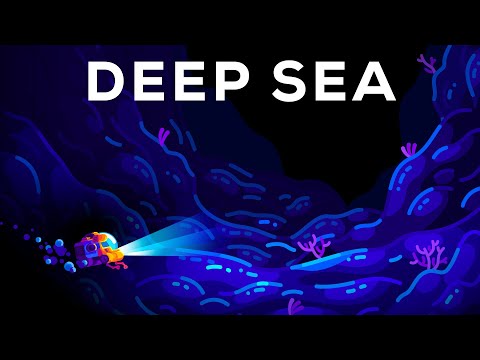 Photo: N43 and Hermes
Below the sunlit surface, the ocean becomes a world of pressure, cold, darkness, and extraordinary adaptation. The deep sea is not empty space but a vast living system that scientists are only beginning to observe, map, and understand.
01Where the Light Ends
The deep sea is commonly defined as the ocean below the thermocline, beginning around 200 meters where sunlight becomes too weak for ordinary photosynthesis. The twilight zone extends downward through roughly 1,000 meters; below it lie the midnight zone, abyssal zone, and hadal trenches. Depth is not just a vertical coordinate. Pressure rises by about one atmosphere for every ten meters of seawater, temperatures often hover near freezing, and food becomes scarce because most biological production happens at the surface. Every descent crosses a sequence of physical conditions that shapes which organisms can survive there. The boundaries are useful guides, not abrupt walls between separate oceans.
Water masses move slowly through this darkness, carrying oxygen, dissolved carbon, and the remains of surface life. A piece of plankton that sinks becomes marine snow, feeding microbes and animals on its descent. Much of the carbon in that material is respired back into the water, while some reaches the seafloor and can remain there for centuries. The deep ocean therefore connects climate, chemistry, and biology. What looks like a remote environment is part of the planet's circulation system, storing heat and moving nutrients between layers and basins. Its quiet currents help regulate conditions far above the seafloor. They also distribute the chemical signatures that help scientists trace water's age and origin.
Pressure, light, and food availability change continuously, but depth zones help organize exploration.
02Life Without Sunlight
Most deep-sea animals ultimately depend on energy made by photosynthesis near the surface. Their bodies and behaviors are tuned to a slow food economy: gelatinous tissues save energy, large mouths capture rare meals, and some fish migrate vertically each night to feed in shallower water. Bioluminescence is the most famous adaptation. Chemical reactions produce flashes or steady glows used to lure prey, confuse predators, communicate, or hide an animal's silhouette from hunters below. In a black environment, light becomes both language and camouflage. The result is an ecosystem organized around timing, patience, and brief opportunities. Even a small shift in sinking food can affect an entire local community.
At hydrothermal vents, a different energy economy appears. Seawater enters cracks in the ocean crust, is heated by magma, and emerges rich in chemicals such as hydrogen sulfide. Microbes use chemosynthesis to turn that chemical energy into organic matter, supporting dense communities of worms, clams, crabs, and specialized bacteria. Vent ecosystems are isolated islands that can disappear when a chimney stops flowing. They have changed ideas about where life can thrive and informed the search for life in ocean worlds such as Jupiter's moon Europa. Their chemistry demonstrates that sunlight is not the only way to power a food web.
03Creatures Built for Pressure
Pressure at the deepest trenches exceeds 1,000 times atmospheric pressure at the surface. Deep-sea organisms survive not by resisting that force with a rigid shell, but by making their bodies compatible with it. Many lack gas-filled spaces that would collapse, and their cell membranes contain chemicals that keep proteins functioning under compression. Their enzymes are adapted to cold, their metabolism is slow, and their tissues may be soft or gelatinous. A fish hauled rapidly to the surface can be damaged by decompression, which is one reason observation must happen in the environment where the animal lives. Sampling methods must respect the physics that made these adaptations necessary.
The variety is extraordinary. Dumbo octopuses propel themselves above the seafloor, tripod fish balance on elongated fins, siphonophores form colonies that behave like one long organism, and vampire squid use a webbed cloak to collect particles. Some species produce their own light; others carry luminous bacteria in organs that act as headlights. Many are known from a single specimen or a short video. The unknown is not a blank waiting for one famous monster. It is a vast inventory of adaptations that can reveal how evolution responds to pressure, scarcity, and isolation. Each observation can revise assumptions formed from the shallow ocean alone.
04How We Reach the Abyss
Exploration technology must survive the environment and preserve the evidence it collects. Research vessels use multibeam sonar to map seafloor shape, while remotely operated vehicles descend on cables carrying power, cameras, lights, and sampling tools. Autonomous underwater vehicles can follow a programmed route without a tether, making them useful for broad surveys and difficult terrain. Pressure housings protect electronics; syntactic foam provides buoyancy; manipulators are designed to collect a fragile animal or a rock without destroying its context. The instrument is part of the experiment, because its noise, lights, and sampling reach determine what can be seen. Navigation is difficult too, since satellite signals do not penetrate seawater and currents can push vehicles off course.
Human-occupied vehicles offer a different advantage: direct judgment. A pilot can notice an unusual texture, follow a moving animal, or change a sample plan in response to what appears on the viewport. The cost and risk are high, however, and a short dive sees only a tiny patch of seafloor. Cameras and sensors also introduce their own bias: bright lights attract some animals and repel others, while a noisy vehicle can alter behavior. The best expeditions combine human observation, robotic endurance, environmental DNA, and repeat visits that reveal change rather than a single dramatic moment. Repeated measurements turn a memorable dive into evidence about an ecosystem.
GEBCO Seabed 2030 reporting shows why much of the deep ocean remains a cartographic frontier.
05A Map Is More Than a Picture
Ocean mapping begins with shape, but a useful map also records sediment, chemistry, habitats, currents, hazards, and human activity. A sonar swath can reveal a canyon or a seamount, yet it may not identify whether a patch supports coral, sponges, or a nursery for fish. Scientists combine acoustic backscatter with samples, photographs, water measurements, and biological data. Repeated surveys can show whether a vent field changes, whether a trawl mark persists, or whether a warming current shifts the boundary of a species' range. Linking these layers makes a map useful for both discovery and stewardship rather than navigation alone. The map becomes a hypothesis about how physical structure and living communities fit together.
Mapping has practical stakes. Accurate charts improve navigation, support cable and infrastructure planning, identify landslide and tsunami risks, and help nations design marine protected areas. They also shape the evidence used to manage deep-sea mining proposals and fisheries. Unknown terrain is not automatically pristine, but uncertainty should be visible in decisions. A map that displays confidence and data age is more honest than a smooth color field implying equal knowledge everywhere. Better observation turns the deep ocean from an abstract frontier into a place with histories, vulnerabilities, and claims that can be evaluated. The same data can support science, safety, and more accountable policy.
06The Frontier Has Consequences
Deep-sea ecosystems are connected to the surface through food, carbon, currents, and climate. Warming changes oxygen levels and stratification; acidification affects organisms that build shells; plastic and chemical pollutants can sink into sediments; industrial noise travels through water. Disturbance may recover slowly because growth and reproduction are slow in cold, food-poor environments. At vents, communities can be resilient to natural disruption, but that does not make every human disturbance harmless. Protection requires knowing which habitats are rare, connected, or important to species that move between depth zones. Monitoring must include the surrounding water column, not only the dramatic landscape at the bottom.
Exploration should therefore pair curiosity with restraint. A new species is valuable knowledge, but a sample can also remove a part of an ecosystem that took centuries to develop. Open data, international standards, careful permitting, and long-term monitoring can help science keep pace with commercial interest. The deep sea will never become fully familiar; its scale makes that impossible. The goal is a defensible relationship with the unknown: enough observation to understand what is at risk, enough humility to admit what remains uncertain, and enough imagination to see the abyss as a living part of Earth rather than an empty final frontier.
Channel: Kurzgesagt – In a Nutshell | Title: What's Hiding at the Most Solitary Place on Earth? The Deep Sea | Views: ~25.6M (observed 2026-08-08)
By N43 and Hermes for DutyStation News.