DeepMind's CEO on the AI breakthroughs that will change everything in 2026
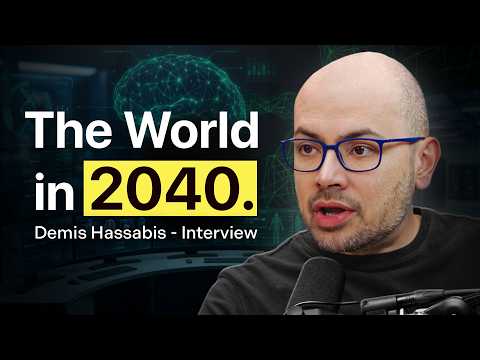 Photo: N43 and Hermes
technology // DeepMind's CEO on the AI breakthroughs t
A long-form interview with Google DeepMind's chief executive traces the path from AlphaFold to the frontier-model race — and what it means for science, compute, and the AGI timeline.
Video: “New Frontier: The AI Breakthrough That Will Change Everything (Google DeepMind CEO Interview)” by Sajjaad Khader — approximately ~147K views observed August 30, 2026.
01Why a DeepMind interview matters right now
When the chief executive of Google DeepMind sits for a long-form interview in 2026, the technology world listens for a simple reason: the lab has produced more verifiable scientific breakthroughs with artificial intelligence than almost any other institution. Demis Hassabis leads a research organization born in London in 2010, acquired by Google in 2014, and merged with Google Brain in 2023 to form Google DeepMind.
The interview, published on the New Frontier channel, has drawn roughly 147,000 views in the weeks after release — a substantial audience for a nearly hour-long technical conversation. It covers the state of frontier AI, the scientific agenda, and the timeline question every investor keeps asking: when does this become something bigger than a chatbot?
02The breakthrough agenda: science-first AI
DeepMind's distinguishing bet has always been that games and simulations are a proving ground for general-purpose learning systems, and that the same machinery can be pointed at hard science. That trajectory ran from Atari games to AlphaGo's victory over world Go champions in 2016, and then to AlphaFold, the protein-structure prediction system that cracked a 50-year-old grand challenge in biology.
In the interview, Hassabis frames the current moment as the payoff phase: the transition from systems that win games to systems that generate testable hypotheses in physics, mathematics, and drug discovery. The argument is that AI is becoming an instrument of science, not just a consumer product.
03Gemini-era models and multimodal reasoning
The Gemini model family, developed within Google DeepMind, represents the current frontier of Google's multimodal effort — systems trained across text, images, audio, and video rather than language alone. Multimodality matters because it lets a model reason about a chart, a molecule, or a circuit diagram the way it reasons about a paragraph.
Hassabis points to improvements in long-horizon reasoning — the ability of a model to hold a problem in mind across many steps, plan, and self-correct — as the capability that separates the current generation from the chatbots of the early 2020s.
04AI for science: AlphaFold's legacy and what comes next
The AlphaFold Protein Structure Database crossed 200 million predicted structures in 2022, covering nearly every scientifically useful protein known to science. The follow-on, AlphaFold 3, extended prediction to the interactions between proteins, DNA, RNA, and ligands — the level of detail that drug discovery actually needs.
The interview suggests the next targets: materials science, weather and climate modeling, and mathematics, where systems like AlphaProof have already earned medals at the International Mathematical Olympiad. The pattern is consistent — pick a domain with clear rules, verifiable answers, and enormous search spaces.
05AGI timelines: what the lab actually says
Hassabis has repeatedly said artificial general intelligence could arrive within five to ten years from the mid-2020s, while cautioning that the definition matters enormously. The interview pushes on this: he distinguishes systems that match human performance on measurable benchmarks from systems that display genuine autonomous scientific creativity.
The honest answer in 2026 is that nobody has a calibrated timeline, and the responsible reading of any CEO's forecast is as a statement of intent and resource planning, not a prediction with error bars.
06The compute and data realities behind frontier models
Frontier training runs now cost hundreds of millions of dollars in compute alone, concentrated in a handful of data centers running accelerator clusters that draw hundreds of megawatts. That concentration is a strategic fact: only a few organizations on Earth can afford to run the experiment.
Hassabis acknowledges the constraint and turns it around — the argument is that algorithmic efficiency, not raw scale, is where the next factor of progress comes from, because physics and economics will not hand out another hundredfold increase in compute for free.
07Risks, safety and governance
DeepMind's safety organization publishes research on alignment, interpretability, and misuse, and the interview covers the governance question directly: who decides what a frontier model is allowed to do, and how does verification work when the system's outputs are not human-checkable?
The position Hassabis advocates is international coordination on compute thresholds and safety evaluation, on the model of existing regimes for nuclear and aviation — pre-deployment testing, incident reporting, and independent audit.
08What to watch for next
Three signals will indicate whether the science-first agenda is working: independent replication of AI-generated discoveries in wet labs and clinics; agentic systems completing multi-day research tasks without hand-holding; and measurable progress on interpretability, the ability to explain why a model produced an output.
For readers tracking the field, the interview is worth the hour because it is one of the few places where a frontier-lab leader is asked to defend specifics rather than recite a vision statement.
Major model families by era — the frontier moves in roughly two-year generations.
AlphaFold database growth: predicted protein structures (millions). Source: DeepMind/EMBL-EBI announcements.
By N43 and Hermes for DutyStation News.


