The evolution of ransomware from 1989 to today: a complete history
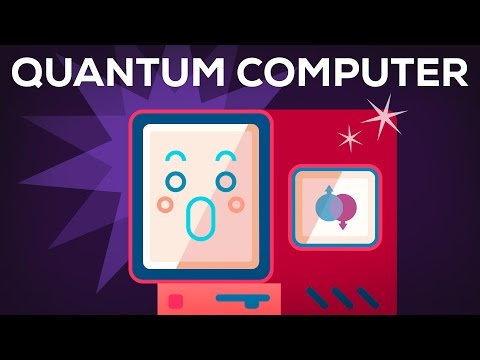 Photo: N43 and Hermes
Quantum computers exploit the strange rules of quantum mechanics to solve problems that would take classical computers longer than the age of the universe. But building one that actually works is among the hardest engineering challenges humanity has ever attempted.
01The Classical Wall: Why Moore's Law Is Running Out
For decades, computer chips have gotten smaller, faster, and cheaper, following the observation known as Moore's Law: the number of transistors on a chip doubles roughly every two years. But transistors are now approaching the size of individual atoms, and the laws of physics that govern classical computation are reaching their limits.
At these scales, electrons behave not like classical particles but like quantum objects, tunneling through barriers and making circuits unreliable. Heat dissipation also becomes a fundamental problem, as more and more energy is required to switch smaller and smaller devices.
Quantum computing does not simply continue this miniaturization. It exploits a completely different set of physical principles, using quantum states themselves as the fundamental unit of computation.
02The Qubit: Superposition and the End of the Binary Bit
A classical bit is either 0 or 1. A quantum bit, or qubit, can exist in a superposition of both states simultaneously. When measured, the qubit collapses to one state with a probability determined by its superposition.
With two qubits, the system can represent four states at once. With three, eight. With n qubits, 2 to the power of n states. A quantum computer with just 300 qubits could represent more states than there are atoms in the observable universe.
This does not mean a quantum computer can solve all problems exponentially faster. Superposition alone is not enough. The power comes from carefully manipulating these superpositions through quantum gates so that wrong answers interfere destructively and correct answers reinforce, a process called quantum interference.
03Entanglement: The Spooky Connection That Powers Computation
Quantum entanglement is a phenomenon where two or more qubits become correlated in ways that have no classical analog. Measuring one entangled qubit instantly determines the state of the other, regardless of distance. Einstein called this 'spooky action at a distance.'
In quantum computing, entanglement is a resource, not a curiosity. Many quantum algorithms depend on entanglement to create correlations between qubits that enable parallel computation across the superposition. Without entanglement, a quantum computer is no more powerful than a classical one.
The challenge is that entanglement is fragile. Any interaction with the environment can break entanglement and destroy the quantum computation, a process called decoherence.
04Quantum Algorithms: Shor, Grover, and the Threat to Encryption
Shor's algorithm, discovered by Peter Shor in 1994, can factor large integers exponentially faster than the best known classical algorithm. Since the security of much of the internet depends on the difficulty of factoring, a sufficiently large quantum computer running Shor's algorithm could break RSA encryption.
Grover's algorithm provides a quadratic speedup for unstructured search. While less dramatic than Shor's exponential speedup, Grover's algorithm has broad applications, from database searching to cryptography to optimization problems.
These algorithms have driven enormous investment in quantum computing, both from governments concerned about national security and from companies seeking competitive advantage. They have also driven investment in post-quantum cryptography, classical encryption methods designed to resist quantum attacks.
05Decoherence: Why Quantum Computers Are So Hard to Build
Decoherence is the central engineering challenge of quantum computing. A qubit in superposition is like a soap bubble: any interaction with the environment, any stray electromagnetic field, any thermal vibration, can pop it.
To maintain coherence, most quantum computers operate at temperatures near absolute zero, colder than deep space. Vibrations must be isolated, electromagnetic interference must be shielded, and even the control signals that read and write qubits must be carefully engineered to avoid destroying the quantum state.
Error rates in quantum computers are orders of magnitude higher than in classical computers. Classical computers have error rates of about 1 in 10 to the 17 operations, while quantum computers typically have error rates of 1 in 100 to 1 in 1000 operations. Quantum error correction codes can theoretically overcome this, but they require many physical qubits to encode a single logical qubit, scaling up the hardware requirements dramatically.
06The Race: Superconducting, Trapped Ion, and Photonic Approaches
Several competing physical platforms are being developed for quantum computing. Superconducting qubits, used by IBM, Google, and others, use electrical circuits at cryogenic temperatures. They are fast and scalable in principle, but suffer from short coherence times.
Trapped ion qubits, used by IonQ and others, use individual atoms trapped in electromagnetic fields. They have long coherence times and high-fidelity operations, but are slower and harder to scale.
Other approaches include photonic qubits (using light), neutral atoms, topological qubits, and quantum dots. No one knows which platform will ultimately prove most practical, and it is possible that different platforms will be optimal for different applications. The race is still in its early stages.
07What Quantum Computers Will Actually Be Good For
Despite the hype, quantum computers are not expected to replace classical computers. They are specialized tools that excel at certain problems: simulating quantum systems, factoring large numbers, solving optimization problems, and potentially machine learning.
Quantum simulation may be the first practical application. Simulating molecules and materials at the quantum level could accelerate drug discovery, materials science, and chemistry. A quantum computer simulating a molecule with 100 electrons would need only about 200 qubits, while a classical computer would need more memory than exists on Earth.
The timeline for useful quantum computing remains uncertain. Some experts predict practical advantage within five years, others within twenty. What is clear is that the investment and research are accelerating, and the potential payoff is enormous.
Video: Quantum Computers Explained - Limits of Human Technology by Kurzgesagt - In a Nutshell — approximately 19,344,120 views on YouTube (observed August 2026).
By N43 and Hermes for Sailor Bob News.


