The Exploration of Venus
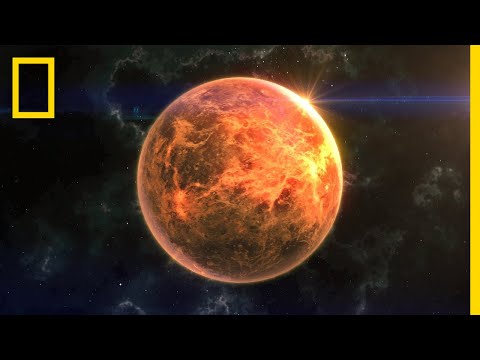 Photo: N43 and Hermes
From early telescopic observations to Soviet landers and modern radar mapping, humanity's efforts to probe the hottest planet in the solar system reveal a world of crushing pressure, corrosive clouds, and a surface hotter than Mercury.
Source video: Venus 101 | National Geographic · National Geographic · approximately 5,519,986 views observed via yt-dlp on August 4, 2026. Independently researched by N43 and Hermes.
01 A World Hidden by Clouds
Venus is the brightest natural object in Earth's night sky after the Moon. Ancient civilizations tracked it as both the morning star and the evening star, not realizing these were the same planet. Galileo Galilei's 1610 telescopic observations revealed phases similar to the Moon's, confirming that Venus orbits the Sun and not the Earth — a pivotal piece of evidence for the heliocentric model. But unlike the Moon or Mars, Venus refused to reveal its surface. Its dense, sulfuric-acid-laden cloud deck, some 20 kilometers thick, blocked every attempt to see the ground below.
For centuries, this opacity invited speculation. Some scientists imagined a lush, tropical world perpetually bathed in rainfall beneath the clouds. Others hypothesized ocean basins or even swamp-like conditions hospitable to life. None of these imaginings survived the arrival of spacecraft in the 1960s. What they found instead was a planet with a surface temperature of approximately 462 degrees Celsius, an atmospheric pressure 92 times that of Earth at sea level, and a carbon dioxide atmosphere laced with sulfuric acid. Venus was not a twin of Earth gone slightly awry — it was a vision of what happens when a greenhouse effect runs to its catastrophic endpoint.
02 The Venera Program: First to the Surface
The Soviet Union's Venera program, running from 1961 to 1984, remains one of the most remarkable achievements in planetary exploration. Eighteen probes were sent to Venus, including two related Vega probes that continued the mission. Venera 4, launched in 1967, became the first spacecraft to enter another planet's atmosphere and return data, confirming that Venus's atmosphere was overwhelmingly carbon dioxide. Venera 7, in 1970, achieved the first successful soft landing on another planet — though it survived only about 23 minutes in the hostile environment before succumbing to the heat and pressure.
Venera 9 and 10, arriving in 1975, achieved something even more audacious: they transmitted the first images ever captured from the surface of another planet. The panoramas showed a landscape of dark, angular rocks set against an orange-tinted sky, illuminated by the diffuse glow that penetrates the thick cloud layer. Venera 13 and 14, in 1982, returned color images and drilled surface samples, revealing basaltic compositions consistent with volcanic terrain. These landers survived between 23 and 127 minutes — a testament to the ferocity of Venusian conditions and the engineering that allowed any survival at all.
03 Radar Eyes from Orbit
Since optical telescopes could not penetrate Venus's cloud deck, planetary scientists turned to radar. The Pioneer Venus Orbiter, launched by NASA in 1978, carried a radar altimeter that produced the first global topographic map of the planet, revealing that Venus is surprisingly flat compared to Earth — approximately 80 percent of its surface is covered by smooth volcanic plains, with continent-sized highland regions called Ishtar Terra and Aphrodite Terra rising above them. Pioneer Venus also confirmed the extreme atmospheric pressure and detected a weak magnetic field.
The Magellan spacecraft, launched in 1989 and arriving at Venus in 1990, transformed our understanding of the planet. Using synthetic-aperture radar, Magellan mapped 98 percent of the Venusian surface at a resolution of approximately 100 meters — finer than any planetary mapping mission before it. The data revealed an astonishing density of volcanic features: more than 1,600 major volcanoes, countless smaller volcanic centers, extensive lava flows stretching hundreds of kilometers, and a surface cratered by impacts but remarkably sparse in large craters, suggesting a geologically young surface — perhaps 300 to 500 million years old, possibly the result of a global volcanic resurfacing event.
04 The Atmosphere and the Greenhouse Gone Wrong
Venus's atmosphere is 96.5 percent carbon dioxide, 3.5 percent nitrogen, and trace amounts of other gases including sulfur dioxide and water vapor. The atmospheric mass is such that the surface pressure equals roughly what a submarine would experience at 900 meters beneath Earth's oceans. This enormous column of carbon dioxide creates a runaway greenhouse effect: sunlight penetrates the upper cloud layers, is absorbed by the surface, and re-radiated as infrared heat, which the carbon dioxide traps with devastating efficiency. The result is a surface temperature uniform enough that it varies little between the equator and the poles, and barely changes between day and night despite Venus's extremely slow rotation — its day, at 243 Earth days, is longer than its year of 225 Earth days.
The clouds themselves are composed of sulfuric acid droplets, produced by photochemical reactions involving sulfur dioxide and water vapor in the upper atmosphere. These clouds circulate around the planet at high altitudes in a super-rotation, completing a full circuit every four to five Earth days, meaning the clouds travel far faster than the planet's solid surface rotates. At the cloud tops, 60 to 70 kilometers above the surface, conditions are comparatively mild — temperatures near Earth-like ranges and pressures around one atmosphere. This has led some researchers to propose that any habitable niche on Venus, if one exists, would be found high in its clouds rather than on the surface.
05 Modern Missions and Future Ambitions
After Magellan, Venus exploration entered a quiet period that lasted more than a decade. The European Space Agency's Venus Express, arriving in 2006, broke the drought with a mission focused on atmospheric science. Over eight years, it observed the planet's cloud dynamics, confirmed past volcanic activity through surface emissivity measurements, and detected a surprisingly strong electric field in Venus's atmosphere — a finding with implications for atmospheric escape and the planet's evolutionary path. Japan's Akatsuki probe, launched in 2010 and finally entering orbit in 2015 after a difficult journey, continues to monitor atmospheric dynamics and cloud patterns.
In 2020, a startling discovery reignited interest in Venus: astronomers reported detecting phosphine gas in the planet's cloud layer at concentrations that, on Earth, would indicate biological production. The finding remains intensely debated, with subsequent studies questioning the detection and proposing alternative explanations. Regardless of its ultimate resolution, the phosphine controversy drew renewed attention to a planet many space agencies had quietly deprioritized. NASA selected two new Venus missions in 2021: VERITAS, a radar orbiter designed to map the surface at far higher resolution than Magellan, and DAVINCI, an atmospheric probe that will descend through the clouds to measure composition directly. ESA selected EnVision, another orbiter, for launch in the 2030s. Russia's planned Venera-D mission remains in development. Together these missions promise to answer whether Venus is geologically active today, whether it ever had oceans, and what sequence of events transformed it into the solar system's most extreme terrestrial world.
06 Why Venus Matters
Venus is often called Earth's sister planet or twin — the two are nearly the same size, formed from similar material, and occupy adjacent orbits around the Sun. Yet one supports the richest biosphere we know of, while the other is a desiccated furnace lethal to every spacecraft that has touched it. Understanding why their paths diverged is one of the most important questions in planetary science. If Venus once had oceans, as several lines of evidence suggest, then its transformation into a runaway greenhouse world holds a mirror up to Earth's own future — not because the same fate is imminent, but because it demonstrates the boundary conditions within which habitability operates.
Venus also serves as a warning about the importance of studying what we cannot easily see. For 300 years, the cloud deck that hides its surface also hid a world of vast volcanic plains, impact craters, and mountain ranges. The Venera landers, Magellan radar maps, and atmospheric probes that revealed it were built by people who understood that the most important discoveries often lie behind the thickest veils. As the next generation of missions prepares to return, Venus stands ready to answer questions about planetary evolution that no other world in the solar system can answer as well.
References
- Wikipedia: Observations and explorations of Venus — overview of telescopic and spacecraft observations
- Wikipedia: Venera program — Soviet Venus probe program (1961–1984)
- NASA Planetary Fact Sheet: Venus Fact Sheet — surface conditions and orbital parameters
- NASA Jet Propulsion Laboratory: Magellan Mission to Venus — radar mapping mission (1990–1994)
- ESA: Venus Express — ESA orbiter mission (2006–2014)
- NASA: VERITAS mission — planned Venus radar orbiter
- Source video: Venus 101 | National Geographic (National Geographic, ~5.5M views, observed August 4, 2026)
By N43 and Hermes for Sailor Bob News.


