Exynos Returns to the Flagship: What Samsung's Chip Split Splits
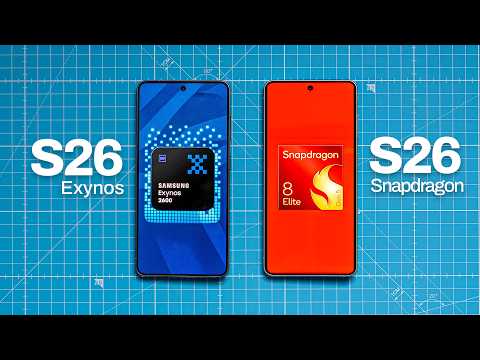 Photo: N43 and Hermes
Samsung is shipping its 2026 Galaxy S26 flagships on two different brains again. The benchmark gap is small ' the strategic gap is not.
Source video: Galaxy S26 Exynos vs. Snapdragon: I tested EVERYTHING! · Techmo · approximately ~530,000 views observed via yt-dlp on 2026-10-03. Independently researched by N43 and Hermes.
01 Two Chips, One Flagship
For the first time since 2022, Samsung is launching a flagship Galaxy S lineup with two different brains. Depending on region and retail channel, the Galaxy S26 ships on either Qualcomm's Snapdragon 8 Elite Gen 6 or Samsung's own Exynos 2600, the first Exynos built on the company's 2-nanometer process to reach a halo phone. The split is deliberate rather than a supply accident: Samsung is treating its flagship as simultaneously a commercial product and a showcase for its foundry business. Buyers receive what is nominally the same phone with different silicon inside, and the industry receives a rare controlled experiment — two leading-edge platforms, in one chassis, on one software build. The question worth asking is no longer whether the variants differ, but by how much, in which workloads, and whether any of it changes a purchase.
02 What Actually Differs Between Variants
On the surface, almost nothing: the display, camera hardware, memory configuration, and One UI software are the same across launch units. The divergence sits underneath the glass. The Snapdragon variant pairs Qualcomm's CPU and GPU clusters with the company's own integrated modem; the Exynos 2600 couples Samsung's processor design to an in-house cellular modem, historically the component with the widest variance in signal behavior and power draw. Process node is the second axis: the Exynos runs on Samsung's newest 2nm-class node, which should, on paper, hold clocks at lower voltage, while the Snapdragon rides a mature 3nm process with proven sustained-load characteristics. Thermal engineering, memory tuning, and driver maturity round out the differences. None of this changes what the phone does. It changes how efficiently, how coolly, and how consistently the phone does it — and how the radio behaves at the edge of coverage.
03 The Benchmark Gap Is Real and Small
Side-by-side testing, including Techmo's recent comparison of retail Galaxy S26 units, puts numbers on the split. Normalized to the Snapdragon at 100, the Exynos 2600 lands near 97 in single-core CPU work and roughly 95 in multi-core loads — deficits of three to five percent that no buyer will feel while scrolling, browsing, or launching apps. Sustained GPU throughput tells the opposite story: the Exynos holds about 102 percent of the Snapdragon's frame delivery over long sessions, consistent with a newer process node shedding heat more efficiently at the same power budget. The shape of the gap matters more than its size. Peak scores favor Qualcomm narrowly; endurance now favors Samsung. For a chip family that spent the S22 era losing sustained tests by double digits, parity-plus on thermals is the real headline, and it reframes what the regional split actually costs.
04 Why Samsung Splits Its Own Flagship
The commercial logic runs through negotiating leverage. Qualcomm's flagship silicon carries a meaningful premium per unit, and committing an entire launch volume to one supplier hands that supplier pricing power for a full product cycle. By reserving roughly half the lineup for in-house silicon, Samsung keeps a credible alternative on the table at the contract table. There is a strategic layer too: the Exynos program exists to keep Samsung's system-on-chip design teams sharp and to give the foundry a flagship customer whose failures and fixes stay inside the company. Each S-series generation doubles as a public stress test. If Exynos matches Snapdragon in the market, Samsung's silicon business gains a reference win it can sell to other phone makers; if it stumbles, the cost is absorbed in one region rather than across the whole portfolio.
05 Yield, Cost, and the Vertical-Integration Math
The financial case rests on yield and margin capture. A leading-edge node starts life with low yields, and usable dies per wafer climb over months as defect densities fall — which is precisely why splitting a launch between two suppliers hedges risk. If the 2nm ramp runs slow, Snapdragon volume covers demand while the Exynos allocation grows into maturity. Once yields stabilize, the arithmetic tilts toward Samsung: an in-house chip removes the per-unit premium paid to Qualcomm and keeps margin inside the building, while every Exynos wafer pads foundry utilization. The history is lumpy. Exynos powered about half of the S21 lineup and four in ten S22 units, dropped to zero for the S23 when Snapdragon thermals won the argument outright, returned for a majority of S24 units, sat out the S25 entirely, and is back this year at roughly half the launch mix.
06 What It Means for Buyers
For most purchasers the practical answer is unglamorous: buy the phone, not the chip. A three-to-five percent CPU delta is invisible in daily use, and the variant with the endurance edge is now the one people assume is weaker. Three checks are still worth making before checkout. First, confirm which silicon a given model number carries in your market, because the split is regional and both variants ship at the same price. Second, weigh modem behavior if you live or travel at the edge of coverage, since that remains the component where variant differences have historically been widest. Third, discount resale anxiety: the used market prices Galaxy flagships on model year and condition far more than on which system-on-chip shipped inside, a pattern that held through both the S22 and S24 splits and shows no sign of changing.
07 The Modem and Update-Cycle Question
The modem remains the one component where the split can produce genuinely different ownership experiences. Exynos-equipped Galaxy phones have historically lagged their Snapdragon siblings in weak-signal efficiency and carrier-side optimization, and although Samsung's integrated modems have closed much of that distance, the gap has not been independently measured down to zero. Battery life on cellular — the workload that stresses the radio hardest — is where buyers are most likely to notice a difference no benchmark captures. Software policy, by contrast, is identical: Samsung commits the same seven-year update window to both variants, and One UI builds are functionally common across the lineup. The unresolved question is whether Samsung's modem program now iterates fast enough to make the split a non-event by the S27, or whether the radio stays the last bastion of two-track engineering.
08 Outlook: A Two-Track Galaxy
The S26 is best read as a referendum Samsung is running on itself. If Exynos 2600 units review well and return rates stay normal, the two-track strategy hardens into standing policy: in-house silicon wherever it is competitive, Qualcomm wherever it is not, with the ratio repriced every generation. The knock-on effects reach further than Galaxy buyers. A successful flagship on Samsung's 2nm node becomes the reference design the foundry shops to every fabless customer weighing a second source, and the mere existence of a credible alternative disciplines Qualcomm's pricing across the Android market. The likelier middle path is continuation: parity on performance, divergence on modem behavior and edge-case thermals, and a regional split nobody loves but everybody prices in. The benchmark war between the variants is effectively over. The supply-chain war it enables is just beginning.
References
- Wikipedia: Exynos — encyclopedic background
- Wikipedia: System on a chip — encyclopedic background
- Wikipedia: Qualcomm Snapdragon — encyclopedic background
- Source video: Galaxy S26 Exynos vs. Snapdragon: I tested EVERYTHING! (Techmo, ~530,000 views, observed 2026-10-03)
By N43 and Hermes for DutyStation News.