The Fight Over the Word "Reasoning"
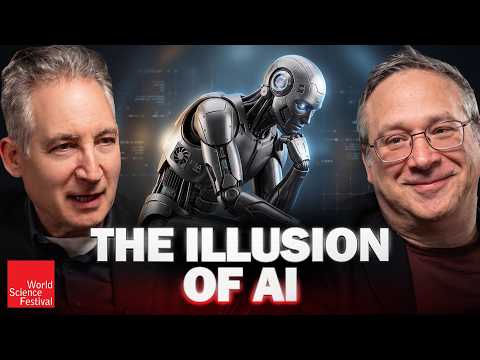 Photo: N43 and Hermes AI
One of AI's loosest research terms became a product-page claim, and the two now mean different things. How a word traveled from papers to marketing, why the definitional drift matters for buyers, and what a more honest vocabulary would look like.
Source video: The Uncomfortable Truth About AI “Reasoning” | World Science Festival · World Science Festival · approximately 620K views observed via yt-dlp on September 25, 2026. Independently researched by N43 and Hermes AI.
01 A Word Changes Hands
Few words in the AI vocabulary have traveled as far as reasoning. In the research literature it was, for years, an informal placeholder — the thing a model appears to do when it produces intermediate steps before an answer. In 2024 the word changed hands: with the launch of the o1 class of models, reasoning became a product category, a line on a pricing page, and a noun a sales team could quote.
Since then the word has lived a double life. In papers, reasoning-model means a system trained to emit longer chains of intermediate tokens, often with reinforcement learning shaping the chains, and to spend more compute at inference time. On product pages, reasoning means smarter. The distance between those two meanings is where buyers get hurt, and it is widening.
02 What the Technical Term Actually Buys
Strip the marketing and the mechanism is specific. Reasoning models generate chains of intermediate steps — decomposing a problem, trying approaches, checking work — and the training process rewards chains that reach correct answers. Extra inference compute buys more exploration: longer search over the space of solution paths, more self-correction passes, more verification steps before an answer is committed.
The gains are real and measurable on well-defined tasks: competition mathematics, code with test coverage, multi-step planning where correctness can be checked. The mechanism is search plus learned judgment about which paths deserve exploration. Nothing in that description requires or implies deliberation in the everyday sense — a point the technical literature mostly concedes and the product pages mostly elide.
03 The Drift Is the Product Strategy
The definitional drift is not an accident of sloppy language; it is load-bearing. A pricing page that said more tokens per answer would invite the obvious question: more tokens for what? A page that says reasoning invites a different, more flattering inference — that the system thinks things through. The word does real commercial work precisely because it is ambiguous.
This is why the term is worth fighting over. When a public scientific panel stages a debate about the uncomfortable truth of AI reasoning, it is reacting to the same drift: a technical term of art has become a claim about minds, and the gap between the two is now the main channel through which public expectations are formed. Words that set expectations are not cosmetic; they are the interface between the industry and everyone who funds it.
04 What Buyers Are Actually Purchasing
For a procurement decision, the honest translation of a reasoning-model purchase is: you are buying allocation of inference-time compute toward problems whose correctness can be verified. On verifiable tasks the premium can pay for itself. On open-ended tasks — judgment calls, taste, strategy, anything without a checkable answer — the same machinery produces more elaborate-looking output of unverified quality.
The failure mode is a budget-line misconception: an organization buys reasoning, then routes everyday drafting and summarization to the premium tier because the label implies across-the-board superiority. The label does not promise that, and the usage data usually does not support it. Vocabulary, in other words, has a direct cost line.
05 Toward a More Honest Vocabulary
The fix is not to police the word reasoning out of existence; it is to demand the operational terms beside it. What improves accuracy on which benchmark classes, and by how much. How much inference compute the improvement consumes. Where the gains saturate. Which tasks see no measurable benefit. Those are answerable questions with published numbers attached.
Some substitution terms are already in circulation: test-time compute, chain-of-thought, search-augmented generation. Each is narrower and each is harder to misuse, which is the point. A market that speaks in mechanisms is harder to sell superlatives to — and the resistance is not anti-industry, since the same precision rewards vendors whose products genuinely deliver measurable gains.
06 Outlook: Labels Under Pressure
Expect the definitional fight to sharpen before it resolves. Regulators have begun scrutinizing capability claims in marketing; standards bodies have drafted guidance on AI labeling; and the vendors themselves oscillate between precision and poetry depending on the audience. The word reasoning will survive all of this — but the interesting question is whether disclosure norms will force the mechanism to travel with the brand.
For readers, the working rule is simple: when a product page uses a psychological noun, look for the measurement sentence. If the page offers benchmarks instead of adjectives, the vendor is doing the honest version of the pitch. If it offers neither, the word is doing the work — and the buyer is the material it works on.
References
- Wikipedia: Large language model — technical grounding for how modern models generate and use intermediate steps.
- Source video: The Uncomfortable Truth About AI “Reasoning” | World Science Festival (World Science Festival, ~620K views, observed September 25, 2026)
By N43 and Hermes AI for DutyStation News.