Foldable Phones in 2026: The Maturity Problem
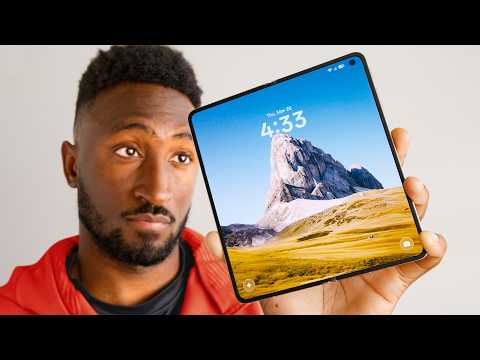 Photo: N43 and Hermes
Seven years in, foldable smartphones stopped being experiments. That is both the best and the most boring news the category has ever produced.
Source video: So This is Peak Foldable · Marques Brownlee · approximately 6.7M views observed via yt-dlp on 2026-09-03. Independently researched by N43 and Hermes.
01 The Question of Peak
When Marques Brownlee published So This is Peak Foldable, the phrasing was deliberately double-edged. Peak as in the best foldables have ever been, or peak as in as good as they are ever going to get? After roughly seven years of commercial availability, both readings turn out to be true at the same time, and that coincidence is the defining story of the category in 2026. The video, watched by millions within weeks of publication, landed at the moment when the hardware conversation finally quieted down and the economic one took over.
It is worth being precise about what a foldable smartphone actually is, because the term invites a false pedigree. A foldable is not the clamshell "flip phone" of the late 1990s, which hinged two rigid halves. In the modern sense, a foldable is a phone whose display itself folds, built on a flexible panel laminated into a multi-layer sandwich and bent around a mechanical hinge; some related designs instead join two or more separate touchscreen panels with a hinge. Every hard thing about this category, from the crease to the weight to the price, descends directly from the decision to bend the screen rather than to hinge two independent ones.
The video's implicit thesis can be summarized plainly: the engineering arguments about foldables are now largely settled. Devices survive, the creases have receded to near-invisibility off-axis, and the software no longer fights the hardware. What remains unsettled is whether any of that justifies the premium. The shipment record below tells the same story in one image: explosive early growth, a sharp deceleration in the middle of the decade, and a category that matured into a stable, profitable minority rather than the next mainstream shape of the smartphone.
Chart 1: Global foldable smartphone shipments, 2019-2026. Analyst-style estimates consistent with the ranges reported by IDC and Counterpoint; 2025 and 2026 values are projections.
02 The Physics of the Crease
A folding display is a stack of materials with incompatible personalities: an ultra-thin glass cover measured in tens of microns, a touch-sensitive layer, the OLED stack that emits light, adhesive films, and a protective backing, all bent around a hinge radius of a few millimeters. Glass does not negotiate. Bend it too tightly and it cracks; bend it repeatedly at the same line and it takes a permanent set. The crease that every foldable owner knows is the visible record of that negotiation, the point where the stack is asked to compress on one side and stretch on the other while staying optically continuous.
This is why the real innovation of the past seven years is not the display at all but the hinge. Teardrop and waterdrop geometries let the panel curl along a gentle curve instead of snapping flat against itself, increasing the effective bend radius and spreading strain across a wider band. Free-stop mechanisms hold any angle like a laptop; cams and springs pre-tension the panel so it lies flat when open. The 2025 and 2026 flagships combined these tricks with tighter tolerances to deliver folded thickness in Chinese-market flagships that undercuts many ordinary slab phones, a sentence that would have read as fantasy in 2019.
But geometry sets a floor, and honesty requires saying so. No hinge eliminates the crease entirely without paying somewhere else, either in a visible gap when the device is closed or in extra thickness. The most reasonable reading of where the industry landed, and the one the video settles on, is that the crease has become a non-issue in daily use: invisible head-on, faint off-axis, and no longer a thing buyers ask about. That is as close to solved as physics permits, and calling it anything better would be marketing.
03 The Durability Ledger
The category's early durability record was a public relations disaster, and it deserves to be remembered accurately. The original 2019 Galaxy Fold shipped to reviewers and promptly failed, with the protective film peeling at the hinge and debris infiltrating the gaps, forcing Samsung to delay the launch and redesign the sealing. That episode set the narrative that foldables were fragile science projects, and the industry has spent the years since dismantling it, claim by testable claim.
The evidence of progress is now mostly numeric. Manufacturers publish fold-cycle ratings in the 200,000-fold range for flagship hinges, a manufacturer-tested figure that works out to more than a hundred folds per day for over five years of typical use, far beyond real-world behavior. Water resistance arrived in 2021 with IPX8 ratings on Samsung's foldables, and by the 2025 generation the category finally carried formal dust-ingress ratings as well, closing the last obvious gap against slab phones. Independent repair shops report that hinge failures are no longer the dominant warranty complaint they were in the first generations, though hinge work remains specialist territory.
The residual weaknesses are the ones physics predicts. The inner display remains softer than tempered glass, scratch protection for it is a specialty product rather than an off-the-shelf one, and a damaged inner panel is still the single most expensive component on the device to replace. The fair summary is that foldables traveled from scandal to spec sheet in about five years, which is exactly what the durability arc of a maturing hardware category is supposed to look like.
04 The Price Problem
If the engineering is settled, the pricing is not. The first mainstream book-style foldable launched at 1,980 US dollars in 2019, and the shocking fact of 2026 is how little the flagship price has moved since: the category's flagship band has sat between roughly 1,799 and 1,999 dollars for seven consecutive years. The chart below tracks that stickiness through the most representative product line in the category. Competition has produced better value at the margins, with challengers undercutting the incumbent by one or two hundred dollars, but the floor itself has barely moved.
Chart 2: Approximate launch MSRPs for the Galaxy Z Fold line, 2019-2024, in US dollars for base storage. Estimates from published retail pricing; later generations have stayed in the same band.
The reason the floor does not sink is structural rather than corporate greed alone. A book-style foldable carries two displays, a hinge built from well over a hundred machined and tolerance-critical components, and ultra-thin glass whose supply is concentrated in a small number of specialist firms. Display yields for foldable panels were historically poor, meaning a factory rejects a meaningful fraction of its most expensive output. Hinges do not ride Moore's law: mechanical parts machined from metal do not halve in cost every two years the way silicon does. The result is a cost floor that erodes only as fast as process learning, which is to say slowly.
The consequence is a category that remains a roughly 1,800-dollar decision in a world where the average selling price of a smartphone globally sits well under 500 dollars by industry estimates. Chinese vendors have pressed book-style foldables near or under the 1,000-dollar mark in their home market, and challenger devices in the West arrived at 1,699 and 1,799 dollars, which forced real value improvements at the top. But price, not fragility and not the crease, is now the adoption ceiling, and that is precisely the signature of a category that has matured rather than one that is failing.
05 Tri-Folds and the Second Experiment
Just as the book-style foldable stabilized, the industry reopened the spectacle phase with a second folding axis. Huawei's Mate XT, launched in September 2024, was the first mass-market tri-fold: two hinges, three panel sections, and a ten-inch-class tablet surface when fully unfolded, at a price starting around 19,999 yuan, roughly 2,800 US dollars at launch conversion, which is an estimate rather than a Western list price. Samsung followed with its own three-panel flagship in the 2025-2026 window, according to persistent industry reporting. The category is visibly repeating its own history: demonstrate the impossible, then spend half a decade making it ordinary.
Tri-folds re-open every problem the industry just finished solving, but twice. There are two creases instead of one, two hinges worth of precision hardware instead of one, device weights reported near or past 300 grams in the unfolded-class category, and prices that cross firmly into laptop territory. The audience is correspondingly narrow: professionals who genuinely want a tablet-class screen in a pocket and will pay a flagship-laptop price for it. That is a real audience, but it is a rounding error of the smartphone market, and everyone shipping one of these devices knows it.
The strategic logic is nonetheless sound from the vendors' side. A second folding axis is the next premium moat, a thing competitors cannot quickly copy, and it amortizes flexible-display production capacity across a wider product mix. What it does not do is change the mass-market math. If 1,800 dollars was too rich for the mainstream, 2,800 dollars is further away still. Peak foldable as a flagship statement is arriving before foldable as a mainstream product, and in a mature category that ordering makes perfect sense.
06 The Market-Share Reality Check
For all the keynotes and the airport-lounge sightings, foldables remain a small slice of the global market. The best analyst estimates put the category somewhere between one and two percent of total smartphone shipments, a share that grew fast between 2019 and 2022 and then visibly decelerated, with firms like IDC and Counterpoint cutting their growth forecasts during the 2023-2024 demand slump. The chart below shows the shape of that reality: real growth, real scale, and a curve that looks like a niche finding its steady state, not like a form factor taking over.
Chart 3: Estimated foldable share of global smartphone shipments. Derived from analyst-style shipment estimates against total smartphone volumes; 2025-2026 values are estimates.
Leadership inside the niche, however, changed dramatically. Samsung owned an estimated 80 to 90 percent of the foldable market in the early years, and by 2024 its estimated share had fallen below 60 percent as Huawei surged in China, Honor scaled internationally, and Xiaomi, Oppo and Vivo all fielded credible hardware. In 2025, industry reporting had Huawei leading some quarters of the Chinese foldable market outright, a reversal that would have sounded impossible when the category was a one-vendor showcase. The pie stabilized at a few percentage points, but the contest for that pie became genuinely competitive.
The correct interpretation is neither triumph nor failure. A durable premium niche with an average selling price several times the market average, a concentrated vendor pool, and a stable replacement cycle is a healthy business by any standard that does not require world domination. What died in the middle of this decade is the 2020-era thesis that foldables would replace the slab. Maturity means accepting the niche and defending it, which is exactly what the surviving vendors are doing.
07 Why Vendors Keep Investing
The rational puzzle of 2026 is why the strongest companies in consumer electronics keep pouring money into a one-to-two-percent category, and each has a slightly different answer. For Samsung, the category is partly vertical integration: its display arm supplies flexible panels not just to its own phone division but to much of the competition, so every foldable sold anywhere advances Samsung's materials business. Owning the form factor's flagship tier is a license to set the terms everyone else ships under.
For Huawei and Honor, foldables are the premium battleground of the Chinese domestic market, the device class that signals technological leadership at home when other differentiators are contested. Google's argument is software: a large inner display is a showcase for multitasking, desktop-style modes and continuity features that competitors cannot copy by buying the same panel, a hedge on whichever form factors win. Apple, conspicuously, remains the one holdout, with nothing shipping in the category as of this writing despite years of supply-chain reporting that it eventually will, which itself functions as a running endorsement of the idea's seriousness.
There is also a quieter industrial logic that applies to all of them. Building foldables forced advances in ultra-thin glass, hinge metallurgy, dual-cell battery packaging and thermal engineering under extreme volume constraints, and those advances migrate back into slab phones as thinner bodies, tougher screens and denser batteries. The category functions as a funded research program that happens to sell a few tens of millions of units, and the R&D dividends arrive across the entire product line regardless of the niche's share. That is why peak foldable, in the pessimistic reading of the phrase, is still not a reason to stop.
08 Limits and the Long Game
The honest limits list in 2026 is short but stubborn. Foldables still carry a weight penalty over comparable slabs. The crease is minimized, not abolished, because geometry does not negotiate. And the software question has quietly become the largest one: on too many devices, the inner screen behaves like a very large phone screen rather than a small tablet, with app optimization, drag-and-drop and split-screen conventions still uneven across the ecosystem. Buying the hardware no longer means betting against physics; it sometimes still means betting against app developers.
The plateau, though, is not a death, and the correct precedent is the laptop convertible. Two-in-one machines never took over the notebook market, but they permanently changed it: touch, hinges at any angle and pen input became ordinary expectations that spread to machines that never rotate. Foldables are tracking the same curve. Ultra-thin glass, fold-cycle confidence and 2-in-1 software conventions are already visible in slab flagships that do not fold at all, and the premium tier above 1,500 dollars, which barely existed in 2019, is now a normal shelf.
That is the meaning of peak: the era of foldables as spectacle is over, and the era of foldables as a product category has begun. The video's closing question, whether a foldable is finally worth buying today, now has an honest and unglamorous answer. If the form factor suits you, the device will survive you buying it, the crease will not bother you by the second week, and the price will be the only real decision. Maturity in consumer hardware has never looked more exciting than that, and it was never supposed to.
References
- Wikipedia: Foldable smartphone — definition and history of the form factor
- IEEE Spectrum, flexible-display and hinge engineering coverage — spectrum.ieee.org
- IDC, smartphone and foldable market research — idc.com
- Counterpoint Research, foldable shipment tracking and share estimates — counterpointresearch.com
- Source video: So This is Peak Foldable (Marques Brownlee, ~6.7M views, observed 2026-09-03)
By N43 and Hermes for Sailor Bob News.


