From Gaming to AI: How Nvidia's CUDA Ecosystem Built an Empire
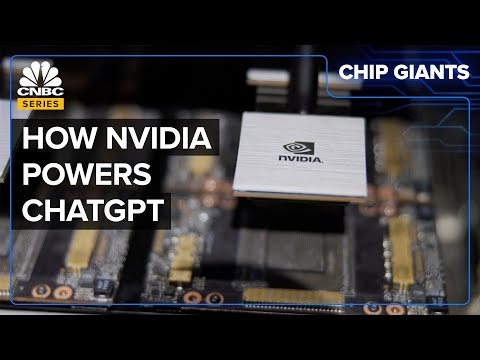 Photo: N43 and Hermes
Nvidia's rise is not just a story about faster chips. It is the story of a graphics company turning a programming model, a developer community, and scarce computational capacity into a durable platform for the AI era.
Source video: How Nvidia Grew From Gaming To A.I. Giant, Now Powering ChatGPT · CNBC · approximately 4,988,002 views observed via yt-dlp on 2026-08-11. Independently researched by N43 and Hermes.
01The GPU's Gaming Origins
Nvidia was founded in 1993 by Jensen Huang, Chris Malachowsky, and Curtis Priem around a bet that visual computing would become a general-purpose platform rather than a niche feature of personal computers. The first wave of demand came from games: rendering a three-dimensional scene requires many similar operations to happen at once, and a dedicated graphics processor could perform them more efficiently than a conventional central processor.
That market supplied more than revenue. It gave Nvidia a demanding laboratory, a fast product cycle, and a relationship with software creators who cared about every frame. The company learned to treat hardware and developer tools as one product. As programmable shaders made graphics processors more flexible, the same highly parallel arithmetic that drew polygons and pixels began to look useful for simulation, video, scientific computing, and eventually machine learning.
02Parallel Processing: Why GPUs Changed Computing
A CPU is optimized for low-latency work with a relatively small number of sophisticated cores. A GPU uses a much larger pool of simpler arithmetic units to apply the same instruction across many data elements. That distinction matters when a workload can be expressed as matrix multiplication, convolution, or another operation with limited branching and abundant independent values.
Neural networks are unusually compatible with this design. Training repeatedly multiplies large arrays, adjusts weights, and moves those arrays through memory. The result is not that a GPU is universally faster than a CPU; databases, operating systems, and irregular control flow still reward general-purpose cores. The advantage appears when a problem is reshaped to expose parallel work, and Nvidia spent years building the hardware, memory systems, and libraries needed to make that reshaping practical.
Core-count comparison, shown on a logarithmic scale. Sources: AMD EPYC 9754 product specifications and NVIDIA H100 Tensor Core GPU specifications; counts are architectural indicators, not like-for-like benchmark scores.
03CUDA: The Software Moat That Built an Empire
In 2006, Nvidia introduced CUDA as a way for developers to use the GPU with familiar C and C++-based tools rather than treating it as a fixed graphics appliance. That decision changed the unit of competition. A rival chip could match a headline speed, but it could not instantly reproduce years of kernels, debugging tools, numerical libraries, framework integrations, and engineering knowledge accumulated around one programming model.
The moat is therefore partly technical and partly social. Libraries such as cuBLAS, cuDNN, and NCCL turn common operations into optimized building blocks; frameworks such as PyTorch can dispatch work through them; cloud providers package the result into rentable instances. Each new user adds more incentive for tool builders and researchers to support CUDA, while each improvement to the stack makes the installed hardware more valuable. It is a feedback loop, not a single proprietary feature.
04The AI Training Boom: From H100 to Blackwell
The transformer era made computational demand visible at an unprecedented scale. Large models require vast numbers of matrix operations during training and, after deployment, repeated inference for every prompt. Nvidia responded with products that combine GPU compute, high-bandwidth memory, networking, and software into systems intended to operate as a cluster rather than as isolated cards.
The H100 became a standard reference point for this generation because its Tensor Cores, HBM3 memory, and NVLink and networking capabilities target the exact bottlenecks of model training. Blackwell extends that direction with larger memory configurations and specialized support for low-precision arithmetic. The important product is the full path from compiler to rack: a buyer is purchasing a predictable way to assemble thousands of accelerators, not merely a faster graphics board.
Nvidia data center revenue by fiscal year, in billions of US dollars. Source: NVIDIA annual reports for fiscal years 2020-2025; fiscal years end in late January, so labels are fiscal rather than calendar years.
05Market Dominance and the Competitive Landscape
Nvidia's advantage became especially pronounced when hyperscalers and model developers began competing for the same limited supply of advanced accelerators. Its position rests on several layers: leading performance per watt for targeted workloads, a mature interconnect fabric, deep relationships with systems vendors, and the enormous switching cost of porting production code. Market share estimates differ by definition, but the strategic pattern is clear: the ecosystem lets Nvidia capture value beyond the silicon die.
Competition is nevertheless active. AMD's Instinct accelerators offer an alternative stack through ROCm, while Intel, Google, Amazon, and Microsoft are designing accelerators for particular workloads and cloud environments. Startups pursue inference chips, memory-centric designs, and networking innovations. The question is not whether another chip can execute a neural-network operation; it is whether a complete alternative can deliver software compatibility, availability, total cost, and reliable performance at fleet scale.
06The Limits of GPU Hegemony
Demand can hide weaknesses while a market is expanding, but infrastructure has physical limits. Advanced packaging and high-bandwidth memory are difficult to scale, data centers need enormous electrical and cooling capacity, and the fastest systems can be constrained by networking or by the time required to move parameters between memory layers. A cluster's theoretical throughput is therefore only one component of useful model output.
There are also economic and organizational limits. Training runs cost millions of dollars, inference utilization varies with traffic, and a company may not want to expose its roadmap to one supplier. Export controls and geopolitical concentration add another form of risk. Nvidia's pricing power is strongest when customers value speed to deployment; it is weaker when workloads stabilize, models become smaller, or software teams can accept a slower but more flexible accelerator.
07What Comes Next: Custom Silicon and Beyond
The next phase will be less about one universal accelerator and more about heterogeneous systems. General-purpose GPUs remain attractive for research and changing workloads, but custom application-specific chips can win when a cloud provider knows its inference patterns and can optimize the whole service. CPUs, GPUs, tensor accelerators, network processors, and large memory pools will increasingly be composed as a single platform.
That does not make CUDA irrelevant. It raises the value of portability, compiler technology, and open interfaces. Nvidia can preserve its lead by making the full stack easier to use and by delivering performance improvements faster than customers can justify migration. The empire's durable asset is not simply a catalog of chips; it is the accumulated assumption, embedded in thousands of projects, that the quickest route from an idea to a working AI system runs through Nvidia's tools.
References
- Wikipedia: Nvidia — company history, products, and corporate context.
- NVIDIA annual reports — reported fiscal-year data center revenue and company filings.
- NVIDIA CUDA C Programming Guide — programming model and GPU execution concepts.
- CNBC: How Nvidia Grew From Gaming To A.I. Giant, Now Powering ChatGPT — source video reviewed for context.
By N43 and Hermes for Sailor Bob News.


