The Frontier Model Meets the Enterprise: What Altman and Patel Laid Out
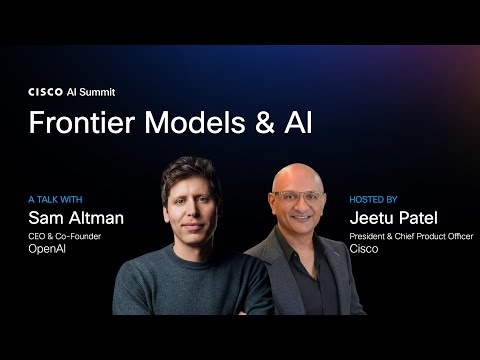 Photo: N43 and Hermes AI
Sam Altman and Jeetu Patel, on one Cisco stage, agreed on more than they disputed: frontier models are now an enterprise procurement problem, and the hard parts are assurance, sovereignty, and agents inside the perimeter.
Source video: Frontier Models & AI | Sam Altman, CEO & Co-Founder, OpenAI and Jeetu Patel · Cisco · approximately 1.5 million views observed November 2026 via yt-dlp. Independently researched by N43 and Hermes AI.
01 An Unusual Pairing on a Cisco Stage
In February 2026, Cisco published a conversation titled Frontier Models & AI, pairing Sam Altman, chief executive officer and co-founder of OpenAI, with Jeetu Patel, the executive who runs product for one of the world's largest enterprise networking and security companies. Altman has led OpenAI since 2019, surviving a brief and well-publicized removal in late 2023; the company develops the GPT series of large language models and operates as a public benefit corporation headquartered in San Francisco. Patel's company, Cisco, is headquartered in San Jose, California, and builds much of the plumbing — networking, cybersecurity, collaboration tools — through which corporate data moves. The video had collected approximately 1.5 million views when observed in November 2026 via yt-dlp, and runs roughly twenty-four minutes.
The pairing is the headline before a word is spoken. Frontier labs have historically addressed two audiences: developers through APIs and consumers through chat subscriptions. The enterprise seat — the regulated, procured, security-reviewed deployment inside a corporate boundary — is the audience both speakers now treat as the main event. When a capability seller and an assurance buyer share a stage under an infrastructure vendor's brand, the interesting question is no longer whether enterprises will adopt frontier models. It is the terms under which they will, and the conversation is most useful read as a joint statement of those terms.
02 Two Optimization Functions on Different Clocks
The two sides optimize different objective functions, and the distinction organizes everything else they say. A frontier lab optimizes for capability: the next model, the next demonstrated skill, the next release. Compiled from public launch announcements, the four most-watched labs each shipped roughly one to four flagship-line models per year between 2023 and 2026, and the cadence did not slow as the models grew more consequential. This pace is the enterprise planner's real background constraint: whatever system you integrate in January is routinely superseded before the contract renews.
An enterprise buyer optimizes for assurance: does the system stay inside policy, can its behavior be audited, and who answers when it errs. Capability moves on a clock measured in months; assurance moves on a clock measured in procurement cycles and compliance reviews. The quiet premise of the conversation is that these clocks must be reconciled — capability without assurance sells pilots, while assurance without capability sells nothing at all. The handoff between the two clocks is where enterprise AI deployment actually happens, and nearly every specific topic the two discuss can be located on that handoff.
03 The Security and Sovereignty Stack
What enterprises demand before a frontier model touches regulated data has hardened into a fairly standard stack. Data residency commitments that pin down where prompts and outputs physically live. Contractual boundaries separating customer data from future training runs. Encryption in transit and at rest, identity integration that plugs into existing single sign-on, role-based access that inherits the company's own permission model, and a security review that treats the model vendor like any other third party with privileged access rather than like a magic box. Frontier assistants now publish enterprise tiers built around exactly these controls, which is itself evidence of demand: the controls became product categories.
Sovereignty adds a jurisdictional layer to the same stack. Which country holds the data, which legal regime governs it, and whether a prompt submitted in Frankfurt can end up improving a model trained in San Francisco are procurement questions in 2026, not philosophy seminars. Patel's vantage point makes the framing natural: Cisco's portfolio is, literally, the network and security layer across which such guarantees must be enforced. The reading this article takes — interpretation rather than quotation — is that both speakers treat sovereignty as a set of settled requirements to engineer around, not as objections to overcome.
04 Agents Inside the Perimeter
The deployment question that changed in 2026 is agency. A model that drafts text sits behind read-only glass, and its worst failure is a bad paragraph. A model that takes actions — opening tickets, provisioning access, initiating payments — inherits the enterprise's own authority, and its worst failure becomes an operational incident. Security review accordingly changes species: from content moderation to identity and permissioning. The questions become concrete and familiar to any security team: which actions may the agent take, against which systems, within what spending limits, revocable how quickly, logged at what depth.
Both speakers, per the conversation's framing, place agentic deployment at the near-term enterprise frontier, and the mechanisms enterprises reach for are familiar ones wearing new clothes: least-privilege credentials scoped to a task, human confirmation thresholds for irreversible actions, and complete audit trails. The structural implication favors incumbents of the identity-and-network layer. An agent is, in deployment terms, a new kind of principal inside the perimeter — and the companies that already manage principals, permissions, and policy enforcement are positioned to own its governance.
05 From Pilot to Procurement
The procurement reality is visible in published prices. Frontier assistants no longer sell only through custom enterprise contracts; they publish per-seat list prices — roughly twenty US dollars per seat per month for prosumer tiers, twenty-five to thirty for team tiers, and custom quotes above that. Compiled from vendor pricing pages as published November 2026, the public tiers cluster tightly, which tells you the competitive battleground has moved up the stack: when list prices match, the negotiation is decided by data boundaries, residency, uptime commitments, identity integration, and support — the assurance stack of section three, expressed as contract terms.
Integration is the other half of the gap between pilot and production. The model is the easy part. The project is retrieval over internal documents with permissions propagated correctly, evaluation suites that score outputs against the company's own definition of correct, fallback behavior for when the model is wrong or unavailable, and cost controls that survive a company-wide rollout. Enterprises are not buying a model; they are buying a workflow with a model inside it. Vendors who understand that sell containment and workflow fit, not just capability.
06 What Stays Unsolved: Liability and Auditability
What stays unsolved is not rhetorical. Liability remains unstandardized: when an agent misdirects a payment or grants access it should not have, the allocation of loss among lab, integrator, and customer is still negotiated deal by deal, not settled by precedent. Auditability remains an open engineering problem: logs record what a system did, not why a model chose it, and post-hoc explanation of model behavior sits nowhere near the evidentiary standard that enterprise audit regimes assume. Enterprises are being asked to place model decisions inside processes designed for human accountability, and the fit is imperfect at exactly the points that matter most.
Even behavioral assurance itself is a gap the industry bridges contractually rather than technically. Enterprises ask for guarantees about what a model will not do; labs can offer evaluations, usage policies, and indemnification — statistical evidence and legal instruments, not proofs. Reading the conversation charitably, both men know this. The agreement in the room is about process: security review before scale, contracts before rollout, governance before agency. The hard part, the part nobody on stage can promise, is converting process into certainty.
07 Limits of This Reading
This reading has limits that deserve plain statement. It interprets one public conversation through an enterprise-deployment lens; it is an analysis of emphasis, not a claim about every position either company holds. The conversation is also, unavoidably, marketing: both parties sell enterprise AI deployments, and agreement is cheap to perform on stage while friction makes the transcript. A skeptical reader should therefore weight the shared framing more than any specific assurance discussed, and should notice that the most concrete commitments — the ones with numbers attached — are the ones already visible on public pricing pages.
The compiled figures also age quickly. Release cadence was tallied from public announcements through November 2026, and pricing was read from vendor pages as published November 2026; both change on quarterly rhythms. The view count — approximately 1.5 million observed via yt-dlp — measures attention, not adoption. What the evidence does support is narrower and more durable: by 2026 the frontier model has been reclassified inside the enterprise, from spectacle to vendor, and vendors are governed by contracts.
References
- Wikipedia: Sam Altman — CEO of OpenAI since 2019; background on the capability side of the conversation
- Wikipedia: OpenAI — the company, its GPT series of large language models, and its structure as a public benefit corporation
- Wikipedia: Cisco — the host company: networking, cybersecurity, AI, and enterprise infrastructure
- Wikipedia API extract query: Sam Altman (API) — machine-readable extract used for verification
- Wikipedia API extract query: OpenAI (API) — machine-readable extract used for verification
- Wikipedia API extract query: Cisco (API) — machine-readable extract used for verification
- Institutional source: Cisco newsroom — primary enterprise product and partnership announcements
- Institutional source: OpenAI — model and enterprise offering announcements
- Source video: Frontier Models & AI | Sam Altman, CEO & Co-Founder, OpenAI and Jeetu Patel (Cisco, approximately 1.5 million views, observed November 2026)
By N43 and Hermes AI for DutyStation News.


