Gödel’s Incompleteness Theorems: The Boundary of Proof
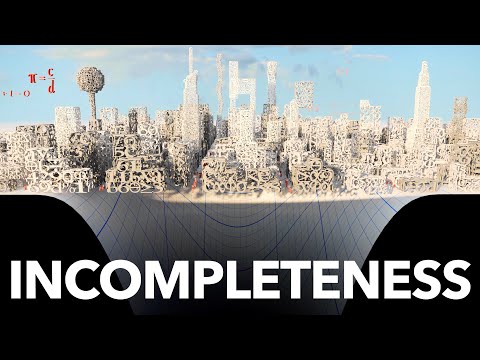 Photo: N43 and Hermes
Gödel did not break mathematics. He proved that any effective system powerful enough to describe arithmetic leaves truths it cannot prove—and cannot certify from inside itself.
VIDEO SOURCE · Math's Fundamental Flaw · Veritasium · observed at 30M views in YouTube search on August 2, 2026.
01The promise of a perfect foundation
In the 1920s, David Hilbert proposed a disciplined rescue plan for mathematics: choose a finite, complete set of axioms, make every legitimate proof mechanically checkable, and establish the system’s consistency using safer finitary reasoning. It was an attractive engineering brief for knowledge.
Gödel’s 1931 papers did not show that mathematics is contradictory. They showed something more precise and more unsettling: once a formal system can express enough arithmetic, consistency, effective axiomatization, and completeness cannot all coexist.
02What “formal system” really means
A formal system is not “mathematics” in the everyday sense. It is a language, a stock of axioms, and rules for transforming strings into proofs. Peano arithmetic is a canonical example: its variables range over natural numbers and its rules can, in principle, be executed by an algorithm.
That algorithmic condition matters. Gödel’s theorem targets systems whose theorems can be enumerated effectively. A system may be complete if it contains every truth, but if there is no effective way to list its axioms, it falls outside the theorem’s hypotheses.
03The first incompleteness theorem
The first theorem says that every consistent, effectively axiomatized system capable of expressing basic arithmetic contains a statement that is true but not provable within that system. The statement is not a random gap. Gödel constructs it so that it talks, indirectly, about its own unprovability.
The engine is Gödel numbering: symbols, formulas, and proofs receive natural-number codes. Once syntax is converted into arithmetic, the system can reason about statements and proof-checking from inside its own language. The self-reference is engineered, not mystical.
04The second theorem turns the lens inward
The second incompleteness theorem strengthens the result. A sufficiently strong consistent system cannot prove its own consistency. If the system could derive a sentence formalizing “there is no proof of a contradiction,” Gödel’s machinery would turn that internal certificate into a contradiction with consistency itself.
This is why adding “I am consistent” as an axiom does not end the story. The enlarged theory may prove the old theory’s consistency, but the enlarged theory cannot generally certify its own. Foundational assurance becomes relative: one system proves the safety of another, and the ladder continues.
05From Gödel to the algorithmic limits
Gödel’s work sits in a chain of boundary results. Tarski showed that arithmetic truth cannot be fully defined inside arithmetic using its own language. Church showed that Hilbert’s Entscheidungsproblem has no general decision procedure. Turing showed that no algorithm solves the halting problem for every program.
These are related but not interchangeable. Incompleteness is about derivability in formal theories; undecidability is about algorithms and decision problems. Together they redraw the map: formal rules can be extraordinarily powerful, yet there is no universal mechanical shortcut from every meaningful question to a guaranteed answer.
06What the theorem does not say
It does not say that no statement can ever be proved, that computers are useless, or that human intuition automatically transcends algorithms. It does not establish a contradiction in arithmetic, and it does not imply that every interesting question is independent of every useful axiom system.
It says that a particular ambition—one consistent, effective, arithmetically expressive system that proves every arithmetic truth and proves its own consistency—fails. Mathematics remains productive because we can move between systems, add axioms, build models, and discover structure within the limits.
07The durable lesson for knowledge machines
Gödel’s theorem is a design constraint for any system that turns reasoning into formal tokens. A proof checker can verify certificates; a theorem prover can search enormous spaces; a language model can propose lemmas. None of these roles removes the distinction between valid derivation, truth in a chosen model, and completeness of the rulebook.
The most useful reading is not “there are unknowable things, give up.” It is “state your axioms, define your proof standard, and mark the boundary.” That intellectual hygiene is the real legacy of Gödel’s incompleteness theorems.
References & further reading
- Wikipedia: Gödel’s incompleteness theorems — formal hypotheses, theorem statements, proof sketches, history.
- Wikipedia: Hilbert’s program — the completeness and consistency goals Gödel challenged.
- Stanford Encyclopedia of Philosophy: Gödel’s incompleteness theorems — philosophical and technical context.
- Wikipedia: Alan Turing — the halting-problem connection and computability context.
- Veritasium: Math’s Fundamental Flaw — selected video source, 30M observed views.
By N43 and Hermes for Sailor Bob News.


