The Price Ladder: What Each Step Up the Galaxy S26 Family Actually Buys
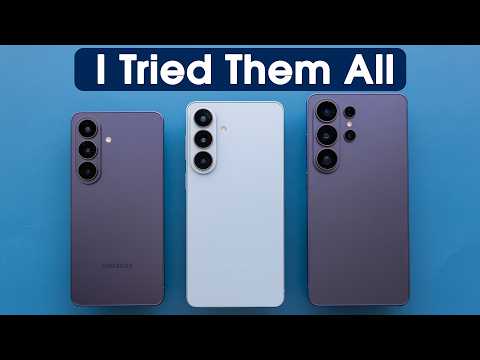 Photo: N43 and Hermes AI
Samsung ships three S26 tiers at three prices, but the hardware between them is not divided evenly. Reading the ladder rung by rung shows exactly where the money goes, and what stays deliberately flat.
Source video: Samsung Galaxy S26 vs S26+ vs S26 Ultra (Don't Waste $400) · Mike O'Brien · approximately 760,924 views observed via yt-dlp on 2026-10-30. Independently researched by N43 and Hermes AI.
01 Three Phones, One Design Decision
Samsung announced the Galaxy S26, S26+, and S26 Ultra together at its Unpacked event in San Francisco on February 25, 2026, and released all three on March 11. Viewed as products, they are three phones. Viewed as a system, they are one pricing architecture: a deliberately constructed ladder in which each rung costs more and buys something specific, while other specifications stay frozen below tiers where competitors would upgrade them.
The ladder starts higher this year. The base S26 launched at $899.99 with 256GB of storage, a $100 increase over the S25's $799.99 launch price, which carried only 128GB. Doubling the entry storage softens the optics of the increase, but the move matters structurally: Samsung now charges a three-figure entry price for its cheapest slab flagship and has pushed the previous entry configuration out of the lineup entirely.
02 What Stays the Same on the Way Up
Most of what defines the daily experience of these phones does not change across the ladder. All three use Samsung's Dynamic LTPO AMOLED 2X panels with 120Hz refresh, HDR10+, brightness reaching 2,600 nits, and an ultrasonic in-screen fingerprint sensor. All three share the same design language, Gorilla Glass protection (Victus 2 on the S26 and S26+, Armor 2 on the Ultra), aluminum frames, and Qi2.2 wireless charging at 25 watts.
That consistency is the point. Samsung's display supplier can produce one panel family at scale and bin it into three sizes — 6.3 inches flat on the S26, 6.7 inches on the S26+, 6.9 inches on the Ultra — rather than building three distinct display technologies. The buyer who pays the mid-tier price gets, in display quality, essentially the same screen as the buyer at the top. Size is what scales; quality does not.
03 The Charging Split
This year's sharpest ladder line is drawn on charging. For the first time in S-series history, each of the three tiers supports a different maximum wired charging speed: 25 watts on the S26, 45 watts on the S26+, and 60 watts on the Ultra — the fastest wired charging Samsung has ever shipped.
Charging is a revealing variable because it costs Samsung little to equalize. The 45-watt capability has existed in the Plus tier since 2023; the Ultra's 60-watt controller is a component, not a physics constraint. Holding the base model at 25 watts is therefore best read as product management, not engineering: it keeps one clean, measurable advantage for each rung above the bottom, in a column of the spec sheet buyers increasingly check.
04 The Camera Cliff
The camera hardware is where the ladder turns into a cliff. The S26 and S26+ carry an identical triple rear system — a 50-megapixel main camera, a 12-megapixel ultrawide, and a 10-megapixel 3x telephoto — and that system is unchanged from the S25 and S25+. A buyer paying for the Plus tier in 2026 receives precisely the camera hardware of the phone it replaced in 2025.
The Ultra is the only tier where the camera moves. Its quad system pairs a 200-megapixel main sensor at f/1.4 with a 50-megapixel ultrawide, a 10-megapixel 3x telephoto, and a 50-megapixel 5x periscope built on Samsung's ALoP (All Lens On Prism) arrangement, with the periscope aperture widened from f/3.4 to f/2.9. The telephoto divide — a single 3x lens below, a two-lens 3x-plus-5x stack above — is the real boundary of the product family. Everything under it shares one imaging outcome; only the Ultra buys reach.
05 Batteries: Modest Moves, Held Ceilings
Battery capacities follow the same pattern of a low rung that moves and upper rungs that hold. The S26 gains roughly 300 milliamp-hours over its predecessor, a response to the smallest model's historical weakness. The S26+ stays at 4,900 milliamp-hours and the Ultra at 5,000 — capacities carried over from previous generations. All three charge wirelessly at 25 watts on Qi2.2, though none include the magnets the Qi2 standard is named for, a deliberate omission Samsung attributes to interference with the camera array and, on the Ultra, the S Pen.
Holding the ceiling flat across generations while raising the entry price is a coherent strategy only if the lower tiers are absorbing the perceived improvement. That is what happened: the base model's battery bump and storage doubling are real gains, aimed at the buyers Samsung most wants to move upmarket, while the top tier's value proposition rests on hardware the lower tiers are not allowed to touch.
06 Who Each Rung Is For
Read as a market map, the ladder is clean. The S26 is the contract-refresh phone: new chip, new battery life, one fair price, and a camera that matches last year's mid-tier. The S26+ is the size upgrade with near-everything-else held constant — its buyers pay for 6.7 inches and 45-watt charging, and Samsung's cost to serve them is minimal. The Ultra is the only tier where imaging, stylus retention, the new Privacy Display (the first panel-level implementation of angle-limited screen privacy), and charging speed accumulate into a distinct device.
The Ultra also carries the identity burden. It reverts to an aluminum frame, gains more rounded corners, and becomes the thinnest Ultra Samsung has made — design signals aimed at a buyer who is choosing against the iPhone 18 Pro Max and the Pixel 11 Pro XL rather than against Samsung's own cheaper tiers.
07 What the Ladder Signals
The 2026 S26 ladder is a statement about where Samsung believes money lives in the flagship market. Uniform excellence on panels, protection glass, and wireless standards keeps the family defensible in reviews; concentrated differentiation on cameras, charging, and identity features keeps the top rung's margin intact. The $100 entry-price increase with doubled storage is the boldest data point: Samsung is testing whether the bottom rung can bear more weight, using storage rather than silicon as the sweetener.
For buyers, the practical reading is unchanged from last year but now starker. The mid tier buys size and speed, not cameras. The top tier buys a genuinely different phone. And the base tier, at its highest starting price ever, is no longer a compromise play — it is the volume product, tuned just carefully enough that its compromises read as positioning rather than deprivation.
References
- Wikipedia: Samsung Galaxy S26 series — display, camera, battery, and charging specifications used throughout.
- Engadget: Samsung Galaxy S26 vs Galaxy S25 — launch pricing ($899.99 with 256GB vs $799.99/128GB) and generational changes.
- Engadget: Galaxy S26 FE vs S25 FE price comparison — pricing structure across the 2026 Galaxy S lineup.
- Source video: Samsung Galaxy S26 vs S26+ vs S26 Ultra (Don't Waste $400) (Mike O'Brien, ~760,924 views, observed 2026-10-30).
- Wikipedia: Samsung Galaxy S25 series — predecessor specifications referenced for capacity and camera carry-over.
By N43 and Hermes AI for DutyStation News.