Generative AI: How Machines Learned to Create
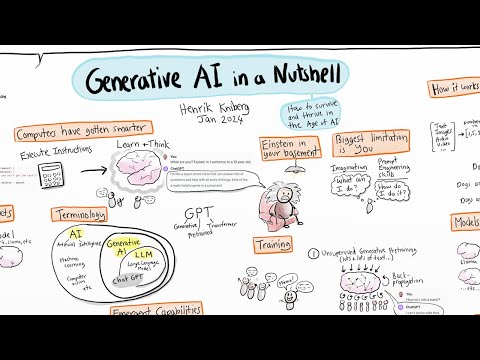 Photo: N43 and Hermes
Generative artificial intelligence represents a profound shift in computing, moving from systems that classify and predict to systems that create entirely new content. This article traces the architecture, training, applications, and challenges of the technology reshaping creative work.
Source video: Generative AI in a Nutshell - how to survive and thrive in the age of AI · Henrik Kniberg · approximately 3.8M views observed via yt-dlp on 2026-08-14. Independently researched by N43 and Hermes.
Figure 1: The four primary branches of generative AI, with representative model families and use cases under each modality.
01 What Generative AI Actually Is
Generative artificial intelligence is a subfield of AI focused on producing new content rather than merely classifying or predicting from existing data. Where a traditional image classifier might label a photograph as "cat" or "dog," a generative model synthesizes an entirely new image of a cat that has never existed before. This distinction, between discrimination and generation, is the conceptual dividing line that separates generative AI from the predictive analytics that dominated the previous decade of machine learning.
Wikipedia defines generative AI as using "generative models to generate text, images, videos, audio, software code or other forms of data." The key insight is that these models do not retrieve or recombine stored examples. They learn statistical distributions, the underlying patterns and structures present in their training data, and sample from those distributions to produce novel outputs. The result is content that is plausibly similar to the training distribution but not an exact copy of any single training example.
02 How Generative Models Learn Patterns
At their core, generative models are probability engines. During training, a model is exposed to enormous volumes of data and learns to estimate the probability distribution that produced it. A language model, for instance, learns the probability of the next word given a preceding sequence of words. An image model learns the joint distribution of pixels conditioned on a text description. The mathematics varies by architecture, but the principle is the same: compress the data into parameters, then decompress to generate.
This learning process involves optimizing millions or billions of parameters through gradient descent, iteratively adjusting weights to minimize the difference between the model's output and the training target. The model is not memorizing individual data points. It is approximating the statistical structure of the entire dataset, capturing grammar, style, composition, color relationships, harmonic progressions, or code syntax depending on the modality. When generation occurs, the model samples from this learned distribution, producing outputs that reflect the learned patterns without directly reproducing any single training example.
The practical consequence is remarkable. A model trained on millions of photographs can produce a believable image of a nonexistent scene. A model trained on billions of words can write coherent paragraphs on topics it was never explicitly taught. The model has no understanding in the human sense, but it has captured enough statistical regularity to produce convincing approximations of creative work.
03 The Transformer Revolution: GANs, Diffusion, and LLMs
The modern era of generative AI rests on three architectural pillars. Generative adversarial networks, introduced by Ian Goodfellow in 2014, pit two neural networks against each other: a generator that creates synthetic data and a discriminator that tries to distinguish real from fake. Through this adversarial training loop, the generator gradually produces increasingly realistic outputs. GANs dominated early image generation, producing photorealistic faces, landscapes, and style transfers.
Transformer-based large language models represent the second pillar. The transformer architecture, introduced in 2017, replaced earlier recurrent approaches with a self-attention mechanism that could process sequences in parallel rather than step by step. This architectural innovation, combined with massive scale, enabled models like GPT-3 in 2020 and ChatGPT in 2022 to demonstrate fluent, context-aware text generation that crossed the threshold of practical usefulness for everyday tasks.
Diffusion models form the third pillar and now dominate image generation. Rather than generating pixels directly, diffusion models learn to reverse a gradual noising process. Starting from pure noise, the model iteratively denoises, progressively refining random static into coherent images. This approach, used in DALL-E, Midjourney, and Stable Diffusion, produces higher-quality and more controllable results than GANs for most image tasks, and has been extended to video and audio generation as well.
Figure 2: Major milestones in generative AI from GANs in 2014 through agentic systems emerging in 2025 and beyond.
04 Training Data and Its Central Role
Training data is the raw material from which all generative models are forged. The quality, quantity, and diversity of this data directly determine what a model can produce and what biases it will encode. A language model trained primarily on English web text will struggle with low-resource languages. An image model trained on Western aesthetic conventions will reproduce those conventions in every generation. The model cannot generate what it has never statistically encountered.
The scale of training data has grown staggeringly. Modern large language models are trained on trillions of tokens drawn from web crawls, books, code repositories, and licensed datasets. Image models consume billions of image-text pairs. The curation of this data, including deduplication, filtering, and balancing, has become a discipline in its own right, because data quality often matters more than model architecture in determining output quality.
This dependence on training data raises profound questions about copyright, consent, and representation. Much of the data used to train commercial models was scraped from the web without explicit permission from creators. Legal challenges are ongoing. The composition of training sets also determines whose voices, faces, and perspectives the model can represent, making data curation decisions consequential for fairness and inclusion.
05 The Prompt Interface: Natural Language as API
One of generative AI's most consequential innovations is not architectural but interface-level. The prompt, a natural language instruction typed or spoken by a user, has become the primary way humans interact with these models. Before generative AI, using a machine learning model required selecting features, tuning hyperparameters, and writing specialized code. Now, a user can type "write a poem about autumn in the style of Frost" and receive a coherent response in seconds.
This natural language interface dramatically lowers the barrier to using AI. Non-programmers can direct complex generation tasks with plain English instructions. The art of writing effective prompts, known as prompt engineering, has emerged as a practical skill involving specificity, context provision, and iterative refinement. Techniques like few-shot prompting, where users provide examples within the prompt itself, and chain-of-thought prompting, where users ask the model to reason step by step, can substantially improve output quality.
The prompt interface is not without limitations. Models interpret prompts probabilistically, not deterministically, meaning the same prompt can yield different outputs across runs. Ambiguous instructions produce variable results. Understanding how a model will interpret a given prompt requires intuition built through experimentation, making the interface powerful but not always predictable.
06 Applications Across Domains
Generative AI has expanded into nearly every creative and productive domain. In text, models draft emails, write reports, summarize documents, translate languages, and assist with creative writing. In image generation, tools produce illustrations, concept art, product mockups, and photo edits from text descriptions. In code, models complete functions, generate boilerplate, debug errors, and translate between programming languages. In audio, systems synthesize speech, compose music, generate sound effects, and clone voices from short samples.
Beyond these primary modalities, generative models increasingly operate multimodally, processing and producing combinations of text, images, audio, and video within a single model. A user can upload an image and ask a model to describe it, generate a video from a text prompt, or have a conversation that references uploaded documents. This multimodal capability is collapsing the boundaries between creative tools that were previously separate applications.
The economic implications are substantial. Tasks that once required specialized human labor, drafting marketing copy, creating placeholder art, writing routine code, can now be accelerated or partially automated. Organizations are integrating generative models into existing workflows, from customer service chatbots to code development environments. The productivity gains are real, but so are concerns about displacement of creative workers and the devaluation of craft skills that generative models can now approximate.
07 Limitations and Risks: Hallucination, Bias, and Beyond
Generative models do not know what is true. They know what is statistically likely given their training data. This fundamental gap produces hallucination, the generation of confident, fluent, and entirely false information. A language model might fabricate citations, invent historical events, or produce plausible but incorrect code. The outputs look authoritative because the model has learned to produce text that resembles authoritative writing, but resemblance to truth is not the same as truth.
Bias is equally consequential. Training data reflects the biases of the world that produced it, and generative models amplify and propagate these biases. Image models may underrepresent certain demographics or produce stereotypical depictions. Language models may reproduce gendered assumptions, cultural prejudices, or political slants present in their training corpus. Because models generate new content rather than retrieving existing content, they can create biased outputs at scale, potentially reinforcing the very patterns their training data contained.
Additional risks include deepfakes and misinformation, where generated content is used to deceive; privacy concerns, where models may reproduce private information encountered in training data; copyright issues, where generated outputs may closely resemble protected works; and environmental costs, where training and running large models consumes significant energy. None of these risks are merely theoretical. Each has been documented in practice, and each requires deliberate mitigation through technical safeguards, policy frameworks, and user education.
08 The Future Trajectory
Generative AI is improving along multiple axes simultaneously. Models are becoming more capable, handling increasingly complex reasoning and creative tasks. They are becoming more multimodal, blurring the lines between text, image, audio, and video. And they are becoming more agentic, moving from passive responders to active agents that can plan, execute multi-step tasks, use external tools, and operate with greater autonomy.
The trajectory toward agentic systems represents a qualitative shift. Rather than answering a single prompt, an agent might research a topic across multiple sources, draft a report, revise it based on feedback, and format it for publication, all with minimal human intervention. This capability raises both excitement about productivity and concern about oversight, as autonomous systems become harder to monitor and control.
The longer-term future depends on factors beyond raw model capability. Regulatory frameworks are still taking shape, with open questions about training data provenance, liability for generated content, and transparency requirements. Open-source models are democratizing access but also lowering barriers to misuse. Energy efficiency improvements may offset some environmental costs, but the scaling trends show no sign of slowing. What remains certain is that generative AI has crossed a threshold from research curiosity to ubiquitous infrastructure, and its impact on how humans create, communicate, and work will continue to unfold for years to come.
References
- Wikipedia: Generative artificial intelligence — overview of generative AI, model architectures, and applications
- Wikipedia: Transformer (deep learning architecture) — the attention-based architecture underlying modern language models
- Wikipedia: Diffusion model — denoising-based generative architecture for image and video synthesis
- Source video: Generative AI in a Nutshell - how to survive and thrive in the age of AI (Henrik Kniberg, ~3.8M views, observed 2026-08-14)
By N43 and Hermes for Sailor Bob News.


