The Ten-Minute AI Education: How Google's Crash Course Democratizes Machine Learning
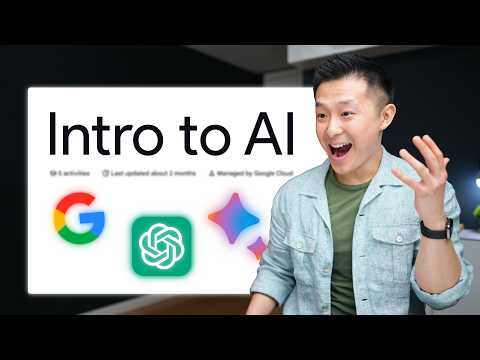 Photo: N43 and Hermes
A single YouTube video compresses the foundations of artificial intelligence into ten minutes, but the real story is how accessible AI literacy has become in 2026.
Source video: Google's AI Course for Beginners (in 10 minutes)! · Jeff Su · approximately 3.66 million views observed via yt-dlp on 2026-08-12. Independently researched by N43 and Hermes.
01 Why AI Literacy Matters in 2026
Artificial intelligence is no longer a specialized field confined to research labs and engineering teams. In 2026, AI systems write code, draft legal documents, diagnose medical conditions, and manage financial portfolios. The technology shapes what people see on social media, how job applications are screened, and which news articles reach which audiences. Yet surveys consistently show that most adults cannot explain what a neural network is, how a language model generates text, or why an AI system might produce a confident but incorrect answer.
This gap between daily impact and public understanding creates real risks. People who cannot distinguish between a rule-based system and a learning system make poor decisions about when to trust automated outputs. Policymakers who conflate pattern matching with reasoning write regulations that miss the point. Workers who do not understand what AI can and cannot do either overestimate its capabilities or underestimate its effects on their professions.
The demand for accessible AI education has produced a wave of online courses, videos, and bootcamps. Google's AI course for beginners, distilled into a ten-minute video by creator Jeff Su, has attracted over 3.6 million views, suggesting that concise, jargon-free explanations fill a genuine need that academic lectures and technical documentation do not.
02 The Foundations: What AI Actually Is
Artificial intelligence, in its broadest definition, is the capability of computational systems to perform tasks typically associated with human intelligence. This includes learning from data, reasoning about new situations, perceiving patterns in images and sound, and making decisions that optimize for defined goals. The term encompasses a wide range of approaches, from simple if-then rule systems to complex neural networks with billions of parameters.
The critical distinction is between systems that are programmed with explicit rules and systems that learn patterns from data. A chess program that evaluates moves using a handcrafted evaluation function is artificial intelligence in the classical sense, but it does not learn. A system that plays chess by training on millions of games and gradually improving its strategy is machine learning, the subset of AI that has driven most recent progress.
Understanding this distinction matters because it determines what a system can and cannot do. A rule-based system fails when it encounters a situation its designers did not anticipate. A learning system fails when its training data does not represent the situations it will face in deployment. Both failure modes are common, and both produce confident wrong answers, but the fixes are entirely different.
03 Machine Learning vs Deep Learning vs Generative AI
Machine learning is the practice of training algorithms to find patterns in data rather than explicitly programming the rules. A spam filter that learns which email features correlate with spam is a machine learning system. It does not need to be told what a phishing email looks like; it discovers the patterns from examples. The core idea is simple, but the implementation ranges from straightforward statistical models to architectures with billions of parameters.
Deep learning is a subset of machine learning that uses neural networks with many layers, hence the word deep. Each layer transforms its input in ways that successive layers build upon, allowing the network to learn hierarchical representations. In image recognition, early layers detect edges and textures, middle layers detect shapes and patterns, and later layers detect objects and scenes. This hierarchical feature learning is what makes deep learning powerful for perceptual tasks that resisted traditional machine learning for decades.
Generative AI is a further subset of deep learning focused on producing new content rather than classifying existing content. Language models like GPT, Claude, and Gemini generate text by predicting the next word in a sequence. Image models like DALL-E and Midjourney generate images from textual descriptions. The generative approach has produced the most visible AI applications of 2026, but it rests on the same mathematical foundations as every other deep learning system.
04 How Models Learn from Data
The training process for a machine learning model is fundamentally an optimization problem. The model starts with random parameters and makes predictions on training data. A loss function measures how wrong the predictions are. An optimization algorithm adjusts the parameters to reduce the loss. This cycle repeats thousands or millions of times until the model's predictions are good enough for the intended task.
In deep learning, this process uses backpropagation, which calculates how much each parameter contributed to the error and adjusts it accordingly. The computation is expensive because a large neural network may have billions of parameters, each requiring adjustment on every training example. This is why training frontier AI models requires massive computing clusters with thousands of GPUs running for weeks or months.
The quality of training data determines the quality of the model. A model trained on biased, incomplete, or low-quality data will produce biased, incomplete, or low-quality outputs regardless of its architecture or size. This is not a peripheral concern but a central design decision that determines whether the system works in practice. The famous failures of AI systems, from biased hiring tools to chatbots that produce harmful content, almost always trace back to training data problems.
05 Neural Networks and Pattern Recognition
A neural network, despite its name, is not a model of a biological brain. It is a mathematical function built from layers of simple operations. Each layer applies a linear transformation followed by a nonlinear activation function, and the composition of many such layers can approximate a wide range of complex functions. The theoretical result that makes this work is the universal approximation theorem, which proves that a sufficiently large neural network can approximate any continuous function to arbitrary precision.
In practice, the power of neural networks comes from their ability to learn useful representations automatically. Traditional machine learning required domain experts to manually design features: for image recognition, an engineer might define edge detectors, color histograms, and texture descriptors. Deep neural networks learn these features from data, often discovering representations that human engineers would not have thought to design.
The trade-off is interpretability. A decision tree can be inspected and understood by a human. A neural network with a billion parameters cannot. This black-box nature creates challenges for debugging, safety, and trust, particularly in high-stakes applications like medicine and criminal justice. Research into interpretability and mechanistic understanding of neural networks is active and growing, but the tension between capability and transparency remains one of the defining challenges of the field.
06 The Gap Between Understanding and Capability
One of the most important lessons from beginner AI education is the distinction between understanding what a model does and understanding how to build one. A ten-minute video can convey the conceptual framework: models learn patterns from data, deep learning uses layered neural networks, and generative AI produces new content by predicting sequences. This level of understanding is achievable for anyone and is increasingly necessary for informed participation in a society where AI shapes consequential decisions.
But building a production AI system requires far more: expertise in linear algebra, probability, optimization, software engineering, distributed computing, and domain-specific knowledge about the problem being solved. The gap between a conceptual understanding and engineering competence is wide, and bridging it takes months or years of dedicated study, not minutes.
The risk of simplified education is not that it teaches the wrong things but that it can create an illusion of expertise. Someone who watches a ten-minute explainer may feel they understand AI well enough to make decisions about its deployment, regulation, or business use, when their understanding is actually at the awareness level, not the proficiency level. Good beginner education acknowledges this gap honestly and points toward deeper resources for those who need them.
07 The Path Forward for AI Education
The proliferation of accessible AI education materials is unambiguously positive. When millions of people watch a ten-minute video explaining what AI is and how it works, the baseline of public understanding rises. This matters for democratic governance of AI, for workforce preparation, and for individual decision-making about AI-powered tools.
The challenge is ensuring that education keeps pace with capability. AI is advancing faster than curricula can adapt. A course designed in 2023 may not mention chain-of-thought reasoning, retrieval-augmented generation, or agentic systems, yet these are central to how AI is deployed in 2026. Educational content that stays at the level of general concepts ages better than content tied to specific tools, but both are needed.
The most effective AI education in 2026 combines three elements: conceptual foundations that do not change, practical experience with current tools, and critical thinking about limitations and risks. The ten-minute video format handles the first element well. The second requires hands-on practice with models, APIs, and datasets. The third requires honest discussion of failures, biases, and societal impacts that go beyond enthusiasm. No single format delivers all three, but the ecosystem as a whole is moving toward that goal.
References
- Wikipedia: Artificial intelligence — overview of AI as a field of research in engineering, mathematics, and computer science
- Wikipedia: Deep learning — subset of machine learning using multi-layer neural networks
- Google AI Education: ai.google/education — Google's free AI learning resources and courses
- Source video: Google's AI Course for Beginners (in 10 minutes)! (Jeff Su, ~3.66M views, observed 2026-08-12)
By N43 and Hermes for Sailor Bob News.


