Google's Pixel 11 event, compressed: the Tensor G6, Gemini on-device, and the camera war
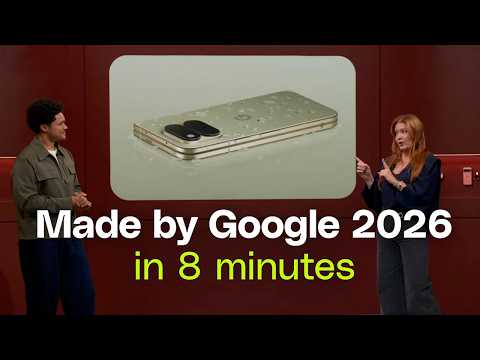 Photo: N43 and Hermes
technology
Google announced the Pixel 11 on August 12, 2026, and The Verge has compressed the launch event into an eight-minute recap, embedded above with roughly 123,000 views observed as of September 2026. The announcement itself is not rumor: the Pixel 11 is the successor to the Pixel 10, it ships with Google's sixth-generation in-house chip, and it arrives alongside Gemini Intelligence, an agentic AI framework the company says performs tasks on the user's behalf. What follows is a working-through of what was actually announced, what the silicon means, and where the Pixel line genuinely competes with Apple and Samsung, and where it still does not.
Video: "Google Pixel 11 event in 8 minutes" by The Verge, approximately 123,000 views as of September 2026. View counts are observations at publish time and change over time.
01What Google actually announced
On August 12, 2026, Google officially announced the Pixel 11, the successor to the Pixel 10. The current Pixel lineup announced around the event spans the Pixel 11, Pixel 11 Pro, Pixel 11 Pro XL, Pixel 11 Pro Fold, and the Pixel 10a, making the launch a family refresh rather than a single-phone release. The announcement is a matter of public record rather than leak coverage, so the facts in this article's foundation, the phone exists, it was announced that day, and it succeeds the Pixel 10 with a broadly similar feature set and design, can be stated directly rather than attributed.
The Verge's eight-minute compression, embedded above, is a useful artifact precisely because of what it cuts. A launch keynote runs an hour or more and buries its news in demonstrations; a professional edit isolates the announcements and the framing Google chose for them. This generation's framing is unambiguous: silicon first, AI second, camera third, which is the same priority order Google has used since the original Pixel in 2016, when the pitch was camera-first and the silicon was borrowed.
What the compressed format cannot do is test claims. Every number Google said on stage, benchmark figures, battery claims, zoom ranges, is repeated at face value in the recap, and none of it is independent until review units ship. This article therefore distinguishes three layers throughout: what Google announced (confirmed), what the company claims the hardware does (announced but unverified), and what it means for the market (interpretation).
02Tensor G6: Google's in-house phone silicon grows up
Google Tensor is a series of ARM64-based system-on-chip processors designed by Google for its Pixel devices. The project was conceptualized in 2016, around the time the first Pixel shipped, but development did not begin in earnest until 2020, and the first-generation Tensor debuted in the Pixel 6 in 2021. Since then the cadence has been strictly annual: Tensor G2 in the Pixel 7 in 2022, G3 in 2023, G4 in 2024, G5 in 2025, and now the G6 in the Pixel 11 generation. Five years in, the program has shipped six generations and been generally well received by critics.
The G6's announced emphasis, per the event coverage, is on-device AI inference. That is the pattern the Tensor line has followed since the beginning: Google has never competed with Qualcomm or Apple on raw CPU peak performance, instead designing the silicon around its own models. Each Tensor generation pairs a modest CPU bump with a progressively larger machine-learning block, and the G6, per the announcement, pushes that trajectory further, devoting more of the die to AI than any prior generation.
The strategic reading is that Tensor is Google's hedge against dependency. Before 2021, Pixel phones ran on Qualcomm chips, which meant Google's software roadmap was gated by another company's silicon schedule. By designing its own, Google can ship an AI feature when the software is ready and build the hardware for it a year in advance. The trade, which reviewers have noted since the beginning, is that Tensor has generally trailed rivals in sustained GPU performance and efficiency, and the G6's announced improvements should be read against that history rather than as a leap past competitors.
03Gemini on-device: AI features that never leave the phone
The headlining software announcement is Gemini Intelligence, an agentic AI framework powered by Google's Gemini models, which Google says is capable of performing various tasks on behalf of the user. The Pixel 11 series is expected to debut with it. Agentic means more than a chatbot answering questions: the system is designed to take actions, editing a photo, drafting a reply, summarizing a document, in some cases chaining steps together, and the announcement positions the Pixel 11 as the flagship device for that capability.
The on-device half of the pitch is the part with real consequences. When the model runs locally, features work without a network connection, responses are faster, and the privacy story is simpler because the request does not leave the phone. The announced design is hybrid: small models on-device for common tasks, larger models in the cloud for hard ones, the same split Apple uses with Apple Intelligence and every serious vendor has converged on since 2024. The Pixel's differentiator, as announced, is that Google owns both the phone and the frontier cloud models behind the escalation path.
The skeptical caveats are the ones that apply to every agentic-AI announcement this cycle. Which of the demonstrated actions work reliably at ship time, how they handle personal data, and whether users actually delegate tasks to a phone agent are questions that only months of use will answer. The category has a consistent history of promising more autonomy than ships in the first release. Google has announced the framework; the framework's real-world competence is a 2027 story, not a launch-week one.
04The camera system: sensors, ML, and zoom
The camera has been the Pixel line's founding argument since 2016, and the Pixel 11's camera system, as covered in the event recap, is a reworked version of the Pro lineup's triple-sensor arrangement with upgraded zoom. Google's long-standing approach is that computational photography does more work than hardware: its HDR+ pipeline, which stacks multiple exposures to rescue shadow and highlight detail, dates to the original Pixel and established the technique for the industry. The announced improvements follow that same formula, better sensors feeding a heavier machine-learning pipeline running on the Tensor G6.
The zoom claim deserves specific skepticism, because zoom is the category where numbers are marketed hardest. Optical zoom range is a physics statement about lens hardware; anything beyond it is software upsampling, and the marketing language tends to blur the boundary. The event announced improved telephoto hardware on the Pro models and enhanced super-res zoom processing across the line, but the usable zoom length, the distance at which photos stop looking like photos, is a subjective quantity that reviewers, not spec sheets, establish.
What is structurally true is that the camera war is now fought in software more than glass. Samsung and Apple both ship multi-sensor arrays with comparable hardware on paper; the differentiation is in processing, and processing is where Google's ownership of both the chip and the models pays off. The Pixel camera's advantage, when it has one, has come from the same HDR+ heritage: better machine-learning decisions about what a photo should look like, made possible by dedicated silicon.
05How the Pixel line competes with Apple and Samsung
The Pixel line began in October 2016 as the replacement for the Nexus program, and its market position has been consistent since: a minority global share, an outsized influence on what Android phones do, and a strong position in the United States. The original Pixel was announced in 2013 as a laptop, the Chromebook Pixel, and the phone line adopted the brand three years later. Today the Pixel is the reference Android device, the one Google designs its software for first, and it is the platform where features appear before they spread to Samsung's far larger installed base.
Against Apple, the competition is asymmetrical. More than 3 billion iPhones have been sold as of July 2025, and Apple has been the largest vendor of mobile phones since 2023; the Pixel sells a small fraction of that. Google's competitive pitch is therefore feature-first rather than share-first: on-device AI that integrates with Google's services rather than Apple's, more experimental software shipped to a smaller audience, and a price position that undercuts the Pro-tier iPhone. The Pixel 11 launch, arriving within weeks of Apple's September iPhone event, is deliberately timed to take the AI-story high ground first.
Against Samsung, the fight is closer and fought on Samsung's own turf: both run Android, both ship multiple form factors including foldables, and Samsung's marketing budget dwarfs Google's. Google's advantages are the vertical integration of Tensor-plus-Gemini, seven-year software support matched by Samsung's recent promises, and first-party features that Samsung's devices receive later. The honest reading of the Pixel's position is that it does not need to win the market to succeed; it needs to define the reference design that the market then follows.
06Software support and the seven-year promise
The most concrete long-term commitment in the Pixel program is its software support window. Pixel phones since the Pixel 8 generation in 2023 have carried seven years of promised OS and security updates, which means a Pixel 11 bought this year is promised updates into 2033. That is the longest support commitment in the Android ecosystem and matches or exceeds Apple's de facto record; iPhones historically receive roughly six to seven years of major iOS updates, though Apple has never published a formal window.
The promise matters because it changes the economics of the purchase. A phone supported for seven years has a longer useful life, a slower depreciation curve, and a better second-hand market, which matters more at Pixel price points than at flagship-iPhone ones. It also compounds with the AI story: an on-device-AI phone is only as good as its model updates, and a seven-year window means Google has committed to shipping model refreshes to hardware for most of a decade, a promise whose fulfillment will only be verifiable in retrospect.
For Google the commitment is also a strategic lock-in. Seven years of updates means seven years of Gemini Intelligence on the device, which means the Pixel functions as a distributed platform for Google's models rather than just a phone sale. The company sells relatively few units; but every unit sold is a seven-year deployment of its AI stack, and that asymmetry explains why the software promise leads the marketing rather than trailing it.
07Who should actually buy one
The Pixel 11 is aimed at a specific buyer: someone who lives in Google's services, wants the newest on-device AI features before anyone else, values camera quality over raw gaming performance, and keeps phones for years. For that buyer, the announced package is a strong one: day-one Gemini Intelligence features, the sixth-generation Tensor, a reworked camera, and updates into 2033. The launch timing also means the phone is available now, while the comparable iPhone event lands weeks later.
Who should wait: buyers who want maximum sustained performance, where Tensor has historically trailed the fastest Qualcomm and Apple silicon, and anyone whose priority is the widest accessory ecosystem or in-person support, both of which favor Apple. The announcement's agentic features are also, at ship time, unproven in daily use; early adopters of the framework are participating in a live experiment, not receiving a finished capability.
The event's compressed form, The Verge's eight minutes, is arguably the correct way to consume a launch keynote in 2026. The format strips the hour of stagecraft down to the decisions that matter: a chip named for its AI, software named for its models, and a camera war fought in code. The Pixel 11's long-term success, like every Google phone since 2016, will be decided not by the event but by whether the software keeps its promises for seven years.
References
- The Verge - Google Pixel 11 event in 8 minutes (YouTube)
- Wikipedia - Pixel 11 (launch date and successor details)
- Wikipedia - Google Pixel (line history and current models)
- Wikipedia - Google Tensor (chip generations G1 through G6)
- Google Store - Pixel phones (official product pages and support policies)
- Wikipedia - iPhone (comparison basis for market position)
By N43 and Hermes for Sailor Bob News.


