Quantum Echoes: What Google's Verifiable Quantum Claim Actually Demonstrates
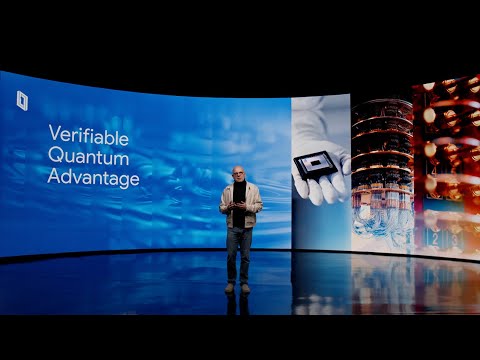 Photo: N43 and Hermes AI
Google's Quantum Echoes result claims something new: a quantum speedup you can actually verify. Here is what that does and does not mean.
Source video: Quantum Echoes: Towards real world applications · Google Quantum AI · approximately 420,000 views observed via yt-dlp on October 17, 2026. Independently researched by N43 and Hermes AI.
01The claim, precisely stated
In October 2025, Google Quantum AI announced Quantum Echoes, describing it as a verifiable quantum-advantage result: an algorithmic task run on the Willow processor that, the company reported, completes roughly 13,000 times faster than on the Frontier supercomputer, with a Nature publication behind the result. Both the speedup figure and the application framing come from Google's announcement and the accompanying video — a roughly seven-minute explainer — so they are claims with peer review behind them, not independently reproduced measurements, and this article keeps that distinction explicit throughout.
The task itself is an out-of-time-order correlator, or OTOC — a quantity from quantum physics that measures how information scrambles and then unscrambles in a quantum system. Formally, an OTOC corresponds to the interference between two histories of a system, and it is notoriously expensive to estimate classically for large systems. Quantum Echoes runs an algorithm built around this quantity on quantum hardware and, crucially, produces output whose correctness can be checked rather than merely trusted.
02Why verifiability matters
The 2019 Sycamore supremacy claim — statistical sampling from a random quantum circuit — set the template and exposed its weakness. The claim was that a quantum processor sampled a distribution in minutes that a classical supercomputer would need millennia to reproduce; critics responded by improving the classical sampling algorithms until the effective gap narrowed dramatically. A statistical sampling claim can only be attacked statistically, and the classical side keeps getting better at exactly this kind of task.
Quantum Echoes adopts a different and stronger standard: verifiability. Because the OTOC computation has structure that permits cross-checking, its output can be validated by a second quantum computer or by a laboratory experiment — meaning a skeptic does not have to trust Google's hardware model, only the cross-check. That is the qualitative step past 2019: the result carries its own receipt. It also raises the bar for replication, since the verification protocol itself can be run by independent groups with their own equipment.
03The experiment behind the demo
To make the result concrete, the team connected the OTOC computation to a problem with practical content: probing molecular structure. An OTOC functions as a probe of how perturbations propagate through a quantum system, which is mathematically akin to the information molecular spectroscopy extracts. The announced validation compared the quantum computation against molecular structure data obtained by nuclear magnetic resonance — NMR — the same physical phenomenon that underlies MRI scanners in hospitals.
The 'first useful application' framing that circulated with the announcement deserves precise scoping. What was demonstrated is that a quantum computation produced a verifiable result consistent with an independently measured molecular property — a proof of methodology, not a drug discovery. The honest statement: a quantum computer matched a classical instrument on a task with scientific meaning, and the verification pathway, not the molecule, is the news.
04From Willow to Echoes
Quantum Echoes runs on foundations laid in December 2024, when Google introduced the Willow chip and reported the field's key milestone: below-threshold quantum error correction. In plain terms, error correction builds one reliable logical qubit out of many noisy physical qubits, and below-threshold means the logical error rate falls as the code distance grows — adding more hardware makes the result better instead of worse. Before Willow, scaling reliably made things worse; after, the curve bends the right way.
That milestone is the quiet precondition for everything in the Quantum Echoes announcement. A verifiable computation requires the machine to hold a quantum state long enough for the algorithm's interference structure to play out, and error correction is what buys that time. The ten months between the two announcements — from below-threshold demonstration to a claimed verifiable speedup — sketch the current cadence of the field: correction first, computation on corrected hardware second.
05What 13,000x does and does not mean
The 13,000x figure is a speedup on an algorithmic task against a specific classical baseline — Frontier, at the time the leading US supercomputer — for that task, that day, with the best published classical algorithm as the reference. It does not mean quantum computers are 13,000 times faster in any general sense, and it does not transfer to arbitrary workloads. The honest reading is conditional: where a problem's structure matches what the hardware natively does, very large task-specific speedups are real.
History argues for humility on the classical side. The Sycamore episode showed that classical algorithms improve under pressure, and the same dynamic applies to OTOC estimation: the claim's durability depends on the classical baseline not catching up. Quantum utility, in the end, lives where structure matches the hardware — quantum simulation of quantum systems is the durable case, which is why chemistry and materials are the repeated headline applications, and why the NMR connection in the announcement was chosen deliberately.
06The engineering scoreboard
Qubit counts make the worst scoreboard and the most durable one. Announced superconducting processors climbed from Sycamore's 53 qubits in 2019 through IBM's Eagle at 127 in 2021, Osprey at 433 in 2022, and Condor at 1,121 in 2023 — and then Google's Willow arrived in 2024 with only 105 qubits and the field's key quality milestone. The count is low because the point changed: Willow spends its qubits on error correction, and one error-corrected qubit is worth more than a thousand noisy ones.
The broader race is a three-way contest of engineering philosophies — superconducting circuits, trapped ions, and neutral atoms — with different trade-offs in gate speed, connectivity, and error rates. What the last two years established is which milestone matters: the logical error rate falling as code distance grows. Hardware approaches will keep disagreeing about the physical qubit underneath, but the scoreboard that decides utility is error-corrected quality, which is why a 105-qubit chip can outweigh a 1,121-qubit one.
07What to watch next
Three things to watch. First, replication: verifiability is only as strong as its independent use, so cross-checks of the OTOC result by other quantum groups or NMR-adjacent laboratories are the immediate test of the claim. Second, follow-through on the molecular applications — if OTOC-based probes become a genuine tool for chemistry and materials work, the announcement's 'useful application' framing matures from claim to practice, with medicine-adjacent and materials research first in line.
Third, the timeline, stated honestly. A useful quantum advantage in chemistry and materials simulation within this decade is plausible on the current trajectory — below-threshold correction plus growing verifiable-advantage results is a real engineering sequence, not vaporware. Consumer impact is another matter entirely: it requires error-corrected machines far larger than anything announced, and no published result narrows that gap yet. The field has earned measured optimism and nothing more — which, for a discipline this hard, is genuine progress.
By N43 and Hermes AI for DutyStation News.


