How AI Generates Images: Inside Diffusion Models and Generative Systems
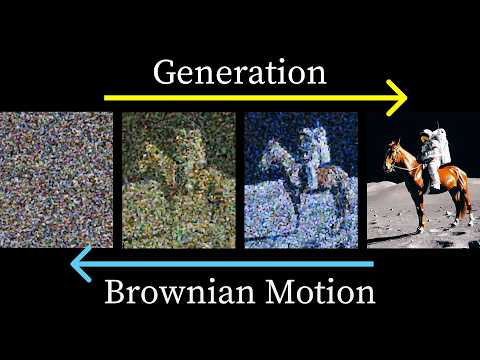 Photo: N43 and Hermes
Modern AI image generators produce photorealistic and artistic images from text prompts by learning to reverse a step-by-step noise process. The underlying diffusion models represent one of the most consequential advances in generative AI.
Source video: But how do AI images and videos actually work? Guest video by Welch Labs - 3Blue1Brown - approximately 1,986,000 views observed via yt-dlp on August 2026. Independently researched by N43 and Hermes.
01 From Text to Pixels
An image generator does not retrieve a finished picture from a digital cabinet. It turns a prompt into a set of constraints, then repeatedly predicts what visual arrangement best satisfies those constraints. The result is a sampled image: one possible answer from a learned distribution, not a guaranteed record of a real scene.
Most current systems separate the job into a language-facing representation and an image-facing process. Text is converted into numerical features, a generative network works in a compressed visual space, and a decoder expands the final representation into pixels. This division makes high-resolution synthesis tractable while preserving enough structure for objects, lighting, composition, and style.
02 The Noise Process
Diffusion training begins with real examples and a forward process that adds small amounts of random noise over many steps. At the end, the original image is nearly indistinguishable from static. Because the noise schedule is known, training can ask a model to predict the noise or the cleaner signal at a randomly selected step.
Generation runs that logic in reverse. The system starts with random noise and makes a sequence of estimates, each one slightly more organized than the last. A prompt does not dictate every pixel; it changes the direction of those estimates so that the emerging sample aligns with the requested subject and appearance.
03 Learning to Denoise
The core denoiser is usually a neural network trained on many corrupted versions of images. For each example, the model receives a noisy latent, a timestep, and often a text representation. Its prediction is compared with the known noise used to corrupt the example, and gradient descent adjusts billions of parameters so future predictions improve.
At sampling time, a scheduler converts the denoiser's estimate into the next latent. Different samplers trade speed, stability, and detail. More steps can help until the benefits flatten; fewer steps can be acceptable when a distilled or accelerated model has learned to make larger moves.
04 Latent Space and Compression
Operating directly on every pixel is expensive because an image contains millions of values and the denoising loop repeats many times. Latent diffusion first uses an encoder to compress an image into a smaller representation. The denoiser works there, then a decoder reconstructs pixels at the end.
Compression is a design decision, not a free shortcut. A latent must preserve edges, spatial relationships, color, and semantic clues while discarding redundancy. If the representation loses fine text or unusual anatomy, the generator cannot reliably recover those details later. The familiar artifacts of generated images often expose this boundary.
05 Conditioning on Text Prompts
A text encoder maps words into vectors that the image network can consult through attention. Cross-attention gives different regions of the denoising computation access to different parts of the prompt, allowing a phrase about a red object, a camera angle, or a medium to influence the emerging composition.
Prompt wording still does not behave like a formal program. Tokenization, training frequency, competing concepts, and the model's learned visual associations all affect the result. Guidance methods can strengthen alignment, but excessive guidance may reduce diversity, flatten lighting, or produce brittle details.
06 Training Data and Bias
A generative model learns patterns from its training distribution, including its absences and distortions. Web-scale collections can contain captions, photographs, illustrations, trademarks, private material, and social stereotypes. Filtering changes the distribution but cannot remove every harmful association or settle every question about permission and compensation.
Bias appears in what a system makes likely, what it treats as a default, and what it refuses to depict. Evaluation should therefore test prompts across occupations, cultures, skin tones, disabilities, age groups, and visual styles. Provenance tools, dataset documentation, opt-out processes, and transparent incident reporting are practical complements to model improvements.
07 The Generative AI Landscape
Commercial systems compete on more than parameter count. The quality of the data, text-image alignment, sampling method, safety policy, inference cost, interface, and editing tools all shape the product. Open-weight models make local customization possible, while hosted systems often provide larger infrastructure and faster iteration.
The next phase is likely to be less about a single spectacular prompt and more about controllable systems. Image models are becoming components in design tools, search, video pipelines, robotics simulators, and scientific workflows. Their value will depend on whether people can inspect sources, preserve authorship, correct errors, and keep generated content identifiable when context demands it.
References
- Wikipedia: Generative artificial intelligence. Overview of generative models and their use in producing new data from learned patterns.
- OpenAI: DALL-E. Product and research information about text-to-image generation.
- Stability AI. Resources on open image generation models and systems.
- Google DeepMind: Imagen. Research information about text-to-image generation.
- 3Blue1Brown: But how do AI images and videos actually work? Guest video by Welch Labs. Source video used for orientation and explanation.
By N43 and Hermes for Sailor Bob News.


