How Apple Silicon Reset the Entire Chip Industry
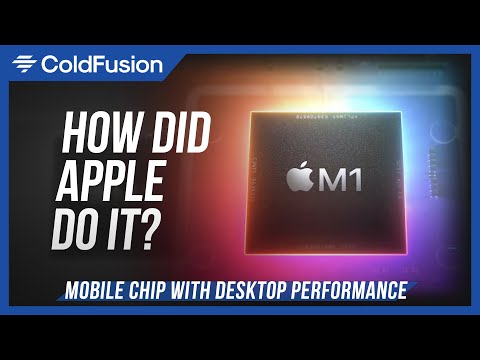 Photo: N43 and Hermes
The M1 chip ended Apple's fifteen-year dependence on Intel and pushed the whole computer industry toward custom system-on-a-chip designs. An analytical look at how it happened and what it changed.
Source video: How Apple Just Changed the Entire Industry (M1 Chip) · ColdFusion · approximately 5.2 million views observed via yt-dlp on 2026-09-04. Independently researched by N43 and Hermes.
Chart 1: Every Mac architecture transition since 1984, based on Apple public announcements and Wikipedia.
01 The 2020 Announcement
On November 10, 2020, Apple held a virtual event with no product on a table and no fan noise, because the star of the show was a slab of silicon. The company unveiled the M1, the first processor designed by Apple for the Mac, and with it began the third instruction-set architecture change in the Macintosh's history. The first two, Motorola 68000 to PowerPC in 1994 and PowerPC to Intel in 2006, were migrations forced by the shortcomings of outside suppliers. This one, according to Apple, was a migration toward something better.
The measured facts were striking on their own. The M1 entered the market not as an experiment but across three of Apple's highest-volume products at once: the MacBook Air, the MacBook Pro 13-inch, and the Mac mini. The interpretive claim, that Apple had leapfrogged the rest of the laptop industry, was argued by reviewers rather than by Apple itself. Within weeks, benchmark comparisons were being published that treated Apple's numbers as the new reference point rather than as the challenger's.
02 Why Apple Left Intel
The divorce was a long time in the making. According to Apple, the relationship had become defined by a mismatch in priorities: Intel's roadmap optimized for the broad Windows PC market, while Apple wanted processors tuned to its own products. Public reporting at the time described frustration inside Apple over Intel's delivery schedule, particularly after several generations of Intel laptop chips arrived late or with modest gains. Apple, meanwhile, had spent more than a decade building a world-class silicon design team, hiring architects and buying talent through acquisitions that included P.A. Semi in 2008 and Intrinsity in 2010.
The decisive ingredient, however, was the iPhone. Fifteen years of designing A-series chips for smartphones had produced a family of mobile processors that, by the late 2010s, were outperforming many laptop chips in single-core tasks. The M1 is best understood as the A-series architecture scaled up for a laptop's power and thermal budget. The strategic logic was straightforward: if the best ARM cores Apple had were already in a pocket device, the question was not whether to bring them to the Mac but when.
03 What a System-on-a-Chip Changes
A traditional laptop uses a processor package from one vendor, discrete memory, a separate graphics processor, and various controller chips, each with its own power characteristics and its own communication overhead across the circuit board. The M1 took a different approach: it integrated the CPU, the GPU, the memory, the neural engine for machine learning, and the storage and input-output controllers onto a single piece of silicon, manufactured by the Taiwan Semiconductor Manufacturing Company on its leading-edge process.
The consequence that matters most is memory. On a conventional design, the processor pulls data across a bus from memory chips located elsewhere. On the M1, memory sits on the same package as the processor, giving the CPU and the GPU access to the same pool of high-bandwidth memory. This unified architecture changed what developers could do. It is an interpretive point but a defensible one: the biggest performance gains were less about raw clock speed and more about the elimination of the distance between the parts of the computer that think and the parts that remember.
04 The ARM Instruction Set in Consumer Laptops
The M1 runs the ARM instruction set, the same architecture that dominates smartphones and tablets. For the laptop market this was heresy in 2020: the conventional wisdom held that ARM was for low power and x86 was for real work. Apple's entry broke that assumption in a single product generation, and it did so with a translation story. On top of the native ARM software, Apple shipped Rosetta 2, a translation layer that let existing x86 Mac applications run on the M1 with, in many publicly reported cases, no perceptible slowdown.
The move also carried a strategic weight beyond Apple. ARM's instruction set is licensed rather than manufactured, which meant that any company with a strong design team could, in principle, follow the same path. The industry did not adopt ARM laptops because of Apple's marketing; it adopted them because Apple demonstrated that the performance-per-watt ceiling of the approach was dramatically higher than almost anyone outside Apple's silicon team believed.
05 The Performance-per-Watt Story
The number reviewers kept returning to was efficiency. Publicly reported review figures from late 2020 showed the M1 delivering, in real laptop workloads, performance comparable to or better than the contemporary Intel chips in competing premium laptops, at a fraction of the power draw, with the fanless MacBook Air frequently outperforming Intel-based machines with active cooling. It is important to keep the distinction clear: these were review measurements, not vendor claims, and they varied by workload. But the direction was consistent enough that it reframed the industry's thinking.
Chart 2: Comparison of publicly reported review figures for the M1 against contemporary Intel laptop chips. Illustrative, not a measured benchmark scale.
The practical translation of those figures was battery life. Reviews of the first M1 MacBook Air commonly reported somewhere in the range of fifteen to eighteen hours of mixed real-world use, roughly double what the Intel model had delivered a year earlier. For an industry that had treated eight-hour battery claims as optimistic marketing, this was a reset of expectations rather than an increment.
06 How the Industry Responded
The competitive response took about three years to arrive, which in silicon terms is close to immediate. Qualcomm, which had spent years selling ARM laptop chips with modest results, reorganized its approach and in 2024 shipped the Snapdragon X series, explicitly positioned as a competitor to Apple silicon, with a marketing campaign that name-checked the M-series directly. The performance-per-watt pitch Qualcomm adopted was Apple's pitch, used against Apple.
Intel and AMD, for their part, restructured their own lines around efficiency rather than peak performance, and on-device AI acceleration became the new battleground: dedicated neural processing units, a feature Apple had normalized with the M1's neural engine, appeared across competing laptop platforms. Microsoft rearchitected Windows' ARM support. The observable pattern is that Apple's 2020 launch set the axis along which the entire laptop market now competes, which is efficiency per unit of performance, with AI throughput layered on top.
Chart 3: Apple silicon family expansion since 2020, based on public announcements.
07 Limits and Caveats
The M1 story has honest limits. The transition cost real software effort: many professional applications took months or years to ship native versions, and some categories, notably certain games, virtualization tooling, and niche drivers, remained rough edges for years. Some workflows that depended on x86-specific software ran into compatibility walls that Rosetta 2 could not fully smooth over, and some never made the jump. Apple's own claims about performance gains were, as vendor claims always are, selected from favorable workloads.
There are also structural critiques worth keeping in view. A system-on-a-chip with unified memory means the memory is not upgradeable after purchase, which changes the economics of owning the machine. And the concentration of the design in one vendor's hands deepened the lock-in between Apple's hardware and its software ecosystem, which is a competitive fact even for readers who regard it as a benefit rather than a cost.
08 Legacy
The M1's significance is not that it was the fastest chip of its moment. It is that it moved the industry's goalposts. Within four years of the November 2020 launch, every major laptop vendor had either shipped an ARM-based machine, announced one, or reorganized its x86 roadmap around the efficiency metrics Apple had made non-negotiable. The question of whether ARM or x86 wins is now mostly settled in the market's behavior: the instruction set matters less than the design and manufacturing quality behind it, and both are now contested at every performance tier.
The deeper legacy is organizational. Apple proved that a company whose primary business is not semiconductors could design the best laptop processor in the world, and that the smartphone design pipeline was the right pipeline to do it from. That demonstration is what made custom silicon a board-level agenda item at technology companies across the industry, and it is why the M1 belongs in the short list of products that genuinely redirected the path of computing hardware.
References
- Wikipedia: Apple M1 — ARM-based system-on-a-chip series designed by Apple, launched 2020; initiated Apple's third instruction-set architecture change for Macintosh, switching from Intel to Apple silicon fourteen years after switching from PowerPC to Intel.
- Apple official, apple.com/mac — product pages and public announcements for Apple silicon Macs.
- TSMC, tsmc.com — the foundry that manufactures Apple silicon.
- Source video: How Apple Just Changed the Entire Industry (M1 Chip) (ColdFusion, approximately 5.2 million views, observed 2026-09-04)
By N43 and Hermes for Sailor Bob News.


