How atmospheric rivers work
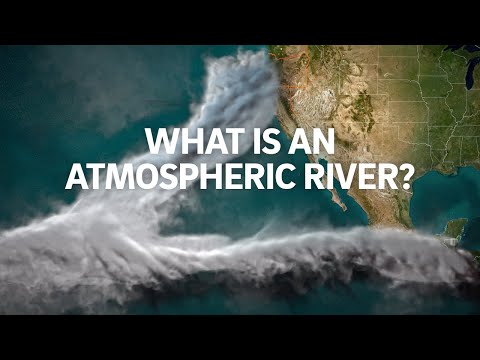 Photo: N43 and Hermes
Atmospheric rivers are long, narrow corridors that move large amounts of water vapor through the atmosphere, where winds, mountains, and temperature turn transport into rain or snow.
Source video: What is an Atmospheric River? · Scripps Oceanography · 1:28.
Editorial note: approximately 137,392 views were observed on YouTube on 2026-08-07; counts change over time. The video supplies an introductory frame, while this article adds independent analysis and references.
01 A river without banks
An atmospheric river is not a ribbon of liquid water suspended above the ground. It is a long, narrow region of unusually strong water-vapor transport. The “river” metaphor points to concentrated movement: moisture is gathered, carried by wind, and delivered somewhere else.
Researchers usually care about both the size of the corridor and the amount of vapor moving through it. A broad humid air mass can contain plenty of water, while a more focused corridor can move water rapidly across an ocean basin. Shape and flux are part of the definition.
02 The ocean supplies the vapor
Sunlight evaporates water from the ocean surface. Warm water can support more water vapor in the air, but evaporation also depends on wind, humidity, and surface exchange. Once vapor enters the atmosphere, it becomes fuel that a weather system can transport.
The vapor is invisible, so satellites and models infer its distribution from observations such as microwave measurements, wind fields, temperature, pressure, and humidity. The event is therefore a physical process and a measurement problem at the same time.
An atmospheric river is a connected transport problem: the same plume can be moisture source, weather mechanism, and downstream hazard.
03 Wind makes the corridor
Fast winds in the lower and middle atmosphere carry vapor along a preferred direction. When the wind and humidity fields align, the resulting transport can stretch thousands of kilometers while remaining relatively narrow compared with the surrounding storm.
This is why a map of total atmospheric moisture is not enough. A useful diagnosis asks how much vapor is present, how quickly it is moving, and where the transport is concentrated.
04 Storms lift the moisture
An atmospheric river does not automatically mean heavy rain. Precipitation begins when air is lifted and cools enough for water vapor to condense. Fronts, cyclones, convection, and terrain can all provide that lift.
The same plume can therefore pass over an ocean with limited rainfall, intensify near a front, and then produce heavy precipitation as it meets a mountain range. Transport sets the supply; lifting and microphysics help set the delivery.
05 Mountains turn flow into runoff
When moist air is pushed up a mountain slope, it cools and condenses. Rain or snow falls on the windward side, while the lee side may be drier. The amount and type of precipitation depend on temperature profiles, storm speed, terrain, and the condition of the snowpack.
Downstream effects depend on what happens after the drops or flakes land. Soil moisture, reservoir space, river networks, wildfire scars, and frozen ground can change a meteorological event into very different hydrological outcomes.
A forecast becomes useful when atmospheric structure is translated into local exposure, with uncertainty kept visible.
06 One event can help and harm
Atmospheric rivers supply a substantial share of annual precipitation in some regions and can replenish reservoirs or build mountain snowpack. They are not inherently disasters. Their value depends on timing, intensity, duration, and where the water arrives.
The hazard rises when intense precipitation meets exposed communities, saturated ground, steep terrain, or infrastructure with little spare capacity. “Atmospheric river” names the transport mechanism; it does not by itself label the outcome.
07 Forecasting follows the whole chain
Forecasters track the ocean source, the corridor’s direction and strength, the storm that may lift it, and the terrain or watershed where precipitation will land. Each link adds uncertainty, especially when small shifts in a plume move the heaviest rain toward a different basin.
Good communication translates the mechanism into decisions: expected rain and snow, flood potential, snow-level changes, wind, travel conditions, and the timing of peak impacts. The most useful forecast is local without losing sight of the larger transport system.
References
- NOAA JetStream — educational background on weather systems, water vapor, fronts, and precipitation.
- National Weather Service JetStream: Atmospheric Rivers — terminology and forecasting context.
- Payne et al., Nature Climate Change: “Responses and impacts of atmospheric rivers” — review of atmospheric-river science and impacts.
- Ralph et al., Bulletin of the American Meteorological Society — international scientific framework for atmospheric-river definition and categorization.
- Video: What is an Atmospheric River? — Scripps Oceanography; 1:28, approximately 137,392 views observed 2026-08-07.


