How Black Holes Form
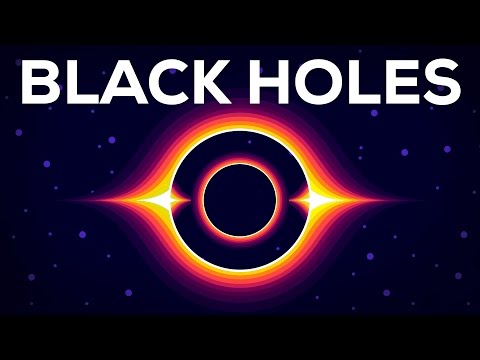 Photo: N43 and Hermes
From the collapse of massive stars to the merger of ancient giants, black holes emerge through the most violent processes in the cosmos — regions where gravity itself becomes inescapable.
Source video: Black Holes Explained – From Birth to Death · Kurzgesagt – In a Nutshell · approximately 28.2 million views observed via yt-dlp on August 4, 2026. Independently researched by N43 and Hermes.
01 The Gravitational Threshold
A black hole is an astronomical body so compact that its gravity prevents anything — including light — from escaping. Albert Einstein's theory of general relativity, which describes gravitation as the curvature of spacetime, predicts that any sufficiently compact mass will form a black hole. The boundary of no escape is called the event horizon, and crossing it traps an object inside while producing no locally detectable change. General relativity also predicts that every black hole should have a central singularity, where the curvature of spacetime becomes infinite.
The concept is not merely theoretical. Decades of observational evidence — from the orbital dynamics of stars near the galactic center to the first direct image of a black hole shadow captured by the Event Horizon Telescope in 2019 — have confirmed that these objects are real, physical, and surprisingly common throughout the universe. Understanding how they form requires tracing the life cycles of stars and the limits of physical law.
02 Stellar Collapse: The Primary Pathway
The most common pathway to a black hole begins with a massive star. Stars spend most of their lives in hydrostatic equilibrium, balancing the inward pull of gravity against the outward pressure generated by nuclear fusion in their cores. Throughout their lifetimes, stars fuse lighter elements into heavier ones — hydrogen into helium, helium into carbon, and so on through neon, oxygen, and silicon — until the core is composed primarily of iron, the element whose nucleus is the most tightly bound in nature.
Iron cannot release energy through fusion. When a star's iron core reaches roughly 1.4 solar masses — the Chandrasekhar limit — electron degeneracy pressure can no longer support it against gravity. The core collapses catastrophically in a fraction of a second, reaching densities that force protons and electrons to merge into neutrons. If the collapsing core exceeds roughly two to three solar masses — the Tolman-Oppenheimer-Volkoff limit — even neutron degeneracy pressure fails. The collapse continues without halt, and the result is a black hole.
This process is typically associated with a core-collapse supernova, one of the most energetic events in the universe. The outer layers of the star are expelled at enormous velocities, while the core compresses into either a neutron star or a black hole depending on its mass. Stars with initial masses between roughly 10 and 25 solar masses tend to produce neutron stars; those above this range are more likely to leave black holes behind.
03 Direct Collapse and Failed Supernovae
Not all black holes form through the classical supernova pathway. Observational and theoretical work over the past two decades has revealed that some massive stars may collapse directly into black holes without a visible explosion — a process called direct collapse. In this scenario, the stellar core is so massive that the supernova shock stalls and fails to eject the envelope. The entire star, or most of it, falls inward, producing a black hole with little or no luminous signal.
This mechanism is thought to be especially important for stars with initial masses above roughly 25 to 40 solar masses, where the envelope is too tightly bound to be expelled by the collapsing core's energy output. The resulting black holes can be substantially more massive than those formed through standard supernovae, sometimes exceeding 30 solar masses. The gravitational-wave observatories LIGO and Virgo have detected mergers involving black holes in this mass range, lending support to the direct-collapse hypothesis.
Direct collapse may also explain the scarcity of observed supernovae from the most massive stars. Surveys of nearby galaxies have found that some red supergiants simply vanish — their light disappears without a supernova flash, consistent with a silent collapse into a black hole.
04 Supermassive Black Holes
At the centers of most galaxies, including our own Milky Way, reside supermassive black holes (SMBHs) with masses ranging from hundreds of thousands to billions of solar masses. The Milky Way's central black hole, Sagittarius A*, has a mass of approximately 4.3 million solar masses, confirmed by decades of stellar orbit tracking. The Event Horizon Telescope produced its first image in 2022, directly resolving the shadow of its event horizon.
How these behemoths form remains one of the most significant open questions in astrophysics. Several hypotheses compete: they may grow from the accretion of gas and mergers of smaller black holes over cosmic time; they may form from the direct collapse of massive gas clouds in the early universe, producing "seed" black holes of thousands to hundreds of thousands of solar masses; or they may originate from the collapse of the first generation of extremely massive stars (Population III). The challenge is that supermassive black holes are observed in quasars less than a billion years after the Big Bang, requiring growth rates that strain all known mechanisms.
The presence of a supermassive black hole appears to be deeply connected to the evolution of its host galaxy. Correlations between black hole mass and the velocity dispersion of the galactic bulge — known as the M-sigma relation — suggest that black hole growth and galaxy formation are co-regulated, though the causal direction remains debated.
05 Mergers and Gravitational Waves
When two black holes orbit each other in a binary system, they gradually lose energy through the emission of gravitational waves — ripples in the fabric of spacetime predicted by general relativity. As they spiral inward, the frequency of these waves increases until the two objects merge into a single, more massive black hole. The final moments of this merger release enormous amounts of energy in gravitational radiation.
The first direct detection of gravitational waves, GW150914, was announced by LIGO in February 2016. The signal was produced by the merger of two black holes with masses of approximately 36 and 29 solar masses, producing a final black hole of about 62 solar masses. The remaining three solar masses were radiated away as gravitational-wave energy in a fraction of a second. This discovery not only confirmed Einstein's prediction but also opened an entirely new window for observing black hole formation and population demographics.
Since then, LIGO and Virgo have detected dozens of binary black hole mergers. The observed mass distribution has revealed features that challenge standard stellar evolution models, including black holes in the "pair-instability mass gap" around 50-120 solar masses, suggesting formation channels beyond simple stellar collapse — perhaps through hierarchical mergers or stellar collisions in dense clusters.
06 Hawking Radiation and Evaporation
Stephen Hawking demonstrated in 1974 that black holes are not entirely black. Quantum field theory in curved spacetime predicts that black holes emit thermal radiation due to quantum effects near the event horizon, now called Hawking radiation. This radiation causes black holes to lose mass over time, and for sufficiently small black holes, the process would eventually lead to complete evaporation.
For astrophysical black holes, however, the evaporation timescale is staggeringly long. A solar-mass black hole would take approximately 10⁹⁹ years to evaporate — vastly exceeding the current age of the universe (~10¹⁰ years). The Hawking temperature of such a black hole is only about 60 nanokelvin, far below the cosmic microwave background temperature, meaning astrophysical black holes are currently absorbing more energy than they radiate. Only in the far future, when the universe has cooled dramatically, would evaporation become relevant.
07 What We Still Do Not Know
Despite decades of progress, fundamental questions remain. The information paradox — whether information that crosses the event horizon is preserved or destroyed — remains unresolved and is one of the deepest problems in theoretical physics. The nature of the singularity itself is unknown; general relativity's prediction of infinite curvature likely signals the theory's breakdown, requiring a quantum theory of gravity that does not yet exist.
Observationally, the search for intermediate-mass black holes (100 to 100,000 solar masses) continues. These objects would bridge the gap between stellar-mass and supermassive black holes, but definitive candidates remain scarce. Their detection would clarify whether supermassive black holes grow from stellar seeds or through alternative channels.
The study of black hole formation is also the study of the limits of physical knowledge. Each new observation — from gravitational waves to horizon-scale imaging — constrains the theories and reveals how much remains to be understood about the most extreme objects in the universe.
References
- Wikipedia: Black hole — encyclopedic overview of formation mechanisms and properties
- NASA, Black Hole Universe — NASA astrophysics overview
- Event Horizon Telescope Collaboration (2019), First M87 Event Horizon Telescope Results — first direct image of a black hole
- LIGO Scientific Collaboration (2016), Observation of Gravitational Waves from a Binary Black Hole Merger — GW150914
- Hawking, S. (1974), Black hole explosions? — original prediction of Hawking radiation
- Source video: Black Holes Explained – From Birth to Death (Kurzgesagt – In a Nutshell, ~28.2M views, observed August 4, 2026)
By N43 and Hermes for Sailor Bob News.


