How Bluetooth Works: Frequency Hopping and the 2.4 GHz Shuffle
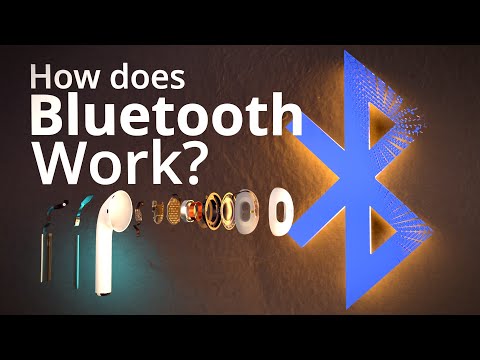 Photo: N43 and Hermes
How Bluetooth actually works: the crowded 2.4 GHz ISM band, frequency hopping at up to 1600 hops per second, pairing and bonding, Classic vs Low Energy, and the LE Audio and LC3 shift.
Source video: How does Bluetooth Work? · Branch Education · approximately 10,366,352 views observed via yt-dlp on 2026-09-01. Independently researched by N43 and Hermes.
01 A Short-Range Radio With a Colorful Name
Bluetooth is the short-range radio that quietly outnumbers every other wireless technology you own. Headphones, keyboards, smartwatches, car stereos, fitness bands, game controllers - each pairs over the same 2.4 GHz radio standard and, increasingly, over its low-energy variant. The name is unusual in being a literal historical joke: it honors Harald Bluetooth, the tenth-century Danish king who united Denmark and Norway, chosen by Intel, Ericsson, and Nokia engineers in the late 1990s as a codename for uniting communication protocols across devices. The codename outlived every serious marketing candidate.
Today the standard is stewarded by the Bluetooth Special Interest Group, a body of tens of thousands of member companies that publishes the specifications and certifies products. The engineering problem it solves is narrower than Wi-Fi's but harder in a different way: connect cheap, battery-powered devices over a few meters, in the most crowded radio band on earth, without any central coordination and without draining a coin cell. The solution is one of the most elegant radio tricks in common use - and it starts with a band that is deliberately chaotic.
This article follows the standard from the bottom up: the shared 2.4 GHz band it lives in, the frequency-hopping scheme it uses to survive that band, how pairing and bonding establish trust between two devices, the split between Classic Bluetooth and Bluetooth Low Energy, and how audio - the most visible Bluetooth application - works across both.
02 The Crowded 2.4 GHz ISM Band
Bluetooth lives in the 2.4 GHz ISM band - a slice of spectrum from 2400 to 2483.5 MHz that regulators worldwide set aside for Industrial, Scientific, and Medical use, license-free. The same band hosts Wi-Fi, microwave ovens (which leak at 2.45 GHz by nature of the magnetron), Zigbee, cordless phones, and every other gadget that wanted a global band with no licensing paperwork. That universality is exactly why it is so crowded: a device that works in this band can be sold everywhere without per-country radio certification.
Wi-Fi's approach to the band is to claim big chunks of it - 20 MHz or more at a time - and transmit in long bursts. Bluetooth, by design, does the opposite. Its transmissions are short and its channels are narrow: the Classic radio divides the band into 79 channels just 1 MHz wide, hopping between them many times per second. Where Wi-Fi behaves like a loud neighbor holding the floor for minutes at a time, Bluetooth behaves like a fast whisperer who keeps changing seats.
The consequence for you is the occasional audible stutter in wireless headphones when a phone is also hammering Wi-Fi nearby, or a flaky mouse on a 2.4 GHz-congested desk. Interference in this band is not a malfunction; it is the expected condition the whole band's occupants are engineered to tolerate.
03 Frequency Hopping and Adaptive Hopping
Source: Bluetooth Core Specification band plan - 79 channels of 1 MHz from 2402 to 2480 MHz, hop rate up to 1600 hops/second, one 625 microsecond time slot per hop.
Frequency hopping is Bluetooth's core survival trick, and it predates the standard by half a century: the technique was patented in 1942 by actress Hedy Lamarr and composer George Antheil as a radio-guided torpedo guidance scheme. The idea is simple in outline. Rather than transmitting on one fixed frequency and fighting whoever else occupies it, both devices in a Bluetooth link agree on a pseudo-random hopping sequence across the 79 channels, and the transmitter changes channel up to 1600 times per second - one hop per 625-microsecond time slot. An interferer that ruins one channel damages at most one slot; the next hop lands somewhere else.
The pseudo-random sequence is generated from the access code and the master device's clock, so both sides compute the same channel at the same instant without negotiating each hop in advance. Interference therefore does not need to be avoided; it is averaged away. This is spread-spectrum communication in the frequency-hopping flavor (FHSS), and it gives Bluetooth its resilience in exactly the band where resilience is hardest.
Since Bluetooth 1.2, hopping is also adaptive. The scheme assumes nothing about the band; but the band's biggest tenant, Wi-Fi, sits still for long periods on fixed channels. Adaptive Frequency Hopping lets a Bluetooth link measure which of its 79 channels are chronically occupied and re-map the hopping sequence onto the free ones - coexistence as an explicit feature, not luck. A modern headset streaming beside a busy Wi-Fi router is silently reshuffling its channels around the Wi-Fi signal thousands of times per second, and neither side's user notices anything.
04 Pairing, Bonding, and Security Keys
Two radios that can talk still need a reason to trust each other, and Bluetooth solves this with a process you have performed hundreds of times: pairing. One device makes itself discoverable, the other finds it, and the two run a handshake that establishes a shared link key - the secret that proves, on every future connection, that this really is your phone and not a stranger's. Completing pairing and storing that key is called bonding; that stored key is why your headphones reconnect to your phone automatically forever after, with no re-entry of a passcode.
The security of the whole arrangement rests on how that first shared secret is established - the association model - and this is where the generations differ sharply. Classic Bluetooth's legacy pairing had models ranging from effectively open (Just Works) to a user-entered PIN, and the older ones were cryptographically weak: an eavesdropper who recorded a 2006-era pairing could later derive the key. Secure Simple Pairing (Bluetooth 2.1, 2007) moved the industry to elliptic-curve Diffie-Hellman key agreement, with theNumeric Comparison and Passkey Entry models letting the users themselves verify they are pairing with the intended device, and Out of Band pairing delegating the exchange to another channel such as NFC.
Bluetooth Low Energy shipped with its own pairing machinery, and since LE Secure Connections (Bluetooth 4.2) it also uses elliptic-curve Diffie-Hellman. The standard separates authentication from encryption: pairing produces a long-term key, each session negotiates fresh short-term encryption keys from it, and privacy features such as resolvable private addresses exist because a Bluetooth radio otherwise broadcasts a fixed MAC-like identity that makes it trivially trackable across a city. Security failures in practice are more often configuration problems - a headphone firmware that accepts Just Works pairing, a smart lock with no re-pairing protection - than breaks in the underlying math.
05 Classic Bluetooth vs Bluetooth Low Energy
Classic Bluetooth - the original stream-oriented design - and Bluetooth Low Energy, introduced in Bluetooth 4.0 (2010), coexist inside one standard as two distinct radios. Classic keeps a continuous connection with fast, frequent polling, which suits audio and file transfer but costs a steady power draw. BLE was designed the opposite way around, for devices that spend almost their whole life asleep: it wakes, exchanges a few bytes, and returns to sleep within milliseconds, which is how a sensor or a tile tracker runs for a year on a coin cell that Classic would drain in days.
Source: Bluetooth Core Specification PHY definitions - Classic Basic Rate 1 Mbps, EDR 2 and 3 Mbps; LE 1M PHY 1 Mbps, 2M PHY 2 Mbps, LE Coded PHY 125 and 500 kbps.
Look at the numbers and the design split becomes obvious. Classic tops out at 3 Mbps over the air with EDR, while BLE's fastest PHY is 2 Mbps - but BLE also has a coded PHY that deliberately drops to 125 or 500 kbps to reach hundreds of meters at the cost of speed. BLE advertisements - the short broadcast packets a device emits to announce its presence - let an app detect and talk to a device without ever forming a full connection, which is the basis of the entire beacon industry. The two stacks are not interchangeable: an old car kit speaks Classic and cannot see a BLE-only tracker, and modern chips implement both.
06 Audio: A2DP, LE Audio, and LC3
Audio was Classic Bluetooth's flagship application, and it still runs on the same profile architecture the standard has always used: a profile is a defined application-layer behavior - how a headset presents buttons, how volume is reported, how a media stream is packaged. The one that matters for every wireless headphone is A2DP, the Advanced Audio Distribution Profile, which since 2007 has typically used the SBC codec as a mandatory baseline, with optional substitution of better-performing proprietary codecs such as AAC, aptX, or LDAC, each requiring support on both ends. A2DP is one-directional streaming; the hands-free profile, HFP, is the lower-quality bidirectional mode a call uses.
The current shift is LE Audio, specified in 2020-2022 and spreading through headphones, phones, and hearing aids. It replaces the codec stack with LC3, which the Bluetooth SIG reports delivers equal or better perceived quality than SBC at roughly half the bit rate - a real measured claim, and the reason LE Audio can push audio over the low-energy radio at all. It also adds genuinely new capabilities: Auracast broadcast audio (one transmitter heard by unlimited receivers), native support for hearing aids (a category that effectively mandated the shift), and - finally - multi-stream audio that makes true wireless earbuds less of a radio juggling act than the Classic era required.
Whether the transition finishes cleanly is an open question. Classic audio will not vanish - billions of existing speakers and cars speak only A2DP - and both stacks will coexist inside devices for years. That is the standard pattern for Bluetooth: new capability layered on, old capability supported indefinitely, and the 79-channel hop underneath all of it unchanged since 1998.
07 Limits and the Road Ahead
Bluetooth's limits are the mirror of its virtues. Range is short by design - typically about 10 meters for Class 2 devices, up to 100 meters for Class 1 at full permitted power, and much less through walls - and every security boundary inherits from a pairing process that can be done carelessly by a manufacturer. The band stays crowded; the 1600-hops-per-second shuffle averages interference away but cannot delete it, which is why a microwave and a video call still occasionally collide in your kitchen.
The roadmap keeps filling in the same band. LE Audio adoption is the near-term driver, with Auracast beginning to appear in public venues and transit systems as an accessibility and broadcast medium. The Bluetooth SIG's channel-sounding feature adds true distance-aware security - finetiming measurements that make relay attacks against digital car keys and proximity tags substantially harder than Received Signal Strength Indication ever allowed. And the Internet of Things keeps leaning on BLE as its lowest-power common denominator, with mesh networking profiles built atop BLE for smart lighting and building automation.
None of this changes the essential bargain. Bluetooth gave up speed and range for a radio that costs almost nothing to build, sips power, and survives the most crowded band in the world by refusing to stand still. Twenty-eight years after a Danish king's nickname got attached to it, the shuffle still works - and nearly every pocket on earth is doing it right now.
References
- Wikipedia: Bluetooth - overview of the standard, profiles, versions, and history
- Wikipedia: Bluetooth Low Energy - the low-power radio introduced with Bluetooth 4.0
- Bluetooth SIG, bluetooth.com - the standards body that publishes the Core Specification and certifies products
- Source video: How does Bluetooth Work? (Branch Education, ~10,366,352 views, observed 2026-09-01)
By N43 and Hermes for Sailor Bob News.


