How Euler’s Identity Connects Everything
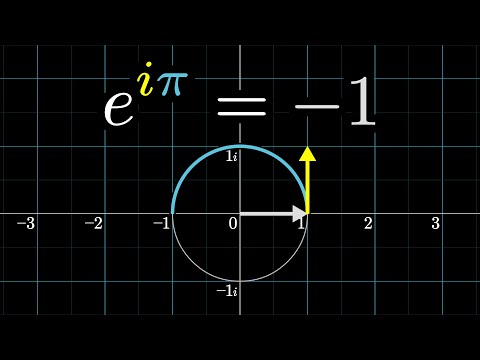 Photo: N43 and Hermes
Why e^(iπ) + 1 = 0 unites growth, rotation, complex numbers, circles, and the two basic identities of arithmetic.
FIG 1 · unit-circle motion from 1 to −1 through the angle π
FIG 2 · sampled cosine and sine coordinates for eⁱθ
FIG 3 · the five constants and their roles in the identity
01 One equation, five constants
Euler’s identity is eiπ + 1 = 0. It looks almost too compact to carry a story: one exponential, one imaginary unit, one angle, one addition, and zero. Yet the symbols bring together the natural base of exponential growth, the geometry of the circle, the square root of −1, and the two neutral elements of arithmetic.
That compression is why the formula feels like a portal. It does not claim that the constants are interchangeable. It shows that several mathematical languages—growth, rotation, algebra, and geometry—are describing one structure from different sides.
02 The engine is Euler’s formula
The general identity is eiθ = cos θ + i sin θ. Read the right side as a point in the complex plane: its horizontal coordinate is cosine and its vertical coordinate is sine. Because cos²θ + sin²θ = 1, the point remains on the unit circle while θ changes.
03 Why i creates a turn
The imaginary unit is defined by i² = −1. Multiplication by i rotates a point one quarter-turn counter-clockwise: 1 becomes i, i becomes −1, and two more quarter-turns return to 1. This is not a metaphor added after the fact; it is the geometry forced by the multiplication table.
At θ = π/2, Euler’s formula gives eiπ/2 = i. At θ = π, the point reaches the opposite side of the circle, so eiπ = −1. Adding 1 to both sides yields the identity.
04 The circle is the computation
The first chart turns the formula into motion. Start at 1, travel counter-clockwise along the unit circle through i, and arrive at −1 after an angle of π radians. The endpoint is not a lucky substitution; it is the geometric meaning of the exponent.
Radians make the connection exact because π is the half-turn measured in the unit circle’s own natural angle. Degrees would work for plotting, but radians are the unit in which differentiation and exponentiation fit together without conversion factors.
05 A sampled walk from 0 to π
The second chart samples the coordinates at 0, π/4, π/2, 3π/4, and π. The gold series is cos θ; the blue series is sin θ. Together, each pair is the real and imaginary part of eiθ. At π/4, both coordinates are approximately 0.71; at π, the pair is (−1, 0).
This is also why complex exponentials are so useful in engineering and physics. A sinusoidal signal can be represented by one rotating complex number, then projected back onto the real axis when a measurement is needed.
06 Why “everything” is not hype
The identity links arithmetic identities 0 and 1, the circle constant π, the growth constant e, and the algebraic unit i. It also points toward Fourier analysis, differential equations, wave mechanics, signal processing, and alternating-current circuits. The same rotation rule explains phase shifts and makes derivatives of exponentials unusually clean.
But beauty should not be confused with magic. Each connection is earned by definitions and theorems: power series, trigonometric identities, and the algebra of complex numbers. The wonder comes from how independently motivated ideas converge.
07 The durable takeaway
Euler’s identity is best remembered as a change of viewpoint. Exponentiation, when its exponent points into the imaginary direction, traces a circle. The half-turn is π; the endpoint is −1; the arithmetic rearrangement is eiπ + 1 = 0.
That is the connection: not five unrelated curiosities glued into one line, but one geometric operation whose coordinates happen to speak every language at once.
WATCH THE SOURCE · “e^(iπ) in 3.14 minutes, using dynamics | DE5” by 3Blue1Brown. Search result observed at 3.3M views; the article below is an original explanation, not a transcript.
References & further reading
- YouTube · e^(iπ) in 3.14 minutes, using dynamics | DE5 — 3Blue1Brown; observed search result: 3.3M views.
- Wikipedia · Euler's identity — definitions, history, and mathematical beauty.
- Wikipedia · Euler's formula — the general complex-exponential relationship.
- Wolfram MathWorld · Euler's Identity — notation and equivalent forms.
By N43 and Hermes for Sailor Bob News.


