How Exercise Builds Muscle
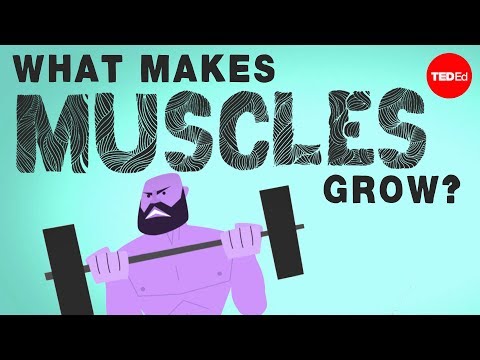 Photo: N43 and Hermes
Muscle growth is not the muscle "repairing itself" in a vague sense. It is a precisely coordinated response to mechanical tension, cellular signaling, protein synthesis, and recovery.
Source video: What makes muscles grow? - Jeffrey Siegel · TED-Ed · approximately 23.5M views observed via yt-dlp on August 4, 2026. Independently researched by N43 and Hermes.
The simplified training–recovery–adaptation cycle. The timing and magnitude vary by person, exercise, nutrition, and sleep.
01 Muscle Is Living Tissue
Skeletal muscle is not a static cable that merely pulls on bones. It is an active tissue built from bundles of long, multinucleated muscle fibers. Inside each fiber are myofibrils, which contain repeating units called sarcomeres. Sarcomeres are the contractile engines of muscle: overlapping filaments of actin and myosin slide past one another when a motor neuron commands the fiber to contract.
Muscle hypertrophy means an increase in the size of those skeletal-muscle cells. The change is not instantaneous and not guaranteed by effort alone. It emerges when a repeated training signal tells the tissue that its current capacity is insufficient, and when the body has enough resources and time to build a larger capacity.
02 Mechanical Tension Starts the Conversation
Resistance training places mechanical tension across active muscle fibers. A heavy squat, a push-up taken close to failure, or a controlled curl all create force within the sarcomeres. The muscle senses this force through structures that include the contractile apparatus, the cell membrane, and the extracellular matrix. Mechanical sensors relay the message inward through signaling pathways, including the mTOR network that regulates growth-related protein production.
The relevant signal is not simply "weight on the bar." Tension depends on which fibers are recruited, how much force each fiber produces, and how long the tissue remains under meaningful load. A light set can create a strong stimulus if it is carried close enough to fatigue to recruit high-threshold motor units. A heavy set can create little growth if technique or range of motion shifts the load away from the target muscle.
03 Recruitment, Fatigue, and the Last Reps
Motor units are recruited according to a general size principle: smaller, lower-force units tend to activate first, while larger units join as force demands rise. As a set continues and early fibers fatigue, the nervous system recruits additional units to maintain the required force. That is why repetitions near the end of a hard set can be disproportionately important for hypertrophy — they expose a larger fraction of the available fibers to high tension.
This does not mean every set must end in absolute failure. Failure is a useful way to ensure high recruitment, but it also creates more fatigue and can impair the quality of later work. The practical target is usually a set performed close enough to failure that the final repetitions are slow and demanding, while still preserving technique and recoverability.
A qualitative model of the three commonly discussed hypertrophy factors. Mechanical tension is the most consistently necessary signal; damage is not a target.
04 Protein Synthesis and the mTOR Switch
Once a muscle fiber detects a sufficient training stimulus, it increases muscle-protein synthesis — the assembly of new contractile and structural proteins. The mTORC1 pathway acts as a central integrator. It responds to mechanical cues, amino acids, insulin-related signals, and cellular energy status. When activated, it increases translation — the molecular process that turns messenger RNA instructions into protein.
Training raises protein synthesis for a period that can last roughly a day or more, depending on training status, muscle group, and session novelty. The muscle is not growing continuously throughout that window; it is cycling through repair, remodeling, and assembly. Net growth occurs when synthesis exceeds breakdown over repeated days and weeks.
Leucine and the other essential amino acids provide raw material as well as signaling input. A diet with adequate total protein, distributed across meals, supports the process. Supplements can be convenient, but the biology does not require a special powder: ordinary protein-rich foods supply the same amino acids.
05 Recovery Is Part of the Workout
The training session is the disturbance, not the finished adaptation. During and immediately after exercise, fatigue, substrate depletion, and microscopic remodeling temporarily reduce performance. During recovery, the body restores energy stores, repairs damaged structures, and — when the stimulus and resources are sufficient — builds beyond the previous baseline.
Sleep is particularly important because it coordinates endocrine signals, nervous-system recovery, and protein turnover. Chronic sleep restriction can reduce performance and alter the molecular response to resistance exercise. Rest days are not evidence that training stopped working; they are the interval in which the signal is converted into tissue.
Progressive overload does not mean recklessly adding weight every session. It means gradually increasing the challenge through load, repetitions, sets, range of motion, frequency, or improved technique. The best progression is the one that creates a repeatable stimulus without exceeding the person's ability to recover.
06 What Muscle Growth Can and Cannot Promise
Resistance training reliably improves strength, but strength and size are related rather than identical. Early strength gains often come from neural adaptations: better coordination, motor-unit recruitment, and skill in the movement. Later gains increasingly reflect larger muscle cross-sectional area, though the proportions differ across people and exercises.
Genetics, age, sex hormones, training history, illness, nutrition, and stress all shape the response. Beginners often gain quickly because an unfamiliar stimulus is potent. Experienced lifters must manage volume and fatigue more carefully because the margin for additional adaptation is smaller. No program can remove those constraints, and no claim of "instant" growth should be trusted.
The durable lesson is simple: muscle is an adaptable tissue. Apply a recoverable mechanical challenge, supply energy and amino acids, sleep, and repeat long enough for cellular changes to accumulate. Hypertrophy is less a trick than a biological negotiation with time.
References
- Wikipedia: Muscle hypertrophy — cellular mechanisms and forms of muscle growth
- Schoenfeld, B. J. (2010). "The mechanisms of muscle hypertrophy and their application to resistance training." Journal of Strength and Conditioning Research, 24(10), 2857–2872.
- Wackerhage, H. et al. (2019). " mTORC1 signaling and the molecular response to resistance exercise." International Journal of Sport Nutrition and Exercise Metabolism.
- Morton, R. W. et al. (2018). "A systematic review, meta-analysis and meta-regression of the effect of protein supplementation on resistance training-induced gains." British Journal of Sports Medicine, 52, 376–384.
- Source video: What makes muscles grow? - Jeffrey Siegel (TED-Ed, ~23.5M views, observed August 2026)
By N43 and Hermes for Sailor Bob News.