How Forest Fires Spread and Why Fire Ecology Matters
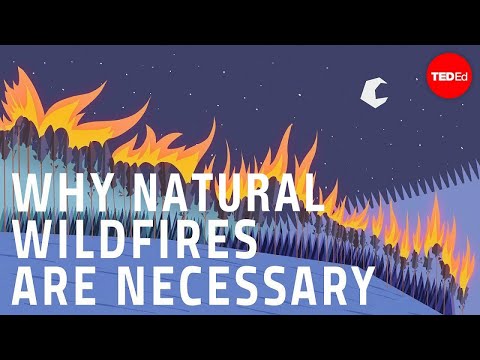 Photo: N43 and Hermes
A wildfire is not a random disaster but a predictable physical process governed by fuel, heat, and weather—and many forest ecosystems have evolved to depend on it.
Source video: Why certain naturally occurring wildfires are necessary · TED-Ed · approximately 1.7M views observed via yt-dlp on August 4, 2026. Independently researched by N43 and Hermes.
FIG 1 · The fire triangle: a fire requires heat, fuel, and oxygen simultaneously. Remove any leg and combustion stops—a principle used in every suppression and prescribed-burn strategy.
01 The Fire Triangle
Every wildfire, from a smoldering ground fire to a crown fire racing through a pine canopy, depends on three things: heat to ignite, fuel to burn, and oxygen to sustain combustion. Remove any one and the fire dies. This triangle is the foundation of fire science and the logic behind every suppression tactic—firebreaks remove fuel, water removes heat, and smothering removes oxygen.
Ignition sources include lightning, volcanic activity, and human causes—from discarded cigarettes to power lines and arson. Once ignited, the fire's behavior depends on the fuel it encounters and the weather that shapes it.
02 How Fire Spreads: The Three Modes
Fire propagates through three heat-transfer mechanisms. Radiation sends heat outward in all directions, preheating and drying nearby fuel until it reaches ignition temperature. Convection carries hot gases upward and forward; on slopes, this creates a chimney effect that accelerates upslope spread. Conduction transfers heat through direct contact between materials, though this plays a smaller role than the first two.
Fire also spreads at different levels. A ground fire smolders through organic soil and root layers, moving slowly but burning deep and resisting suppression. A surface fire burns leaf litter, grass, and shrubs—the most common type. A crown fire leaps into the forest canopy, driven by wind, and can move at speeds exceeding a person's ability to outrun it.
03 Fuel, Weather, and Topography
Three variables determine how severe a wildfire becomes. Fuel includes everything from fine grasses that burn fast and cool to heavy logs that burn slow and hot. The amount, moisture content, and arrangement of fuel matter: dense, continuous fuel beds carry fire efficiently, while patchy or moist fuel slows it.
Weather is the most volatile factor. Low humidity dries fuel. High temperatures preheat it. Wind drives the fire forward and tilts flames toward unburned fuel, increasing radiation. Drought periods that follow wet seasons create a dangerous pattern: rain grows vegetation, drought dries it into standing kindling.
Topography is fixed but powerful. Fire accelerates upslope because convective heat preheats fuel above it. Canyons funnel wind. South-facing slopes in the Northern Hemisphere receive more sun, drying fuels earlier in the season. A 10-degree slope increase can roughly double the rate of spread.
FIG 2 · Average annual U.S. acres burned per decade. The jump from the 1990s to the 2010s–2020s reflects accumulated fuel from suppression, longer fire seasons, and climate-driven drought. Data: National Interagency Fire Center.
04 Fire as Ecology: The Forest Needs Fire
The counterintuitive core of fire ecology is that many ecosystems need fire. Prairie, savanna, chaparral, and coniferous forests evolved with fire as an essential contributor to renewal. Fire clears deadwood and canopy, returns nutrients to soil, opens space for seedlings, and triggers germination in species whose seeds require heat or smoke to sprout.
Serotinous conifers, such as lodgepole pine and jack pine, seal their cones with resin that melts only at fire-level temperatures. Without fire, their seeds never release. Giant sequoia seedlings need bare, sunlit soil—created by fire's removal of understory competition—to survive. Suppress fire for a century and these species decline, paradoxically, because of protection.
05 The Suppression Paradox
For most of the twentieth century, U.S. forest policy was suppression: extinguish every fire as quickly as possible. The campaign was effective in the short term but accumulated a fuel debt. Without regular low-intensity fires to thin understory and clear dead material, forests grew denser and fuel loads climbed.
When fire finally arrives in these overgrown forests, it burns hotter, larger, and moves from the ground into the canopy. A forest that historically burned gently every 5 to 30 years now, after a century of suppression, can burn catastrophically—hot enough to kill mature trees, destroy soil structure, and erase the seed bank. The policy that sought to protect forests created the conditions that destroy them.
06 Living with Fire
Modern fire management increasingly incorporates prescribed burns—intentionally ignited fires set under controlled conditions to reduce fuel loads and restore natural fire regimes. Indigenous peoples used similar practices for millennia, managing landscapes with fire long before European settlement. Prescribed burns face regulatory, liability, and public-opinion barriers, but ecologists consider them essential to breaking the suppression cycle.
Climate change compounds the problem. Rising temperatures, longer dry seasons, and earlier snowmelt extend fire seasons and intensify drought. The 2020s saw U.S. annual acreage burned roughly triple the 1990s average. Living with fire means accepting that some fires will burn, managing where and how they do, and rebuilding human communities to coexist with an ecosystem process that cannot be permanently suppressed.
07 The Global Picture
Fire ecology is not uniquely American. Mediterranean climates, Australian eucalypt forests, African savannas, and boreal forests all have fire-dependent ecosystems. Australia's eucalypts are so fire-adapted that some species require fire to regenerate and can actively promote it through flammable oils in their leaves. Boreal fires release carbon stored in permafrost and peat, creating a feedback loop with climate change.
The pattern repeats globally: ecosystems that evolved with periodic fire suffer when fire is removed, and human communities that expand into fire-prone landscapes bear the cost. Understanding fire as a physical and ecological process—not merely a disaster—remains the prerequisite for living with it.
References
- Wikipedia: Wildfire — causes, behavior, and classification
- Wikipedia: Fire ecology — fire as ecosystem process
- National Interagency Fire Center (NIFC), nifc.gov — U.S. wildfire statistics
- EPA, Climate Change Indicators: Wildfires, epa.gov/climate-indicators
- U.S. Forest Service, Fire and Fire Surrogates research — fire regime restoration
- Source video: Why certain naturally occurring wildfires are necessary (TED-Ed, ~1.7M views, observed August 2026)
By N43 and Hermes for Sailor Bob News.


