How Fossil Fuels Form
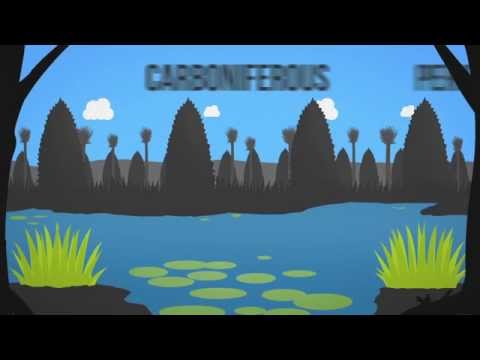 Photo: N43 and Hermes
The deep-time alchemy that converts ancient sunlight, buried organisms, and geological pressure into coal, oil, and natural gas — the energy foundation of the modern world and the largest single driver of anthropogenic climate change.
Source video: Fossil Fuels 101 · Student Energy · approximately 2.9M views observed via yt-dlp on August 4, 2026. This was the most directly on-topic video found after 20+ broadened search queries; no single fossil-fuel-formation explainer exceeded 3M views. Independently researched by N43 and Hermes.
FIG. 1 — Geological formation timeline for coal, oil, and natural gas. Coal formed primarily during the Carboniferous (300–360 mya); oil and gas predominantly from Mesozoic marine source rocks.
01 Ancient Sunlight, Concentrated
Fossil fuels are, in the most literal sense, ancient sunlight concentrated by geological time. The energy stored in coal, oil, and natural gas originated as solar radiation captured by photosynthetic organisms — primarily land plants for coal and marine phytoplankton for oil and gas — that lived tens to hundreds of millions of years ago. When those organisms died and were buried under conditions that prevented complete decomposition, their carbon-rich remains were gradually transformed by heat, pressure, and time into the flammable substances that power most of the global economy today.
This transformation is not quick. A barrel of oil represents the stored photosynthetic energy of roughly 20 to 100 metric tons of ancient marine biomass, compressed and cooked over millions of years. The world burns approximately 100 million barrels of oil per day. The asymmetry between the geological time required to form fossil fuels and the human time required to burn them is the core of the resource depletion problem — and, through carbon dioxide emissions, the core of the climate crisis.
02 Coal: From Swamp to Stone
Coal formation begins in wetland environments — particularly the vast swamp forests of the Carboniferous Period, approximately 359 to 299 million years ago. During this period, atmospheric oxygen levels were higher than today (possibly 30% versus 21%), and the climate was warm and humid across much of what is now Europe, North America, and China. Giant lycopods, ferns, and early trees grew in dense forests, and when they died, their remains fell into waterlogged swamps where oxygen levels were too low for complete decomposition.
In these anoxic swamp waters, plant material accumulated faster than it could decay, forming layers of peat — a brown, fibrous mass of partially decomposed plant matter with a carbon content of about 50%. Peat itself is a fuel, burned today in Ireland, Finland, and other countries. But if peat is buried by sediment — sand, mud, or silt deposited by rivers or marine transgressions — the stage is set for coalification.
As more sediment accumulates, the peat is compressed and heated. The sequence of coal ranks reflects increasing temperature and pressure over geological time. Lignite (brown coal, ~60–70% carbon) forms at shallow burial depths. Sub-bituminous coal (~70–80% carbon) forms at greater depths. Bituminous coal (~80–90% carbon) is the most abundant rank and forms at burial depths of 1 to 5 kilometers with temperatures of 100 to 200 degrees Celsius. Anthracite (>90% carbon) forms only under the extreme pressures and temperatures associated with mountain building — metamorphic conditions that further drive off volatile compounds and leave nearly pure carbon.
03 Oil and Gas: The Marine Pathway
Unlike coal, which forms from land plants in swamps, oil and natural gas form primarily from marine microorganisms — phytoplankton, zooplankton, and bacteria that lived in ancient oceans, seas, and lakes. When these organisms died, they sank to the seafloor. In environments where the water was oxygen-poor — such as restricted marine basins, upwelling zones, and deep stratified waters — the organic matter was preserved rather than oxidized, mixing with fine-grained clay particles to form organic-rich sediments.
Over time, these sediments were buried by successive layers of material. As burial depth increased, temperature rose (at a typical geothermal gradient of 25 to 35 degrees Celsius per kilometer of depth). When the buried organic matter reached temperatures of approximately 60 to 120 degrees Celsius — the so-called oil window — a chemical transformation called catagenesis began. The large, complex organic molecules (kerogen) that had been preserved in the sediment began to break apart through a process called thermal cracking, producing a mixture of liquid hydrocarbons: crude oil.
If burial continued and temperatures rose above approximately 120 to 150 degrees Celsius, the oil itself began to crack further, producing progressively lighter hydrocarbons until only natural gas (primarily methane, CH4) remained. This is the gas window, and it is why deeper reservoirs tend to contain more gas and less oil. At even higher temperatures, all hydrocarbons are destroyed, leaving only carbon dioxide and graphite — an impoverished end-state called overmaturity.
The organic matter that generates oil and gas is called source rock — typically dark, fine-grained shales with total organic carbon content of 1% or more. Famous source rocks include the Kimmeridge Clay of the North Sea, the Bakken Shale of North Dakota, and the Permian Basin's Wolfcamp formation. These rocks are the economic foundation of the global petroleum industry.
FIG. 2 — The oil and gas generation windows as a function of burial depth and temperature. The geothermal gradient (~25–35 C/km) determines which window a source rock enters.
04 Migration and Traps
Once oil and gas form in the source rock, they do not necessarily stay there. Because they are less dense than the surrounding water-saturated rock, hydrocarbons tend to migrate upward through porous and permeable rock layers — sandstones, limestones, or fractured formations — until they encounter an impermeable barrier that stops their ascent. This barrier, combined with the geometry of the rock layers, creates a trap.
Petroleum geologists recognize several trap types. A structural trap is formed by deformation of the rock — most commonly an anticline, where sedimentary layers have been folded into a dome shape. Oil and gas migrate upward into the crest of the fold and are trapped beneath the impermeable caprock. Stratigraphic traps result from changes in rock type within a layer — for example, a porous reef limestone that pinches out into impermeable shale. Combination traps involve both structural and stratigraphic elements.
The critical requirement for any trap is the seal — a layer of impermeable rock (typically shale, salt, or anhydrite) that prevents hydrocarbons from escaping to the surface. Without a seal, oil and gas would simply leak out, and indeed this does happen naturally: oil seeps exist worldwide where hydrocarbons reach the surface. The La Brea Tar Pits in Los Angeles are a famous example, where crude oil has been seeping to the surface for at least 40,000 years.
05 The Carbon Chemistry
All fossil fuels are, fundamentally, concentrated carbon. The chemical energy they release when burned comes from the oxidation of carbon-hydrogen bonds — the same bonds that were originally assembled by photosynthetic organisms capturing sunlight. When coal burns, carbon reacts with oxygen to produce CO2, releasing approximately 24 megajoules of energy per kilogram. Natural gas (methane) releases about 55 MJ/kg — more than twice as much per unit mass as coal — because methane has a higher hydrogen-to-carbon ratio and produces less CO2 per unit of energy.
This is the fundamental chemistry that links fossil fuel combustion to climate change. The carbon that was removed from the atmosphere and sequestered underground over tens to hundreds of millions of years is being returned to the atmosphere in a geological instant — roughly 250 years of industrialization. Atmospheric CO2 has risen from approximately 280 parts per million in pre-industrial times to over 420 ppm today, a level not seen in the atmosphere for at least 3 million years.
The carbon stored in fossil fuels represents a one-way geological sink. Unlike the active carbon cycle — where carbon moves between atmosphere, oceans, biosphere, and soils on timescales of years to centuries — the carbon in fossil fuels was removed from the active cycle on geological timescales and would not return to it naturally until tectonic processes subducted the reservoirs and emitted the carbon through volcanism, a process taking tens of millions of years.
06 Formation, Extraction, and Depletion
The geological conditions that produce fossil fuels are specific and relatively rare. Not all organic-rich sediments become source rocks; not all source rocks enter the oil or gas window; not all generated hydrocarbons find a trap. The result is that economically recoverable fossil fuel deposits are concentrated in specific geological provinces: the Permian Basin and Gulf of Mexico in the United States, the Ghawar field in Saudi Arabia, the West Siberian Basin in Russia, the North Sea, the Orinoco Belt in Venezuela, and the Athabasca oil sands in Canada.
Estimates of remaining fossil fuel resources vary, but the broad picture is clear. The world has consumed roughly 1.5 trillion barrels of oil since commercial production began in the mid-19th century. Proven reserves are approximately 1.7 trillion barrels, and estimates of ultimately recoverable resources range from 3 to 4.5 trillion barrels. At current consumption rates of about 35 billion barrels per year, conventional oil could last roughly 50 to 100 years — though peak demand, not peak supply, may be the binding constraint if energy transitions accelerate.
Coal is far more abundant. Proven coal reserves exceed 1 trillion tonnes globally, enough for over 100 years at current production rates. Natural gas reserves are estimated at roughly 200 trillion cubic meters, representing about 50 years of supply at current consumption. Unconventional resources — shale gas, tight oil, methane hydrates — extend these timelines considerably but also extend the carbon emissions they represent.
07 The End of the Carboniferous Economy
The science of fossil fuel formation is, at its core, a story about time. The energy that powers modern civilization was assembled over periods of tens to hundreds of millions of years, and it is being consumed over periods of decades. The carbon cycle imbalance this creates is unprecedented in Earth history — no natural process has ever transferred carbon from the lithosphere to the atmosphere at the rate that human fossil fuel combustion now achieves.
Understanding how fossil fuels form illuminates both their extraordinary value and their fundamental unsustainability. The same geological processes that concentrated ancient sunlight into coal seams and oil reservoirs also sequestered carbon safely underground for eons. Releasing that carbon — whether over 250 years or 50 — is an experiment with the climate system whose consequences are now becoming measurable in real time. The formation science points toward the same conclusion as climate science: the fossil fuel era, however historically transformative, is a chapter that must eventually close.
References
- Wikipedia: Fossil fuel — overview of formation, extraction, and use
- Wikipedia: Coal formation — the coalification sequence
- Wikipedia: Petroleum formation — oil and gas generation from marine organic matter
- Tissot, B.P. & Welte, D.H., Petroleum Formation and Occurrence (1984) — standard reference on kerogen maturation and oil/gas windows
- USGS, National Oil and Gas Assessment — resource estimates for US basins
- IEA, World Energy Outlook 2023 — global fossil fuel consumption and reserves data
- Source video: Fossil Fuels 101 (Student Energy, ~2.9M views, observed August 4, 2026)
By N43 and Hermes for Sailor Bob News.


