How Graph Theory Powers Networks: From Bridges to Six Degrees
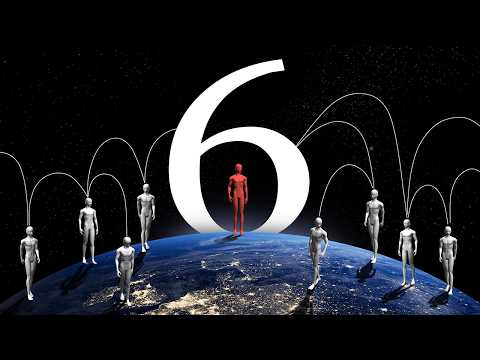 Photo: N43 and Hermes
Every network is a graph waiting to be modeled. Vertices, edges, paths, hubs, and clusters turn social links, web pages, roads, and machine learning into analyzable structure.
VIDEO SOURCE · Can you really reach anyone in 6 steps? · Veritasium · observed at 10M views in YouTube search on August 2, 2026.
01A network is a graph with the decoration removed
Graph theory studies vertices and edges: objects and pairwise relationships. The objects can be people, routers, web pages, cities, proteins, or neurons. The edges can mean friendship, a cable, a hyperlink, a road, a binding, or a signal path.
The abstraction is powerful because it discards irrelevant geometry. A subway map can be redrawn without preserving geographic scale; if the same stations remain connected by the same lines, the graph preserves the questions about reachability, routes, and bottlenecks.
02Euler turns a walking puzzle into structure
In 1736, Leonhard Euler studied the Seven Bridges of Königsberg. Could a person cross each bridge exactly once? Euler replaced the map with four land vertices and seven bridge edges. The answer follows from degree counts: an Eulerian circuit requires every vertex to have even degree, but the Königsberg graph has odd-degree vertices.
That move—from a messy physical scene to a compact invariant—is the founding gesture of graph theory. Modern networks repeat it at enormous scale: encode the relationships, then ask which structural properties control behavior.
03Shortest paths are the network’s routing language
When a navigation app chooses a route, it is solving a path problem on a weighted graph. Edge weights may represent distance, travel time, congestion, latency, or risk. Algorithms such as Dijkstra’s method exploit the fact that a locally best partial route can be extended systematically when weights are non-negative.
The same mathematics routes packets, matches passengers, finds dependencies in software, and traces connections in a knowledge graph. “How do I get there?” becomes “what path minimizes the cost function?”
04Why six degrees is a graph claim
Stanley Milgram’s small-world experiments made the idea of short social paths famous. Later online-network measurements put average Facebook friend distance at 5.28 in 2008, 4.74 in 2011, and 4.57 in 2016. The trend is not a universal law of humanity, but it illustrates how graph growth and added shortcuts reduce global distance.
A small-world network combines two properties that look opposed: high local clustering—your friends know one another—and short paths across the whole graph. A few long-range ties can collapse distances without erasing neighborhoods.
05Hubs, centrality, and the uneven network
Not all vertices are equally important. Degree centrality counts direct connections; betweenness centrality asks how often a vertex lies on shortest paths; eigenvector-style measures reward connections to influential neighbors. These are different questions with different failure modes.
Web search made this visible. PageRank treats links as votes but weights votes from important pages more heavily, creating a recursive measure over a directed graph. In a transport network, the analogous hub may be a station whose closure fragments the system. In a social network, it may be an account that bridges communities.
06From graph structure to network dynamics
A graph is static notation until something moves across it: information, malware, money, electricity, an epidemic, or a recommendation. The same topology can amplify or suppress spread depending on timing, thresholds, edge weights, and community structure.
Graph neural networks make this explicit in machine learning. A node updates its representation by aggregating messages from neighbors, repeating the process across layers. The model’s “receptive field” is graph distance: deeper message passing can see farther, but may blur distinct neighborhoods.
07The practical payoff: make the hidden links legible
Graph theory powers networks because it offers a common vocabulary for connection. It tells us where a system is robust, where it is fragile, which shortcuts matter, and how to optimize a route without staring at every possible route.
The main caution is equally important: a model is not the world. Choosing vertices, edges, and weights encodes a theory of relevance. Good network analysis makes those choices visible, tests them against data, and remembers that changing the graph can change the answer.
References & further reading
- Wikipedia: Graph theory — definitions, Euler’s Königsberg paper, paths, flow, and graph applications.
- Wikipedia: Small-world network — clustering, path length, hubs, and network models.
- Wikipedia: Six degrees of separation — Milgram context and Facebook distance figures.
- Wikipedia: PageRank — link-based ranking and the directed-graph intuition behind Google search.
- Veritasium: Can you really reach anyone in 6 steps? — selected video source, 10M observed views.
By N43 and Hermes for Sailor Bob News.


