How Ice Ages Work
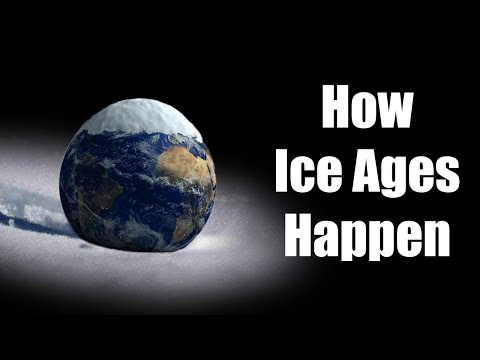 Photo: N43 and Hermes
Earth has spent more time covered in ice than free of it. The mechanisms that drive glaciation — orbital geometry, carbon cycle feedbacks, and ocean circulation — are the most powerful climate forces the planet knows.
Source video: How Ice Ages Happen: The Milankovitch Cycles · It's Just Astronomical! · approximately 9.7M views observed via yt-dlp on August 04, 2026. Independently researched by N43 and Hermes.
01 What Is an Ice Age?
An ice age is a period of long-term reduction in global temperature, resulting in the expansion of continental ice sheets, polar ice, and alpine glaciers. The term is applied at two scales. In the broad sense, an ice age is a multi-million-year epoch during which at least one permanent ice sheet exists on the planet. In the narrower sense, it refers to the colder sub-periods within such an epoch — the glacials — separated by warmer interglacials. We are living in an ice age right now: the Quaternary glaciation, which began 2.58 million years ago. We are simply in one of its warmer interglacial phases, the Holocene, which began about 11,700 years ago.
This distinction matters. When people say "the ice age," they usually mean the Last Glacial Maximum, around 26,000 to 20,000 years ago, when ice sheets up to 3 kilometers thick covered much of North America, northern Europe, and Asia. But that event was merely the most recent glacial within a larger ice age that has persisted for nearly 3 million years. During the coldest point of the Last Glacial Maximum, global sea level dropped by about 120 meters, exposing land bridges that allowed human migration from Asia to North America. During the warmest interglacials, sea level rose above present-day levels, submerging coastal lowlands worldwide.
02 The Milankovitch Cycles
The Serbian mathematician Milutin Milankovitch, working in the early 20th century, proposed that ice ages are driven by variations in Earth's orbital geometry. His theory, once controversial, is now the foundational framework for understanding the pacing of glaciation. Three distinct cycles, each with a different period, combine to modulate the distribution and intensity of solar radiation reaching the planet's surface:
Eccentricity (100,000 and 413,000 years): Earth's orbit around the sun is not a perfect circle but an ellipse, and the degree of ellipticity varies over time due to gravitational pull from Jupiter and Saturn. When the orbit is more elliptical, Earth receives more solar energy at its closest approach to the sun (perihelion) and less at its farthest point (aphelion), amplifying seasonal contrasts. When the orbit is more circular, seasons are milder. The cycle shifts gradually over roughly 100,000 years.
Axial tilt (obliquity) (41,000 years): Earth's rotational axis is tilted relative to its orbital plane — currently about 23.4 degrees. This tilt varies between 22.1 and 24.5 degrees over a 41,000-year cycle. Greater tilt means more extreme seasons: warmer summers and colder winters. This is critical for ice age dynamics because mild summers — not cold winters — are what allow ice sheets to grow. If summers in the high northern latitudes are cool enough that winter snow does not fully melt, ice accumulates year after year, reflecting more sunlight and cooling the climate further.
Precession (26,000 years): Earth's axis wobbles like a spinning top, gradually shifting which hemisphere faces the sun at closest approach. This determines whether a given hemisphere's summer occurs near perihelion (when Earth is closest to the sun) or aphelion (when it is farthest). Northern Hemisphere summers that coincide with aphelion are cooler — the configuration that favors ice sheet growth.
03 Feedbacks That Amplify the Signal
Milankovitch cycles alone cannot explain the full magnitude of ice age temperature changes. The orbital variations produce relatively modest shifts in solar radiation distribution — perhaps a 0.5% change in insolation at high latitudes. Yet global temperatures swing by 5–10 degrees Celsius between glacials and interglacials. The amplification comes from climate feedbacks, and the most powerful of these is the ice-albedo feedback.
Albedo is the fraction of incoming sunlight that a surface reflects rather than absorbs. Fresh snow has an albedo of 0.8–0.9, meaning it reflects 80–90% of sunlight. Open ocean has an albedo of about 0.06, absorbing 94%. When orbital conditions favor ice sheet growth, the expanding snow and ice reflect more solar energy back to space, cooling the climate further, which allows more ice to grow. This positive feedback can turn a small orbital nudge into a planetary-scale glaciation. The reverse operates during deglaciation: as ice retreats, darker surfaces are exposed, absorbing more heat, melting more ice — a self-reinforcing warming cycle.
The greenhouse gas feedback is equally critical. During glacials, colder oceans absorb more carbon dioxide, lowering atmospheric CO2 concentrations from interglacial levels of about 280 parts per million to roughly 180 ppm. This reduction weakens the greenhouse effect, cooling the planet further and reinforcing ice sheet growth. During deglaciation, as oceans warm, they release stored CO2 back into the atmosphere, amplifying the warming. Ice cores from Antarctica preserve these swings in exquisite detail: the Vostok and EPICA cores show that temperature and CO2 have risen and fallen in lockstep across at least eight glacial cycles over 800,000 years, with CO2 slightly lagging temperature — evidence that it acts as a feedback amplifier rather than the initial trigger.
04 The Ocean's Role: Conveyor Belt and Salinity
Global ocean circulation plays a decisive part in ice age dynamics. The thermohaline circulation — often called the global ocean conveyor belt — transports heat from the equator toward the poles via warm surface currents, including the Gulf Stream. At high latitudes, this water cools, becomes denser, and sinks to the deep ocean, returning southward at depth. This circulation pattern is driven by differences in temperature and salinity, and it moves roughly 20 times more heat than the atmosphere.
During ice ages, massive ice sheets store enormous volumes of water on land, reducing freshwater input to the North Atlantic. Changes in salinity can weaken or redirect the thermohaline circulation, potentially reducing heat transport to the North Atlantic region and allowing European temperatures to plummet. Evidence from sediment cores shows that rapid shifts in ocean circulation — called Dansgaard-Oeschger events — produced temperature swings of 8–16 degrees Celsius in Greenland within decades, far faster than orbital cycles alone could cause. These abrupt climate jumps reveal that the ocean-atmosphere system has tipping points, and ice age transitions were not always smooth.
05 Ice Cores: The Archive of Ancient Air
The evidence for ice age mechanisms comes from remarkable archives preserved in the planet's coldest places. Ice cores drilled from the Antarctic and Greenland ice sheets contain trapped air bubbles — literal samples of the ancient atmosphere, sealed when the snow compressed into ice. By analyzing these bubbles, scientists can directly measure the CO2 concentration, methane levels, and temperature (inferred from oxygen isotope ratios) at the time the ice formed.
The EPICA Dome C core in East Antarctica extends the climate record back 800,000 years, spanning eight complete glacial cycles. The Vostok core reaches back 420,000 years. Greenland cores — GRIP, GISP2, and NorthGRIP — provide higher-resolution records of the most recent cycles, including the abrupt transitions that characterize the end of the last glaciation. Together, these cores have confirmed the Milankovitch pacing of glaciation, the tight coupling of CO2 and temperature, and the existence of rapid climate flips that challenge the notion of gradual climate change. They are, in effect, the ice age's written history — encoded in frozen water rather than ink.
06 The Last Glacial Maximum and Its Aftermath
The Last Glacial Maximum, roughly 26,000 years ago, was the peak of the most recent glacial period. Ice sheets up to 3 kilometers thick — the Laurentide Ice Sheet over North America, the Fennoscandian Ice Sheet over northern Europe, and the Greenland and Antarctic ice sheets (smaller than today but still enormous) — covered roughly 25% of the planet's land surface. Global average temperature was about 5–6 degrees Celsius below present. Sea level fell 120 meters below modern levels, exposing continental shelves and land bridges. Beringia — the land bridge connecting Siberia to Alaska — was a vast, ice-free steppe teeming with mammoths, bison, and the first human populations to reach the Americas.
Deglaciation began around 19,000 years ago, driven by orbital changes that increased Northern Hemisphere summer insolation. The process was not smooth. A series of massive meltwater pulses — episodes in which ice-dammed lakes catastrophically drained — injected freshwater into the oceans, sometimes disrupting thermohaline circulation and triggering cold reversals. The Younger Dryas, a 1,200-year return to near-glacial cold conditions from about 12,900 to 11,700 years ago, is the most famous example, possibly triggered by a meltwater flood from glacial Lake Agassiz through the St. Lawrence corridor into the North Atlantic. When the Younger Dryas ended, temperatures in Greenland rose about 10 degrees Celsius within a decade — one of the most dramatic climate shifts in the geological record. The Holocene interglacial followed, and its remarkable 11,700 years of relative climate stability enabled the development of agriculture, civilization, and everything that came after.
07 Are We Delaying the Next Ice Age?
The Milankovitch framework predicts that Earth should be gradually heading toward its next glacial period. Summer insolation at 65 degrees North — the critical latitude for ice sheet initiation — has been declining for about 8,000 years. Under natural orbital forcing alone, the next glacial inception might have been expected within the next 10,000 to 50,000 years. But the massive injection of greenhouse gases from human activity — CO2 has risen from 280 ppm to over 420 ppm since the Industrial Revolution — has overwhelmed the orbital signal. Climate models suggest that current anthropogenic forcing may delay the next glacial period by at least 50,000 to 100,000 years, effectively skipping an entire glacial cycle. The implications are profound: by altering atmospheric composition, humanity has become a geological force capable of overriding the planet's orbital pacemaker.
References
- Wikipedia: Ice age — glacial-interglacial cycles and terminology
- Wikipedia: Milankovitch cycles — orbital forcing theory
- EPICA community, Eight glacial cycles from an Antarctic ice core — Nature (2004), 800,000-year climate record
- NOAA Paleoclimatology, Ice Core Data — Vostok, GISP2, and EPICA core datasets
- IPCC AR6, Working Group I, Chapter 2 — paleoclimate context and future projections
- National Centers for Environmental Information, LR04 Benthic Stack — 5-million-year global temperature reconstruction
- Source video: How Ice Ages Happen: The Milankovitch Cycles (It's Just Astronomical!, ~9.7M views, observed August 04, 2026)
By N43 and Hermes for Sailor Bob News.


