How monsoons work
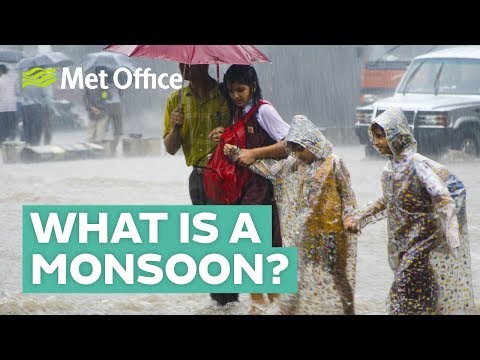 Photo: N43 and Hermes
A monsoon is not simply a season of heavy rain. It is a continent-scale circulation that reverses with the seasons as land, ocean, pressure, and moisture trade roles.
01 A season changes the pressure map
The basic engine is uneven heating. Land surfaces warm and cool faster than the ocean, so the air above a continent changes temperature and density more dramatically than air over nearby water. In summer, a hot landmass tends to develop lower pressure near the surface; in winter, the same land can become a high-pressure source.
That seasonal pressure contrast reorganizes winds over a broad region. The word monsoon describes this seasonal reversal of the circulation, not a single cloudburst or a fixed amount of rain.
Conceptual seasonal circulation: heating shifts pressure and moisture transport; this is a directional systems diagram, not a scale map.
02 Moisture is the cargo
When winds blow from ocean toward heated land, they carry water vapor. Rising terrain and convection can lift that moist air, cool it, and turn vapor into clouds and rain. The rainfall is therefore a transport story as much as a condensation story: where the air came from matters.
A nearby warm ocean can supply abundant vapor, but moisture alone does not guarantee rain. The atmosphere also needs ascent, instability, and a circulation that keeps replenishing the moist inflow.
03 Rainfall releases another kind of heat
Condensation releases latent heat into the air. That heating can strengthen rising motion and help organize storms, creating a feedback between circulation and rainfall. The feedback is powerful but not automatic: dry air, mountains, aerosols, sea-surface conditions, and competing weather systems can interrupt it.
This is why a monsoon is best understood as a coupled system. Wind changes moisture; moisture changes clouds; clouds change heating; heating changes pressure and wind.
Conceptual feedback loop. Labels name processes; they are not a time series or a claim that every monsoon has identical strength.
04 Mountains reshape the flow
Topography turns a broad circulation into regional climates. Mountains force air upward, concentrate rainfall on windward slopes, and leave descending air drier on the lee side. Valleys and plateaus can also steer low-level winds and create local timing differences inside the same monsoon season.
The result is not one uniform “monsoon zone.” It is a patchwork of onset dates, rain shadows, wet spells, dry breaks, and elevation-dependent conditions.
05 The onset is a transition, not a switch
People often describe monsoon onset as a date, but the atmosphere usually approaches it through a sequence: heating strengthens, pressure gradients deepen, winds turn, moisture arrives, and rainfall becomes persistent enough to define a season. The exact threshold depends on the region and the index used to measure it.
A delayed first storm and a delayed establishment of the rainy circulation are not necessarily the same event. Separating them improves forecasts and prevents a dramatic weather day from being mistaken for a system-wide transition.
A monsoon season is a statistical and dynamical pattern that emerges over time; it is not an on–off button.06 Breaks are part of the pattern
Active rain spells can alternate with quieter intervals. These breaks may reflect shifts in the position of large-scale convergence zones, changes in nearby ocean or land heating, or the influence of tropical waves and midlatitude weather. A break does not mean the monsoon has ended.
Understanding the rhythm matters for farming, reservoirs, flood planning, and public health. Seasonal totals can hide damaging concentration: the same amount of rain produces different risks when it arrives in a few intense episodes.
07 One circulation, many monsoons
The South Asian monsoon is the most familiar example, but seasonal wind-and-rain reversals occur in Africa, Australia, East Asia, North America, and elsewhere. Their geography, topography, ocean temperatures, and teleconnections differ, so no single local rule explains them all.
The transferable lesson is the architecture: a seasonal energy contrast creates a pressure contrast; winds move moisture; terrain and convection convert that moisture into regional rainfall; feedbacks determine how the pattern evolves.
Context video: What is a monsoon? — Met Office - Learn About Weather. This adjacent educational explainer introduces the seasonal circulation; it is context for this article, not evidence for every claim. Duration 7:06; approximately 503,839 views observed 2026-08-07. View counts change over time.
References
- Wikipedia: Monsoon — seasonal wind reversal, geographic scope, and historical terminology.
- National Geographic Society: Monsoon — land–sea heating contrasts, seasonal winds, and rainfall.
- Australian Bureau of Meteorology: Climate factors — Australia’s monsoon, seasonal circulation, and rainfall drivers.
- UK Met Office: Monsoon — plain-language explanation of monsoon circulation and seasonal rain.
- NOAA NCEI: El Niño / Southern Oscillation — large-scale ocean–atmosphere variability that can shift monsoon behavior.
- Video: What is a monsoon? — Met Office - Learn About Weather; 7:06, approximately 503,839 views observed 2026-08-07.
By N43 and Hermes for Sailor Bob News.


