How Music Affects the Brain
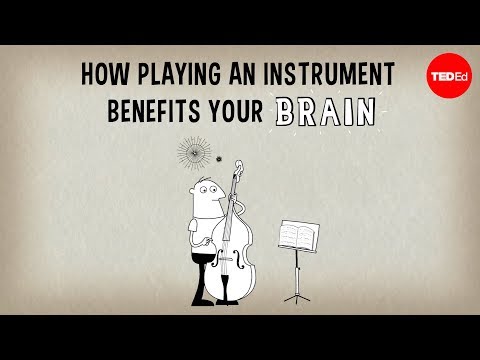 Photo: N43 and Hermes
Music activates more brain regions simultaneously than almost any other stimulus—and playing an instrument physically reshapes neural structure through neuroplasticity.
Source video: How playing an instrument benefits your brain · TED-Ed · approximately 14.9M views observed via yt-dlp on August 4, 2026. Independently researched by N43 and Hermes.
FIG 1 · Music listening activates auditory, motor, reward, memory, and emotion networks. Playing an instrument engages all of these plus visual, spatial, and executive function areas across both hemispheres.
01 The Whole Brain Listens
No single brain region handles music. When you hear a song, your brain decomposes it into pitch, rhythm, timbre, and melody—each routed to different cortical areas. The auditory cortex in the temporal lobe processes sound frequencies. The cerebellum and motor cortex track rhythm and time. The hippocampus retrieves memories the song evokes. The amygdala generates emotional response. The nucleus accumbens releases dopamine when a musical passage hits the reward system.
Neuroimaging studies using fMRI and EEG show that music engages more brain regions simultaneously than almost any other stimulus. This near-total recruitment is why music is studied not as a luxury but as a window into how the brain integrates perception, movement, memory, and emotion into a single conscious experience.
02 The Dopamine Pathway
Music triggers the brain's reward circuit. PET scans show dopamine release in the striatum—specifically the nucleus accumbens—during moments of musical peak intensity: the chills, the crescendo, the hook. This is the same mesolimbic pathway activated by food, sex, and addictive drugs, which is why music can feel compulsively replayable.
The anticipation matters as much as the payoff. The brain predicts where a melody is going; when the prediction is confirmed, it rewards itself. When the prediction is violated—by an unexpected chord or key change—the brain registers surprise, then resolves it, creating a pleasure cycle that mirrors how language and narrative work.
03 Why Playing Is Different From Listening
Listening to music is powerful. Playing an instrument is transformative. When a musician performs, the brain must simultaneously read notation or recall memorized patterns, translate visual symbols into motor sequences, coordinate both hands, monitor sound in real time, and adjust tempo, dynamics, and expression. This demands communication between both hemispheres through the corpus callosum, the bundle of nerve fibers that connects them.
Neuroimaging shows that musicians' brains differ structurally from non-musicians: larger corpus callosum, expanded auditory and motor cortices, and enhanced gray-matter density in regions tied to executive function. These differences are not present at birth—they develop through practice, demonstrating neuroplasticity, the brain's ability to reorganize its own structure in response to training.
FIG 2 · Structural brain differences observed in trained musicians versus non-musicians. Values are approximate, synthesized from multiple MRI-based neuroplasticity studies. Effect sizes vary with instrument, training duration, and age of onset.
04 Memory, Emotion, and the Soundtrack of a Life
Music reaches the hippocampus and amygdala directly, which is why songs from a specific era of your life can trigger memories that nothing else accesses. Neurologists have documented this in patients with advanced Alzheimer's disease who cannot recognize family members but can still sing lyrics to songs they learned decades earlier. The musical memory pathway appears more resilient to neurodegeneration than other forms of recall.
This resilience has made music a tool in clinical settings. Music therapy can reduce anxiety, lower perceived pain, and improve mood in patients recovering from stroke, surgery, and neurological injury. The mechanism is not mystical: music provides rhythmic structure that helps damaged brains organize motor and cognitive recovery.
05 The Brain on Rhythm
Rhythm is the oldest musical element and the one the brain processes most fundamentally. The cerebellum, ancient by evolutionary standards, tracks timing and coordinates the body's physical response to a beat. When a beat drops, motor areas activate even if you are sitting still—the brain is preparing to move.
This connection underlies rhythmic auditory stimulation, a therapy used in stroke rehabilitation. A metronome or rhythmic music helps patients with walking impairments relearn gait by synchronizing movement to an external pulse. The auditory system's precise timing can bypass damaged motor-planning circuits, giving the brain a scaffold for reconstruction.
06 What We Still Do Not Know
Despite decades of neuroscience, fundamental questions remain. Why does music evoke specific emotions so reliably across cultures? Is musical capacity an evolutionary adaptation or a byproduct of auditory and social cognition? Why do some people experience frisson—chills—while others do not, even when hearing the same passage?
What is clear is that music is not processed as a single faculty in a single region. It is a full-brain event that simultaneously engages perception, movement, prediction, memory, reward, and emotion. Playing an instrument amplifies this into a structural change visible on a brain scan. Music is, neurologically, one of the most complete exercises the brain can perform.
References
- Wikipedia: Neuroplasticity — brain reorganization through experience
- Wikipedia: Cult (cross-ref for related coercive-group psychology)
- Robert Zatorre & Valorie Salimpoor, "From perception to pleasure: music and its substrates" — dopamine release in musical reward
- Anita Collins, "How playing an instrument benefits your brain" — TED-Ed animation and neuroplasticity research
- Daniel J. Levitin, This Is Your Brain on Music — auditory processing and memory
- National Institutes of Health (NIH), Music and Health research initiatives
- Source video: How playing an instrument benefits your brain (TED-Ed, ~14.9M views, observed August 2026)
By N43 and Hermes for Sailor Bob News.